Utagawa KUNIYOSHI (1798-1861)
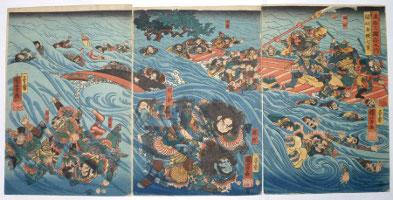
Click here to view image full size. Kwanyu ( Chin. Kwan Yu ), the celebrated warrior who was deified in 1591 as Kwan Ti, the God of War. Shows the warrior standing on a partially submerged boat, far right, with…

Dealing in fine Japanese prints, paintings and books since 1968
Dealing in fine Japanese prints, paintings and books since 1968

Click here to view image full size. Kwanyu ( Chin. Kwan Yu ), the celebrated warrior who was deified in 1591 as Kwan Ti, the God of War. Shows the warrior standing on a partially submerged boat, far right, with…
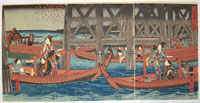
Click here to view image full size. A rare triptych showing fireworks over Ryogoku bridge with numerous pleasure boats negotiating the huge trestles of the bridge. A fine design published 1847 – 50 by Sanoki. Very fine impression. Pristine colour…
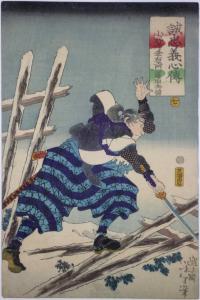
Click here to view image full size. The ronin Okudera Kouemon Fujiwara Hidetomi ( number 7 ) from Seichu gishinden, “Tales of True Loyalty.” From a rare uncompleted set of the 47 Ronin published 6/1868 by Masudaya. Thirteen designs extant.…
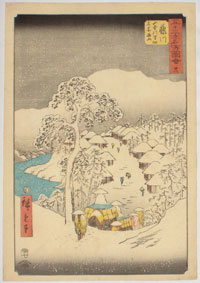
Click here to view image full size. Fujikawa from the so-called “Upright Tokaido.” One of the two snow scenes from the set. Shows travelers coming and going at the edge of the village. Published by Tsutaya, Hare 7, 1855. Very…
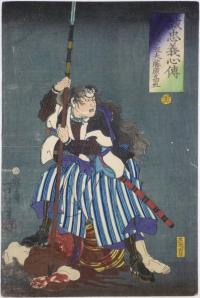
Click here to view image full size. The ronin Muramatsu Sandayu Fujiwara Takano ( number 46 ) from Seichu gishinden, “Tales of True Loyalty.” From a rare uncompleted set of the 47 Ronin published 6/1868 by Masudaya. Thirteen designs extant.…
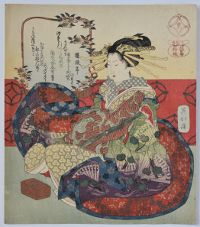
Click here to view image full size. Originally a fishmonger (hence the go Totoya). Studied painting under Kano Yosen’in and then became one of Hokusai’s best pupils. Produced excellent surimono such as here showing a sumptuously attired courtesan representing Kyoto…

Click here to view image full size. An uncut vertical surimono diptych showing two young women in court finery from the Heian period (794-1185). This being considered the finest and most cultured period in Japanese history. One stands on a…

Click here to view image full size. An extremely rare set of hosoban designs: Pictures of Various Women of imperial Japan. Shows, on the left, Princess Joruri – the lover of Yoshitsune. On the right Suke no Tsubone, the wet-nurse…

Click here to view image full size. Numazu from the Upright Tokaido, Gojusan tsugi meisho zue. Published by Tsutaya, 1855. The old adage that familiarity breeds contempt certainly applies to this set, which was reprinted many times. Early printings, as…

Click here to view image full size. Shows station Wada in heavy snow from Kisokaido rokujukyutsugi no uchi. The set of seventy prints was started by Eisen and published by Hoeido in 1835, but in 1837 Hiroshige took over and…

Click here to view image full size. The founder of the Utagawa school who had, amongst others, Toyohiro and Toyokuni as his pupils. Although not the first to use western conventions of linear perspective, he was the first to employ…
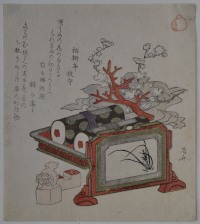
Click here to view image full size. A surimono still life showing two handscrolls, a small screen, a branch of coral, a branch of plum blossom and two seals. (Coral and plum blossom are associated with the new year.) One…

Click here to view image full size. Shinbashi station from a set of prints Tokai meisho kaisei dochu-ki, “Newly Edited Travel Stories of Famous Places of the Tokaido.” Published by Shimizuya Naojiro, 1875. The station was opened in 1872. …
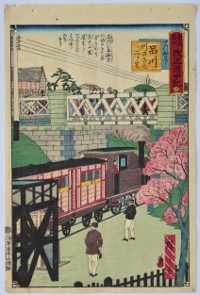
Click here to view image full size. A train passing beneath a bridge at Shinagawa from a set of prints Tokai meisho kaisei dochu-ki, “Newly Edited Travel Stories of Famous Places of the Tokaido.” Published by Shimizuya Naojiro, 1875 …
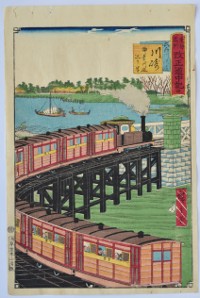
Click here to view image full size. A train at Kawasaki from a set of prints Tokai meisho kaisei dochu-ki, “Newly Edited Travel Stories of Famous Places of the Tokaido.” Published by Shimizuya Naojiro, 1875. Very good impression…

Click here to view image full size. A train at Kanagawa station, Yokohama from a set of prints Tokai meisho kaisei dochu-ki, “Newly Edited Travel Stories of Famous Places of the Tokaido.” Published by Shimizuya Naojiro, 1875. Very…
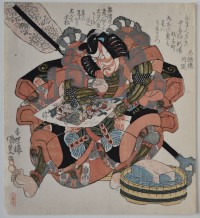
Click here to view image full size. A surimono showing the actor Ichikawa Danjuro VII in the role of Soga no Goro holding a print of the shichifukujin in the takarabune. A parody of the Yanone no Goro story: Yanone…
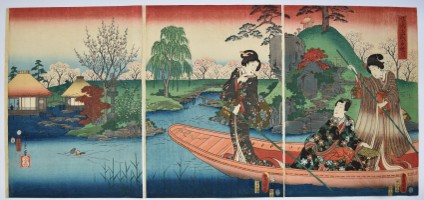
Click here to view image full size. Prince Genji being poled in a punt on a lake. From a set of such triptychs published by Iseya Kanekichi in 1853. Furyu Genji fune asobi, “Fashionable Genji Enjoying a Pleasure Boat.” …
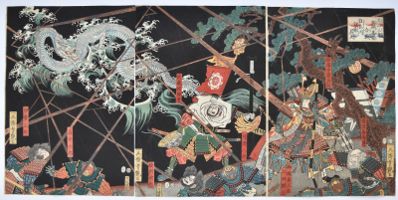
Click here to view image full size. Minamoto no Yoshitsune, on the right holding a large bow, and Benkei, in the centre, face a large white dragon which emerges amongst lightning bolts from the Koromo River at the battle of…
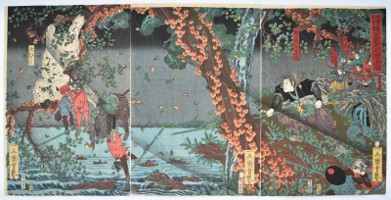
Click here to view image full size. Higuchi no Jiro Kanemitsu, a retainer of Kiso no Yoshinaka, in the Kiso Mountains encounters a giant white baboon (ohishi) which has been terrorising the countryside and attacks it with a long bamboo…
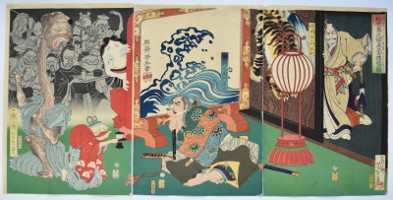
Click here to view image full size. A triptych showing Ban Danemon Naoyuki exorcising the Bakemono in Masanori Fukushima’s mansion. A badger ghost rears up surrounded by other goblins, one of whom attempts to appease him with tea. Fukushima no…
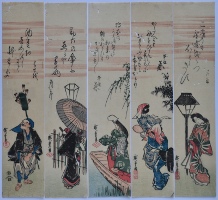
Click here to view image full size. Five ko-tanzaku ( an oban cut into three ) prints of various subjects ( Bon odori, Sukeroku, Hatchitataki, etc ) from an excessively rare set of 15 such prints from 5 sheets. I…

Click here to view image full size. Koishikawa yuki no ashita, “Snowy Morning at Koishikawa” from Hokusai’s most celebrated set: Fugaku sanjurokkei, the “Thirty-six Views of Mount Fuji.” The set of 46 prints published by Eijudo, c. 1830-32. Shows a…
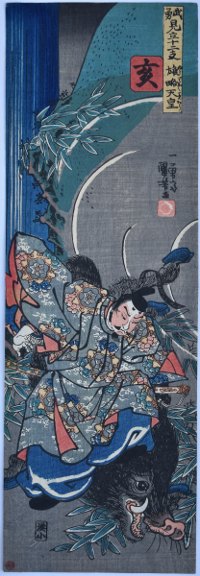
Click here to view image full size. Boar from a chu-tanzaku set of twelve prints Buyu mitate junishi, “Chosen Heroes for the Twelve Signs.” Based on the Chinese zodiac system of twelve animals. Shows Yuryaku Tenno, the 21st Emperor (457-480)…
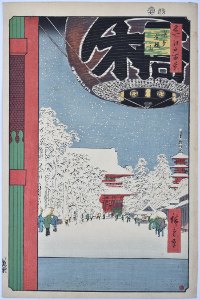
Click here to view image full size. Asakusa Kinryuzan, “Kinryuzan Temple at Asakusa” Meisho Edo hyakkei, “The Hundred Views of Famous Places in Edo.” The view shown by Hiroshige is through the Kaminarimon gateway with the large hanging lantern after…

Click here to view image full size. The Lumberyard, Fukagawa, from Meisho Edo hyakkei, “The Hundred Views of Famous Places in Edo.” Shows snow falling on the timber yards lining a river. An umbrella in the foreground is inscribed Uo,…
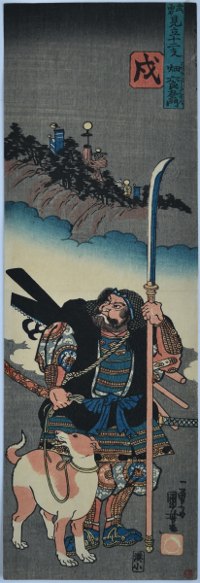
Click here to view image full size. Dog from a chu-tanzaku set of twelve prints Buyu mitate junishi, “Chosen Heroes for the Twelve Signs.” Based on the Chinese zodiac system of twelve animals. Shows Hata Rokurozayemon, a follower of Nitta…
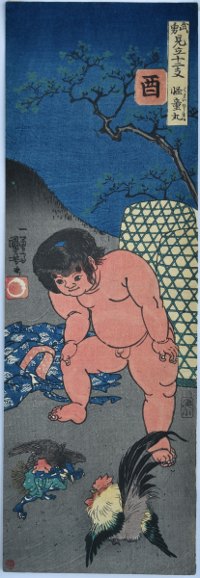
Click here to view image full size. Cock from a chu-tanzaku set of twelve prints Buyu mitate junishi, “Chosen Heroes for the Twelve Signs.” Based on the Chinese zodiac system of twelve animals. Shows Kwaido Maru, the boy Kintoki, umpiring…
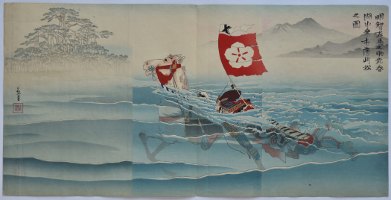
Click here to view image full size. A triptych, Akechi Samanosuke Mitsuhara kosui joho Karasaki matsu no zu. Shows Akechi Samanosuke Mitsuhara swimming with his horse, his kikyo (Chinese bell flower) standard tied to his back, across Lake Biwa to…
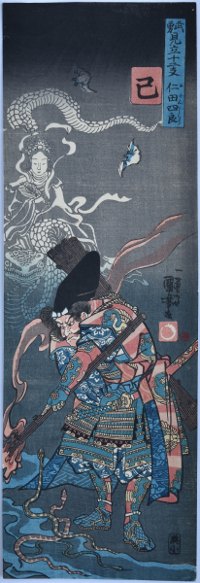
Click here to view image full size. Snake from a chu-tanzaku set of twelve prints Buyu mitate junishi, “Chosen Heroes for the Twelve Signs.” Based on the Chinese zodiac system of twelve animals. Shows Nitta Shiro (Tadatsune) inside Mount Fuji…