1764-65 – a pivotal year for Ukiyoe-e

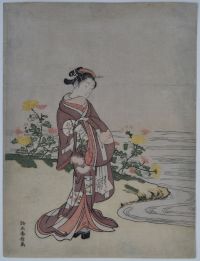
The years 1764/5 are now recognised as the most pivotal in the development of Ukiyo-e. Prior to this year fully polychrome prints were rarely produced. The ability to ‘key’ more than one block been known had for some time using the simple expedient of kento marks cut in relief – a right-angle in the corner, and a horizontal line down the side. However, around 1764/5, a number of favourable circumstances – namely a period of permissiveness in the arts and the proliferation of literary and poetry clubs – gave rise to the e-goyomi print (calendar-print), probably instigated by Jinshiro Tadanobu (Kikurensha Kyosen), founder of the Kikuren Club.   Calendar-prints were a government-controlled monopoly. The none-government clubs this circumnavigated by hiding the dai-sho (long and short months) numerals in various parts of a print’s design. Also, in the development of the colour print process, a tweak was made to the kento marks by the insertion of a sliver of wood; this enabled finer adjustments to be made with the keying of the blocks to compensate for expansion or contraction of the paper (or indeed the blocks). This refinement made it possible for numerous blocks to be used. The clubs commissioned the printers to use the thicker more luxurious hosho paper and a wide range of new pigments. These luxurious prints also often used over-printing and blind-printing.   Harunobu was in the right place at the right time to fully exploit these advances and the next few years would see a huge increase in Harunobu’s output, from initially designing the private e-goyomi to having them commercially sold and going on to produce a large corpus via commercial publishers. Harunobu died in 1770 but the decade saw some of the most exquisite compositions by him that were seldom surpassed in the refinement of…

50th Anniversary of dealing – Part 2

In the 70s and 80s I was buying prints by such artists as Hiroshige, Hokusai, and Utamaro in the UK and in France and selling them in Japan. In Japan, I was buying prints by Yoshitoshi and Kuniyoshi. At that time those artists were not so highly valued by Japanese collectors.   I travelled to Paris every ten days or so and on almost every trip I was able to find something good. A lot of prints had been exported to France in the 19th century. Japanese art and culture enjoyed great influence in France at that time, the importance of ukiyo-e for the French impressionists is well known. Now it is difficult to find good quality prints in France and the prices fetched in auctions are often prohibitive.     At the time of my early trips to Japan in the 70s, there were not so many European or American visitors to Tokyo, visitor numbers to Japan were in the low 100,000s. Now visitor numbers are approaching 25 million per annum. My first experience of central Tokyo was a revelation – a real shock of the new! Tokyo’s highrise office blocks, its modern and efficient transport system, the bullet train all made London feel quite parochial. Because I had been studying ukiyo-e, Kyoto seemed much more familiar to me – if you squinted it was like being in a Hiroshige landscape.   My days were tiring ones of walking around shops in both cities. Prints could turn up anywhere. Outside of the cities it was not unusual for me to be followed by a gaggle of children for whom I was clearly a source of curiosity and general amusement.   I attended various auctions in Japan and often I was the only foreign dealer. The auctions were smaller then…

50th Anniversary of dealing – Part 1

Looking back on 50 years of dealing in Japanese prints, paintings and books I have much to be grateful for. From the first ukiyo-e print that I bought in 1968 to now when I have bought and sold many tens of thousands of prints. In researching specific prints I have built up my kno wledge of the artists and the artisans involved in print production. I continue to learn about the history, culture, and society that all gave rise and shaped what we know as ukiyo-e. Handling and knowing this art of 17th to 19th century Japan has been, and continues to be, a great pleasure and privilege for me.     I was fortunate that when I began as a dealer, it was at a time when prints were readily available and there was a wave of interest in Japanese art. I came to dealing after working as a professional photographer for a few years in London in the ‘swinging 60s’. I started buying and selling prints – initially book plates, Hogarth prints, maps and caricatures, I had a stall in an antiques market and was beginning to almost make a living. In 1968, by chance, I went into a shop just off Charing Cross Road that sold Japanese antiquities. On the wall was a print of a samurai by Kuniyoshi. I was familiar with engravings and etchings but I had never seen a printing technique like that. I was so excited by the print that I paid £40 for it – an extravagant price at that time! I put it on my stall in the Antique Centre near Selfridges. It took me three years to sell it and I made a big loss. This was the beginning of my education as a Japanese print dealer. I am often…

Selected Reference Titles

Listed here are selected titles of reference books that I refer to most regularly – this is not an exhaustive list!   Asano, Shugo and Clark, Timothy, The Passionate Art of Kitagaway Utamaro, Asahi Shimbun, 1995 Forrer, Matthi and Goncourt, Edmond de, Hokusai, Rizzoli International Publications, 1988 Gentles, Margarent O., The Clarence Buckingham Collection of Japanese Prints, Volume 2 Haranobu, Koryusai,Shigemasa, their followers and contemporaries , The Art Institute of Chicago, 1955 Gunsaulus, Helen C., The Clarence Buckingham Collection of Japanese Prints, Volume 1 The Primitives, The Art Institute of Chicago, 1955 Hillier, Jack, The uninhibited brush, Japanese Art in the Shijo Style, Hugh M. Moss Ltd, 1974 Hillier, Jack, The Art of the Japanese Book, 2 volumes, Southeby Publications, 1987 Hirano Chie, Kiyonaga A Study of His Life and Works, Harvard University Press 1939 Keyes, Roger, The Art of Surimono, Privately Published Japanese Woodblock Prints and Books in the Chester Beatty Library, Dublin, Southeby Publications, 1985 Keyes, Roger, The Art of Surimono, two volumes, Southeby Publications, 1985 Koop, Albert J., and Ianda, Hogitaro, Japanese Names and How to Read Them, Routledge & Kegan Paul Ltd., 1923 Lane, Richard, Images from the Floating World, The Japanese Print Including a Dictionary of Ukiyo-e, Oxford University Press, 1978 Mitchell, C.H., The Illustrated Books of Nanga, Maruyama, Shijo and Other Related Schools of Japan, Dawson’s Book Shop, 1972 Robinson, B.W., Kuniyoshi, The Warrior Prints, Phaidon Press, 1982 Schaap, Robert, Heroes & Ghosts, Japanese Prints by Kuniyoshi 1797 – 1861, Hotei Publishing, 1998 Suzuki, Juzo, Utagawa Hiroshige, The Nihon Keizai Shimbun, 1970 Tamba, Tsuneo, The Art of Hiroshige, Asahi Shimbun, 1965 Turk, Frank A., The Prints of Japan, Arco Publications, 1966 Van den Ing, Eric and Schaap, Robert, Beauty & Violence, Japanese Prints by Yoshitoshi 1839 – 1892, Havilland Press, Society for Japanese Arts,…

Nishikawa Sukenobu, 1671-1750

    Given names: Bunkado; Bunkadô; Fujiwara; Jitokusai; Jitokusō; Magoemon; “Uji” Nishikawa; Nishikawa Nishikawa Sukebê /Sukebê; Nishikawa Sukenobu; Saiō; Sukenobu; Uemon; Ukyô; Ukyō; Yûsuke   Sukenobu was “The most accomplished and influential Ukiyo-e painter in Kyoto during the first half of the eighteenth century” [1]. He was born and died in Kyoto, the centre of the Imperial Court, home of the classical arts and aristocratic custom. It is this tradition that permeates Sukenobu’s prolific work. Contemporaries studied his books and prized his paintings of single figures and groups of females. He “influenced Masanobu directly, Harunobu profoundly and almost all subsequent ukiyo-e artists indirectly” [2]. In the years in which the ukiyo-e style was emerging from the publishing district of Edo, Sukenobu was training from a young age in the painting styles of Kano school artist Kano Eino and Tosa school artist Tosa Mitsusuke, (from whom he may have derived the Suke- in his name). Whilst ukiyo-e prospered and grew in Edo, it also developed in the Kamigata area (Osaka and Kyoto) which produced its own style and masters. Of the Kamigata artists Sukenobu led the genre – he produced thousands of illustrations and would remain amongst the most prolific ukiyo-e artists of the entire Edo period.   His images were almost exclusively in monochrome. Sukenobu produced no single-sheet prints. The beginning of ukiyo-e style and Sukenobu’s prodigious output took place in the Genroku era, 1688-1704, a period of great wealth amongst the merchant classes of Osaka, Kyoto and Edo. These cities expanded and saw the emergence and flowering of an urban popular culture: “the later part of the Genroku era around 1700… the townspeople as a class had reached a high degree of affluence and culture, and the artistic impulse in Japan in general was more vital and widely diffused,…

Maki Bokusen (1736-1824)

    Given names: Bokusen; Maki-Nobumitsu Bokusen; Gekkotei; Hokusen; Hokutei; Hyakusai; Maki Shin’ei; Suke-emon; Tokoro; Utamasa.   Bokusen was a Nagoya samurai of the local Owari Fief and ukiyo-e painter, printmaker and copperplate etcher. He was a student of Utamaro and also, as C H Mitchell states, a friend and acknowledged pupil of Hokusai although much of his work bears little resemblance to that of Hokusai.   Bokusen is known for his collaboration with Hokusai on the master’s Manga: It seems that the idea was conceived when Hokusai, at Bokusen’s invitation, went to Nagoya for an extended visit in 1811 Hokusai stayed for six months with Bokusen and during this time developed a circle of students and successfully cultivated his popularity in Nagoya. Hanshu Sanjin in his 1812 preface to Volume One of Hokusai’s Manga writes that over 300 spontaneous drawings were made during this visit. And this is what possibly inspired Bokusen to approach the legendary Nagoya publisher Eirakuya Toshiro, who had previously published illustrated book(s) by him, to turn Hokusai’s sketches into a book. Bokusen and another of Hokusai’s students, Tonansai Hokuun, are credited as copying Hokusai’s drawings in preparation for the woodblock cutter as the term “ko” or “revisers” is used in the colophon, suggesting that it was the two pupils who arranged the varied sketches.   Bokusen’s own published works include:   c1809 Kyogaen shohen. (Mad Sketches) 1809 Bokusen gafu (Album of Sketches by Bokusen) 1810 Hitoyo banashi (One Evening’s Talk) 1813 Shiki sanbaso (The Sanbaso in Four Seasons) 1814 Mushi no koe (Songs of insects). Bokusen and other artists 1815 Bokusen soga shashin gakuhitsu (Various Dreamings by Bokusen: A Study in Truthful Painting) 1816 Santei gafu. Bokusen and Hokusai publish a Manual for Illustration in Three Styles. The illustrations in this publication apply shin, gyo,…

Winter landscapes

    Approximately 70% of Japan’s landscape is mountainous. In the past when travel into the mountains was difficult there was a large demand and great curiosity by the public to see those remote snow covered landscapes. Publishers and leading artists like Hiroshige and Hokusai responded to that demand by ensuring that every landscape set had at least one snow scene and, often, as in the 100 Views of Edo set, there were as many as seven.   Winter landscapes, because of their minimalist nature appeal to a modern aesthetic and are probably the most popular and expensive landscape prints to collect now. They most often show travellers in a snowy pass but we can also enjoy scenes of Edo (Tokyo) under deep snow. Tokyo’s location on the coast of the Pacific Ocean affords the city mild winters with cool spells. Snowfall does occur annually but it is sporadic and it seldom stays. Perhaps there were heavier falls one or two hundred years ago but more likely artists used snow imagery as a way to both emphasise the season and to transform both landscape and cityscape.   In ukiyo-e a number of techniques were used to suggest snow: areas of image were left blank or block cutters and printers created texture on the paper using gauffrage (blind-printing) in which the block is printed without pigment. This convincingly conveyed snow and is primarily found on prints of the Harunobu period and surimono both of which were printed using thick hosho which is ideal for blind-printing.   White pigment was also used: gofun which was prepared from powdered clam shells [calcium carbonate] or shiro prepared from white lead carbonate. Snowflakes could be cut into the blocks and printed; or gofun or shiro could be splashed from a brush onto the paper, or…

Mori Sosen: One Hundred Monkeys

    In the present update is a large painting of one hundred monkeys by Mori Sosen (1747-1824). His life is not well documented but he is known to have studied under the Kano artist Yamamoto Joshunsai (? – 1781) before being drawn into Maruyama Okyo’s (1733-1795) artist circle and his style is more Shijo than anything else. His animal paintings were evidently highly valued by Okyo. He was an immediate favourite with eastern collectors because of his monkey paintings and became known for this subject, although he was more versatile than literature implies and highly accomplished at drawing other animals. But his images of monkeys take precedence and he is considered the pre-eminent painter, east or west, on this subject. He is said to have lived in the woods for three years eating fruit and nuts to study the monkeys and other animals at close quarters. (Even if this is apocryphal it underlines the appreciation of his commitment to understanding the monkey.)   This tour de force of one hundred Japanese macaque monkeys shows every conceivable pursuit. They are the most northern-living monkey and can survive extreme cold. There are many Sosen monkey paintings but few, as here, are genuine.

Some ways to identify first and early impressions

First and early impressions best convey the intentions of the artist and publisher. High quality impressions can be identified by clear, unbroken key-block outlines, especially on any faces or title cartouches; visible wood-grain – the ‘finger print’ of every Japanese print and the depth of impression, which can often be sensed with the fingertip, especially when thicker, or deluxe hosho was used. The following techniques are indicative of and are best demonstrated on only the earliest editions: Bokashi – subtleties of careful gradation, sometimes merging colours one to another or shaded to give form and depth. Fukibokashi – the spraying of pigments or the splashing of gofun (white pigment). The addition of rice flour or mica to give sparkle to colours.   Example of a First Edition Print: Ichiryusai Hiroshige – “Ferryboats to Zenkoji Temple at Kawaguchi”     How many impressions were produced?   Dealers in ukiyo-e are often asked how many impressions were produced or what is the edition? This is a difficult question to answer because of the limit to the information available to us, however the writings of Mr Tokuno (1893)[1] and Mr Watanabe(1936)[2] give us good insight into the printing process and the number of impressions produced.   Before the 20th century, no Japanese print was numbered except to denote the chapter in a series or a station on a highway. In the 19th century mainstream print production was structured to sell as many copies as possible for modest amounts – some prints being sold then for the cost of a bowl of noodles. Ukiyo-e can be seen to have been one of the most democratic art forms and vast numbers of prints were produced.   The consensus of opinion is that ‘editions’ (ippai) of around 200 prints were pulled concurrently. The number of editions…

Washi – Handmade paper

One of the pleasures of dealing in ukiyo-e is to handle hosho on a daily basis and it is a fact that paper making was already established and used for every imaginable purpose in China and Japan well before Guttenberg was printing the Bible on some of the first western handmade paper.   Hosho, used for printmaking, was manufactured in Echizen and a short- fibred variety of kozo called Nasu Kozo was used. Sumptuous hosho is found on many Harunubu prints and also surimono where a thicker paper was needed to better show off blind printing and where editions were small. Paper is discernably thinner on most Hiroshige sets. Besides kozo, Mitsumata and Gampi fibres were used for paper making but kozo was found to be the most suitable for print making coming from the mulberry family. The trees – in fact one year old sprouts from old stumps – were harvested in December, consequently paper making was an occupation that didn’t interfere with summer farming and the cold weather conditions were also better suited to making paper. The inner white bark of the kozo branches was used to make the bast and this was obtained by steaming the branches and stripping the black and green bark away. The fibre was then boiled in an alkali potash solution to remove the lignin and pectin leaving primarily cellulose fibre. Foreign particles were laboriously removed in cold water (not always successfully as they are found sometimes on 19th century landscapes) The fibre was then beaten or rather loosened to obtain the bast. A mould (su- made of hundreds of rounded bamboo splints woven together with silk threads) was lowered into the vat of bast plus water and a viscous solution of neri (roots from the tororo plant soaked and pounded) to aid…

Toyokuni – painted while drunk

In the current update is a painting signed “Toyokuni painted while being drunk.” This is not an isolated example: Certain artists – such as Kyosai – often signed works in this way and indeed may have benefited from a degree of inebriation to prompt inspiration. Artists often collaborated on works, especially of the Shijo school, and one can imagine the conviviality of such a cohors amicorum with food and wine being passed around. It’s difficult to think of a western comparison to this. Hand scrolls, because of their horizontal length and short height, were very suitable for joint efforts of like-minded artists or literati.     The example in this update is spontaneous – even slapdash – due to the artist’s intoxication, but this adds a charm and veracity to the subject. It also makes authentication easier, certainly of Ukiyoe subjects, as forgers tended to concentrate on copying the detailed, more sober and meticulous subjects, as these were the most highly valued.   Japanese paintings are an undervalued area of collecting. It’s possible, as here, to buy an important Hiroshige painting for the price many of his prints fetch. And one is purchasing an unique item.

Why were prints produced in just blue

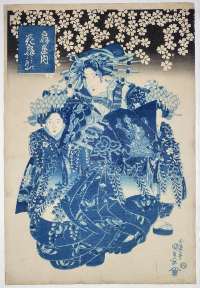
In the current update there is a Kunisada aizuri-e. Why were prints produced in just blue ? The history of ukiyo-e is one marked by the development and assimilation of technical innovations in the printmaking process as well as the adaption of the numerous regulations imposed by the Tokugawa bakufu (shogunate) as a result of the economic climate of the Edo period (1600-1868). Mismanagement of the economy by the government and weak Shoguns led to the issuing, intermittently, of regulatory edicts in an attempt to raise funds, to cut spending and to encourage thrift. The impression offered here shows all the attributes of the earliest printing: Extremely beautiful and careful wiping of the blue block to render the currents of water; careful modulation of the gradation on the fish at top and also on the sea-weed at the bottom. The later printings – even the first with Matsui Eikichi – lack finesse in the printing of the water and in the republished version there is often no attempt to gradate the foreground sea-weed. The pigments are also of a finer quality on this early state , a better red being used on Cho Jun’s trousers. It was the job of the printers to breathe life, so to speak, into the image, to give form and depth by means of skilled bokashi; to augment a design by wiping on clouds or spraying pigment to imitate dust or snow. This all took time rather than relying on a key-block outline and blocks of colour.The only other difference, of course, between early and late printings is the quality of the impression. The more prints that were pulled, the more the blocks wore down producing weak outlines. These decrees were also frequently aimed at raising moral standards, and as ukiyo-e – related as it…

Cho Jun and Ri Ki wrestling underwater

In the new offerings is a vertical Yoshitoshi diptych of Cho Jun and Ri Ki wrestling underwater. This is the earliest known state of what is considered one of Yoshitoshi’s best designs – before the first publisher’s name (Matsui Eikichi) and date (20,2,1887) in lower left margin was printed. This gives an opportunity to examine the differences in printing between the earliest and last editions. (The diptych was subsequently reprinted by Hasegawa Tsunejiro in 1,9,1887.)   From the late 18th century there was a history of publishing some prints in a deluxe edition and a more affordable version of the same design: Paper, pigments and nuances in printing could all be adjusted. And by the time we come to some of Hiroshige’s better known sets we find the first editions had great care lavished on them with extra bokashi (grading the pigment by hand), better pigments and paper. The Hundred Views of Edo is a prime example of this: Every care was taken to convey the atmosphere of a scene. Later editions lack these subtleties with commercial considerations taking precedent. This is certainly true of many of Yoshitoshi’s sets as well.   The impression offered here shows all the attributes of the earliest printing: Extremely beautiful and careful wiping of the blue block to render the currents of water; careful modulation of the gradation on the fish at top and also on the sea-weed at the bottom. The later printings – even the first with Matsui Eikichi – lack finesse in the printing of the water and in the republished version there is often no attempt to gradate the foreground sea-weed. The pigments are also of a finer quality on this early state , a better red being used on Cho Jun’s trousers. It was the job of the printers…

A Twist of Figured Cloth – Shunga wood blocks

This is the first of an occasional blog that I hope clients will find interesting. In the current update is an important and rare set of six original wood blocks for a shunga (erotic) book Aya no odamaki “A Twist of Figured Cloth” by Terasawa Masatsugu (active c1760-1790) published in 1776 in black and white, so these are the key-blocks (or sumi-blocks) which constitute reversed or mirror-images of the book. It is pure serendipity that a few original blocks have survived. Many were planed down to recut as wood became more expensive during the 19th century and a lot more were probably used for kindling or destroyed by fire. There is also an apocryphal story that the Victoria and Albert Museum, here in London, burnt a large number of blocks after the Second World War to free up storage space. Early blocks, such as these, are particularly rare. Blocks that survive with big names attached – Harunobu or Hiroshige, for example, are invariably for copies. Shunga blocks are of added rarity. Indeed, this is the only set I have seen . The blocks have a great beauty in their own right and are from the wood of the single-petaled white mountain cherry (shiro-yamasakura or Prunus mutabilis). During the Edo period outlines were cut following the direction of the brush strokes of the original drawing, the knife being drawn towards the block-cutter. The block- cutter followed the drawing (hanshita-e) which was pasted face downward onto the block and partially peeled or rubbed with hempseed oil to render it more visible. Cutting was deeper in the 18th century and became shallower during the 19th, probably due to the cost of wood and the gradual sophistication of the cutters. In Japan wood was cut with the grain; this method is fundamentally similar to…