Utagawa KUNIYOSHI (1797-1861)

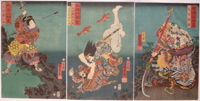
 Click here to view image full size. A fine hanshita-e triptych drawing by Kuniyoshi showing the strong woman Kaneko Kugutsune ( also called O Kane or Omi no O Kane ). She is normally depicted – as here – holding down the sacred white temple horse with her geta. These appear to be lifelike dolls: There seems to have been a craze for such figures in the 1850s. Other materials used to make such figures and animals were shells, cane and flowers. Sumi and light colour, 14.5 x 30 in, 37 x 76.5 cms. Each sheet fully signed Ichiyusai Kuniyoshi ga. Unidentified publisher’s seal, c 1855. Some pentimenti. Laid down onto a larger sheet of paper. Light staining, otherwise good condition. Kuniyoshi appears to have liked this subject and designed a number of prints including a famous horizontal landscape in western style. Status: Sold

Utagawa KUNIYOSHI (1797-1861)

 Click here to view image full size. A fine hanshita-e triptych drawing by Kuniyoshi showing a general ( possibly Kato Kiyomasa ) on a horse far left and surrounded by his soldiers. He is viewing flotillas of boats laden with more troops. Sumi and light touches of red, 14.5 x 30 in, 37 x 76.5 cms. Each sheet fully signed Ichiyusai Kuniyoshi ga with censor seal pasted on for 9 The publisher’s seal Yamamotoya Heikichi and hand-stamped red Kiri seal on each sheet. Extensive pentimenti. Laid down onto a larger sheet of paper. Light staining, otherwise good condition. Status: Sold

Utagawa KUNIYOSHI (1797-1861)

 Click here to view image full size. A triptych with title Furyu ningyo zu, “Pictures of Dolls in Contemporary Fashion.” There was a craze for these lifelike dolls in the 1850s ( this triptych being dated 2/1856 ). In fact Kuniyoshi designed another print in the same year of the centre subject Tammeijiro Genshogo being captured. This impression appears to be the only known copy: Not listed anywhere. Unidentified publisher. An original hanshita-e for the first sheet exists in the Victoria & Albert Museum, illustrated in Japanese Colour Prints, Edward F. Strange, 1913, pl. XLII. Very fine impression and colour. Possibly very slightly trimmed round. Signed Ichiyusai Kuniyoshi ga. Status: Sold

Utagawa KUNIYOSHI (1797-1861)

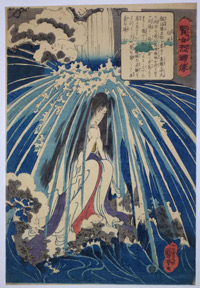
 Click here to view image full size. The best design from Kenjo reppuden, “Stories of Wise and Virtuous Women.” Shows Hatsuhana doing penance under the Tonozawa waterfall fulfilling a vow made on behalf of her sick husband, Katsugoro. She dies from the experience but Katsugoro is cured and kills his brother’s murderer near the waterfall observed by Hatsuhana’s ghost. Published c 1842 by Ibaya Sensaburo. Very good impression, colour and condition. Completely untrimmed with extra paper showing all round. Signed Ichiyusai Kuniyoshi ga. Status: Sold

Utagawa KUNIYOSHI (1797-1861)

 Click here to view image full size. The priest Nichiren calming a storm at Kakuda on his way to Sado Island by invoking the name of the Lotus Sutra ( namu myoho rengekyo ) which is shown written on the waves. From Koso goichidai ryakuzu, “Illustrated Abridged Biography of the Founder. “ Nichiren was the founder of the Buddhist Nichiren sect ( Nichiren shu – Kuniyoshi being a follower ) and indeed the set of ten prints may have been commissioned to mark the 550th anniversary of his death. Published c. 1831 by Iseya Rihei. This is the first edition with black spots printed in the sky; splashed gofun; gradation on the distant sea; blue gradation at top, and grey mountain. One of the three best designs from the set. ( See this website for the snow scene and Nichiren praying for rain. ) Fine impression and colour. Minor soil and slight centre fold. Signed Ichiyusai Kuniyoshi ga. Status: Sold

Utagawa KUNIYOSHI (1797-1861)

 Click here to view image full size. Nichiren struggling up a snow-covered mountain near Tsukahara on the Island of Sado. The best design from Koso goichidai ryakuza, the “Illustrated Abridged Biography of the Founder.” Nichiren being the founder of the Buddhist Nichiren sect ( Nichiren shu – Kuniyoshi being a follower ) and indeed the set of ten prints may have been commissioned to mark the 550th anniversary of his death. Published by Iseya Rihei, c 1831. Like many great landscapes, there exist different states which causes confusion over which is the earliest. The basic difference is that the design is known with and without a horizon line and that there is at least one impression where the uninked, blind-printed line can be seen in a raked light. It has been asserted that those impressions without are the earliest; however, it seems from this that the sumi block was probably cut initially with the line but the publishers thought that it looked aesthetically better without printing it, and it was subsequently removed. In any case, this is an extremely rare print and most surviving examples appear to be similar in impression. There is a break in the border to the left of the bottom of Kuniyoshi’s signature which could give a guide to the earliest states, but as this is often painted in, it is not reliable. The print offered here has the horizon line and the gradation at the base of the mountain upwards. Left border line is unbroken. The composition is based on a design in the illustrated book Bumpo sansui gafu by Kawamura Bumpo, published posthumously in 1824. Although not from a landscape set, this is considered one of the great 19th century landscapes. Provenance: Ex collection Hans Crzellitzer, seal top right corner. Very good impression. Some…

Utagawa KUNIYOSHI (1797-1861)

 Click here to view image full size. Shin Yoshiwara from the set of ten prints: Toto meisho, “Famous Views of the Eastern Capital.” Shows night revellers beneath a moon with an enormous halo. A much admired print with a westernised chiaroscuro effect. Excessively rare. Published by Kagaya Kichibei, c 1834. Fine impression. Extremely well retained colour. Restored top edge running from the centre towards right corner and top left corner. Signed Ichiyusai Kuniyoshi ga. Status: Sold

Utagawa KUNIYOSHI (1797-1861)

 Click here to view image full size. A tiger and dragon from a rare series Kinju zue, “Drawings of Birds and Beasts.” The set of at least five prints published by Joshuya Kinzo, 1837. Although rare, there are different states of the prints from this set, some having yellow cartouches, others red and uncoloured ( as here ). This design is also known with other colour variations. Very good impression, colour and condition. Signed Ichiyusai Kuniyoshi ga. Status: Sold

Utagawa KUNIYOSHI (1797-1861)

 Click here to view image full size. Oishi from a set Kenyu fujo kagami, “A Mirror of Wise and Courageous Women.” She evidently was famous for having used her strength to deliver irrigation water into her own fields. Published c 1843-45 by Takahashiya. Very fine impression. Fine colour. Light album backing, otherwise fine condition. Signed Ichiyusai Kuniyoshi ga.   Status: Sold  

Utagawa KUNIYOSHI (1797-1861)

Click here to view image full size. An aizuri-e print showing the courtesan Nanahito of the Sugata-ebi house, 1 chome, Kyomachi, parading in front of rooftops. Published by Yamaguchiya Tobei, c. 1835-40. In fact, the left sheet of a triptych. Apparently, no known copy of the complete triptych is known, only this design and the first sheet. Nanahito was a popular courtesan also appearing on prints by Kunisada and Eisen.     Very fine impression, colour and condition. Signed “Restraining tears”, Ichiyusai Kuniyoshi ga.     Status: Sold

Utagawa KUNIYOSHI (1797-1861)

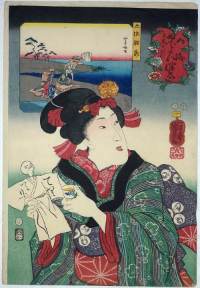
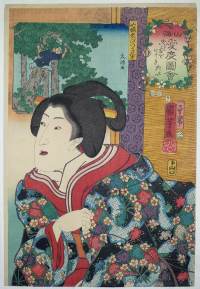
 Click here to view image full size. A beauty in sumptuous clothing from a fine set of seventy numbered prints with title: Sankai medetai zu, “Excellences of Mountain and Sea.” The set compares busts of beautiful women with various products and occupations from the provinces of Japan. The inset view here shows dried bonito from Tosa Province, Tosa katsuobushi. The set published 1852 by Sano-ya Kihei.   Superb impression, very fine colour and condition. Signed Ichiyusai Kuniyoshi ga.   Status: Sold  

Utagawa KUNIYOSHI (1797-1861)

 Click here to view image full size. A beauty in sumptuous clothing from a fine set of seventy numbered prints with title: Sankai medetai zu, “Excellences of Mountain and Sea.” The set compares busts of beautiful women with various products and occupations from the provinces of Japan. The inset view here shows woven silk from Bungo Province, Bungo shiborizone. The set published 1852 by Sano-ya Kihei.   Superb impression, very fine colour and condition. Signed Ichiyusai Kuniyosh   Status: Sold  

Utagawa KUNIYOSHI (1797-1861)

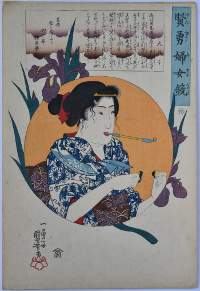
Click here to view image full size. An aizuri-e print of the courtesan Hontsue of the Daimonjiya House in the Yoshiwara, Edo. Seated on a ledge, she holds an extremely long pipe and is compared to one of the sights of Edo: The Ryogoku Bridge. Published by Kawaguchiya Chozo, c 1830s. Fine impression, colour and condition. Signed Ichiyusai Kuniyoshi ga. Status: Sold

Utagawa KUNIYOSHI (1797-1861)

 Click here to view image full size. Women washing cloth in the Chofu River from a set of six triptychs of the Six Tama (or Jewel, or Crystal) Rivers. Musashi no kuni Chofu Tamagawa, “Chofu Crystal River in Musashi Province.” Published by Sanoya Kihei, 1847-8.   Very good impression, colour and condition. Signed Ichiyusai Kuniyoshi ga.   Status: Sold  

Utagawa KUNIYOSHI (1797-1861)

 Click here to view image full size. Etchu Namerikawa otako, “Giant Octopuses in Namerikawa in Etchu” and sub-title Oo itai, “Ouch.” Obviously the cat’s claw being compared to the menacing tentacles of the octopus. A series of seventy prints Sankai medetai zue, “Affectionate Feelings for Mountains and Seas.” The set compares half-length beauties with famous products of the locality. Published by Tsurakichi, 1852. Kuniyoshi was particularly fond of cats and his studio was known to be home to a number of them. This may be his best evocation of a cat.   Superb impression with the cat’s coat blind-printed. Very fine colour and condition. Signed Ichiyusai Kuniyoshi ga.   Status: Sold  

Utagawa KUNIYOSHI (1797-1861)

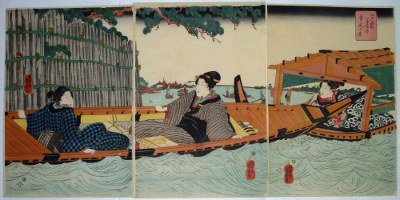
Click here to view image full size. A triptych: Mitate gogyo: Mizu, Ukifune, “Comparisons of the Five Elements: Water,” Ukifune. Shows Prince Genji in a boat with his attendants feeding ducks during the winter. Ukifune was the nickname of a princess in The Tale of Genji. An unrecognised daughter of the Eighth Prince in the 51st Chapter of the story. Ukifune also means: “A boat set adrift.” Published by Sanoki (Sanoya Kihei), 1851-52.     Superb impression, colour and condition. Signed Ichiyusai     Status: Sold    

Utagawa KUNIYOSHI (1797-1861)

 Click here to view image full size. The poetess Ome Shushiki (1668-1725) looking at a poem attached to a tree at Ueno. A chu-tanzaku set of eight prints: Kenjo hakkei, “Eight Views of Accomplished Women.” The set published by Ibaya Sensaburo, c 1843-5. Based on the famous Chinese Eight Views, Japanese artists designed many sets using the Eight Views of Omi as their starting point. Here, Vesper Bell at Ueno [Miidera].   Very good impression and colour. Minor trimming (usual, as they were printed two-to-a-sheet), otherwise very good condition. Signed Ichiyusai Kuniyoshi ga.   Status: Sold  

Utagawa KUNIYOSHI (1797-1861)

 Click here to view image full size. Kogo no Tsubone (1157 – ?) on a balcony after being banished from court. A chu-tanzaku set of eight prints: Kenjo hakkei, “Eight Views of Accomplished Women.” The set published by Ibaya Sensaburo, c 1843-5. Based on the famous Chinese Eight Views, Japanese artists designed many sets taking the Eight Views of Omi as their starting point. Here, Autumn Moon over Saga Moor [Ishiyama].   Very good impression and colour. Minor trimming (usual, as they were printed two-to-a-sheet), otherwise very good condition. Signed Ichiyusai Kuniyoshi ga.   Status: Sold  

Utagawa KUNIYOSHI (1797-1861)

 Click here to view image full size. The faithful wife of Mama walking on a hillside with falling maple leaves. A chu-tanzaku set of eight prints: Kenjo hakkei, “Eight Views of Accomplished Women.” The set published by Ibaya Sensaburo, c 1843-5. Based on the famous Chinese Eight Views, Japanese artists designed many sets using the Eight Views of Omi as their starting point. Here, Clearing Weather at Mama [Awazu].   Very good impression and colour. Minor trimming (usual, as they were printed two-to-a-sheet), otherwise very good condition. Signed Cho-o-ro Kuniyoshi ga.   Status: Sold  

Utagawa KUNIYOSHI (1797-1861)

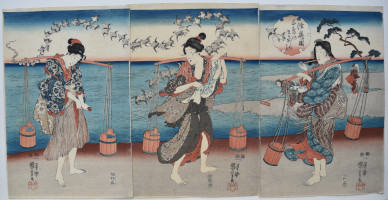
Click here to view image full size. A triptych showing beauties carrying brine in yoked buckets to be made into salt. From a set Mu Tamagawa, Mutsu no kuni chidori no Tamagawa, “Six Jewel Rivers, Plover Jewel River in Mutsu Province.” Also known as the Noda Jewel River. Above, a flock of chidori. The Mu Tamagawa theme was popular in Japanese art. Published by Sanoya Kihei, 1847-8. Very good impression. Slight fading, otherwise good colour. Very good condition. Signed Ichiyusai Kuniyoshi ga. Status: Sold

Utagawa KUNIYOSHI (1797-1861)

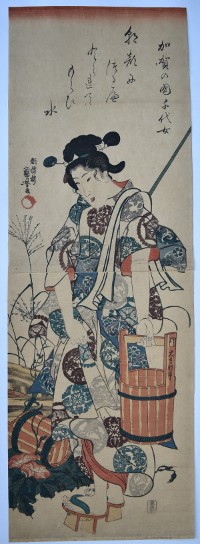
Click here to view image full size. A vertical oban diptych showing the poetess Kagano Chiyo (1703-1775). The story relates how Chiyo goes to her well to draw water only to find that a morning-glory vine has overgrown her bucket. Rather than disturb it, she goes to a neighbour for water. This is the subject of a famous poem by Chiyo. Published by Izumiya Ichibei mid 1840s.     Very good impression and colour. Paper slightly toned and one light crease. Ample room for joining. Signed Chooro Kuniyoshi ga.     Status: Sold    

Utagawa KUNIYOSHI (1797-1861)

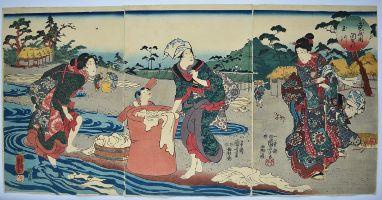
Click here to view image full size. A triptych showing three women washing clothes in a stream from a set Six Tama [Jewel or Crystal] Rivers, this being the Chofu Crystal River (in fact the Tamagawa that flowed into Edo Bay). Musashi no kuni Chofu no Tamagawa. The set published by Sanoya Kihei, c 1847. The complete set is illustrated in The Baur Collection, Matthi Forrer, vol. II, 1994, nos G396-G401 (this being G397).     Very good impression, colour and condition. Signed Ichiyusai Kuniyoshi ga.     Status: Sold    

Utagawa KUNIYOSHI (1797-1861)

 Click here to view image full size. A complete triptych showing beauties in boats on the Sumida River. Shubi no matsu, “Successful-deal Pine Tree” from a set Edo meisho somoku-zukushi, “Notable Sights Famous for Grass and Trees in Edo.” This famous pine was blown down during the An’ei era (1772-1780); its successor died during the Ansei era (1854-1859); the third died at the end of the Meiji era (c 1910). There is also the Hiroshige view of this subject from the 100 Views of Edo. Published by Ebiya Rinnosuke (Kaijudo), 1845.   Very good impression. Fine colour and condition. Full size. Another state has darker water and variegated cartouche. Signed Cho-o-ro Kuniyoshi ga.   Status: Sold  

Utagawa KUNIYOSHI (1797-1861)

 Click here to view image full size. A beauty in sumptuous clothing from a fine set of seventy numbered prints with title: Sankai medetai zu, “Excellences of Mountain and Sea.” The set compares busts of beautiful women with various products and occupations from the provinces of Japan. The inset view here shows dyer beetles being collected in Yamashiro Province. Yamashiro ebizuru mushi. The set published 1852 by Sano-ya Kihei.   Superb impression, very fine colour and condition. Signed Ichiyusai Kuniyoshi ga.   Status: Sold  

Utagawa KUNIYOSHI (1797-1861)

 Click here to view image full size. A beauty in sumptuous clothing from a fine set of seventy numbered prints with title: Sankai medetai zu, “Excellences of Mountain and Sea.” The set compares busts of beautiful women with various products and occupations from the provinces of Japan. The inset view here shows crabs being caught in Nagato Province. Nagato kani. The set published 1852 by Sano-ya Kihei.   Superb impression, very fine colour and condition. Signed Ichiyusai Kuniyoshi ga.   Status: Sold  

Utagawa KUNIYOSHI (1797 – 1861)

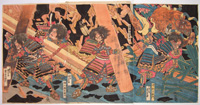
 Click here to view image full size. Saito Toshimoto and a Chinese general struggling underwater. The second best design from Taiheiki yeiyu den, “Heroic Stories of the Taiheiki.” Published by Yamamoto-ya Heikichi, 1848-9. Robinson S62.31. Fine impression, colour and condition. Signed Ichiyusai Kuniyoshi ga. Status: Sold

Utagawa KUNIYOSHI (1797 – 1861)

 Click here to view image full size. Sasai Kyuzo Masayasu enveloped in smoke and avoiding musketry at the battle of Anegawa ( 1570 ). The best design from Taiheiki yeiyu den, “Heroic Stories of the Taiheiki.” Published by Yamamoto-ya Heikichi, 1848-9. Robinson S62.36. Fine impression, colour and condition. Signed Ichiyusai Kuniyoshi ga. Status: Sold

Utagawa KUNIYOSHI (1797 – 1861)

 Click here to view image full size. The battle of Miidera Temple. An early triptych, c. 1820-25. The temple became very prosperous but was at constant war with its rival, the Hieizan. Both temples kept armies of mercenaries. Published by Yamamoto-ya Heikichi. A later edition is illustrated in Utagawa Kuniyoshi, Exhibition to Commemorate the 200th Anniversary of Utagawa Kuniyoshi’s Birth, Nagoya City Museum et al, 1996, no. 5, p. 36. Probably Robinson T6. Very good impression, colour and condition. Signed Ichiyusai Kuniyoshi ga. Status: Sold

Utagawa KUNIYOSHI (1798 – 1861)

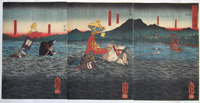
 Click here to view image full size. Takatsuna’s greatest exploit: Shown here ( centre ) swimming with his horse across the swollen Uji River to attack Kiso no Yoshinaka. His rival Kagesuye ( left ) and Shigetada further off to the right. Published by Yenshu-ya Hikobei 1849. A wonderful design. Robinson T217. Superb impression. Very fine colour and condition. Signed Ichiyusai Kuniyoshi ga. Status: Sold

Utagawa KUNIYOSHI (1797 – 1861)

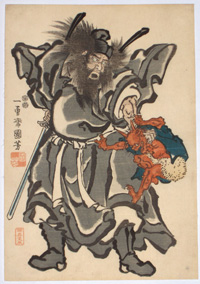
 Click here to view image full size. Shoki, “The Demon Quellor.” The ghostly Chinese protector of the Emperor Ming Hwang. A favourite subject for the Japanese, he is usually shown beating off annoying oni. He is always depicted dressed in Chinese military attire with the characteristic Chinese hat with side streamers and holding a two-edged sword. Illustrated on the cover of Utagawa Kuniyoshi. An exhibition of the work of Utagawa Kuniyoshi based on the Bidwell Collection, Springfield Museum of Fine Arts, 1980, no. 164. Kuniyoshi designed two other Shoki oban prints. All are rare. Published by Kinshodo, c. 1848 – 53. Ex collection Felix Fricke, seal au verso. Very good condition. The background is blind printed to imitate partially creped paper. Signed Ichiyusai Kuniyoshi. Status: Sold