Utagawa HIROSHIGE (1797-1858)

Click here to view image full size. An uncut fan print from a set of views of Ise: Ise meisho, Asakumayama toge no chamise, “Teahouses on the Mount Asakuma Pass, Famous Places of Ise Province.” Hiroshige used this same view about a decade later for no.7 from the set The Sixty-odd Provinces. He cleverly uses the cliff sides to wrap around the uchiwa-e shape. Published c.1840. Extremely rare: This actual impression illustrated in Hiroshige no uchiwa-e, Unsodo, 2010, p.78, pl.108. Ex collection Maroni with seal at bottom. (His collection was sold at public auction at Kende Galleries, N.Y. 1947-9.)     Fine impression and colour. Centre fold (as often), otherwise very good condition. Signed Hiroshige ga.     Status: Sold

Utagawa HIROSHIGE (1797-1858)

Click here to view image full size. An uncut fan print. Moon from a setsugekka set of famous views of Edo. Shows the interior of a teahouse. Published 1849-53 by Ibaya Sensaburo.     Very good impression and colour. Restored centre bottom and other minor imperfections, but otherwise good condition. Signed Hiroshige ga. Very rare: Seemingly only two other impressions extant.     Status: Sold    

Utagawa HIROSHIGE (1797-1858)

Click here to view image full size. A tanzaku showing a rooster and hydrangea. Published by Kawaguchi Shozo, c. 1830s. Another impression is illustrated in Four Hundred Ukiyoe Woodblock Prints From The Museum Of Art, Rhode Island School Of Design, 1990, no. 121, p. 54. Hiroshige is best known for his landscapes, but he produced almost as many bird and flower prints.    Very good impression, colour and condition. Signed Hiroshige hitsu.    Status: Sold

Utagawa HIROSHIGE (1797-1858)

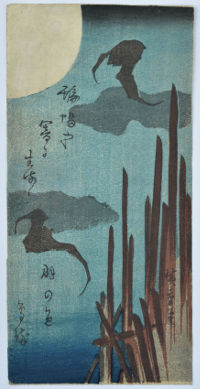
Click here to view image full size. A small tanzaku showing bats flying against a full moon above a lumberyard. A poem reads: “The colour of the bats’ wings was born in darkness.” Published c. late 1830s. Rare: Another impression is illustrated in Japanese Prints IV – Hiroshige and the Utagawa school, the Rijksmuseum, 1984, 46 61:35, p. 35.     Very good impression, colour and condition. Signed Hiroshige hitsu.     Status: Sold

Utagawa HIROSHIGE (1797-1858)

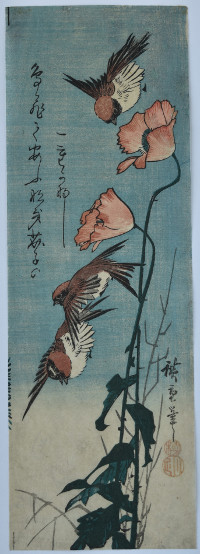
Click here to view image full size. A chu-tanzaku showing sparrows and poppies. Published by Kawaguchiya Shozo, c. late 1830s. A poem: Tori tonde (tobite) / abunaki keshi no / hitoe kana, “ A bird flying by / poses danger to poppies / with single layers of petals.” The same poem is used on another chu-tanzaku showing a bluebird and poppies, see MET Museum, JP2532. Other impressions of this print are in Honolulu Museum of Art, 18009; MFA, Boston, 21.8018; Chazen, University of Wisconsin-Madison, 1980.1887.     Very good impression and colour. Very small expertly restored wormholes, otherwise very good condition. Signed Hiroshige hitsu.     Status: Sold

Utagawa HIROSHIGE (1797-1858)

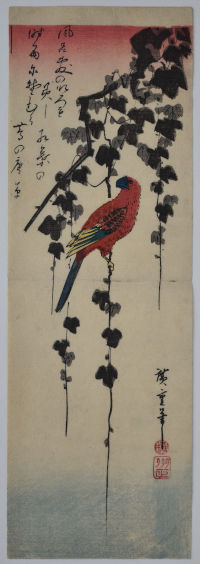
Click here to view image full size. A tanzaku showing a parrot perched on hanging ivy. Published c 1830s by Kawasho (Kawaguchi Shozo).     Fine impression and colour. Centre fold, otherwise very good condition. Signed Hiroshige hitsu.     Status: Sold    

Utagawa HIROSHIGE (1797-1858)

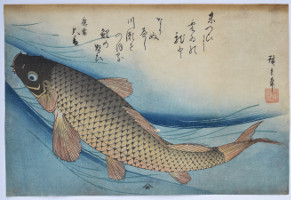
Click here to view image full size. A koi, carp (Cyprinus carpio) swimming amongst reeds. Poem by Makuzu. From the second series of ten fish prints published by Yamasho, c. 1840-42. The first series was issued privately for a poetry group (probably the Shingyoku Circle) with judges’ names and with extra poems. These prints are of the utmost rarity as probably only enough for the Circle were made and they never come onto the market. Due to their popularity this second set was commissioned. This is the very rare first edition with the reeds printed. Block defect showing but with gradation still on belly of fish. One of the finest designs from the two series. Very rare. Kruml 12a     Fine impression. Slight fading and edge soil, otherwise very good condition. Without centre fold (in itself rare as they often have them). Signed Hiroshige hitsu.     Status: Sold

Utagawa HIROSHIGE (1797-1858)

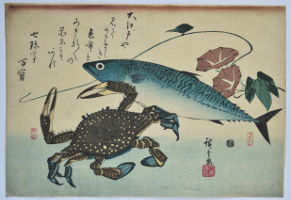
Click here to view image full size. A kami, crab (Charybois), and saba, mackerel (Scomber Japonicus), together with two flowers of morning glory. Poem by Shichichintei. This is the first edition (Kruml 19a). From the second series of ten fish prints published by Yamasho, c. 1840-42. The first series was issued privately for a poetry group (probably the Shingyoku Circle) with judges’ names and with extra poems. These prints are of the utmost rarity as probably only enough for the Circle were made and they never come onto the market. Due to their popularity this second set was commissioned.     Fine impression, colour and condition. Signed Hiroshige ga.     Status: Sold

Utagawa HIROSHIGE (1797-1858)

Click here to view image full size. Kozuke, Harunasan setchu, “Kozuke [Province], Mount Haruna Under Snow.” From a set of 69 prints [Dai Nihon] Rokujuyoshi meisho zue, “Famous Places in the Sixty-odd Provinces [of Japan]” published by Koshihei between 1853 and 1856, this being 1853. A red bridge spans a gorge with precipitous cliffs and a fast flowing river. Fantastic crags point upwards into the sky. In the distance is Mount Haruna – a sleeping volcano.   Very fine impression and colour. Light album backing, otherwise fine condition. Signed Hiroshige ga.   Status: Sold  

Utagawa HIROSHIGE (1826-1869)

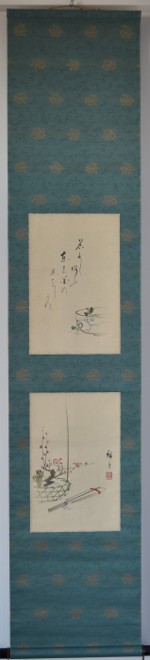
Click here to view image full size. Click here to view image full size. A pair of original kakejiku with two paintings on each. Possibly from the front and back cover pages of a first edition “One Hundred Famous Views of Edo” set. Sumi and colour, image size of each painting 13.5 x 8.75 in; 34.25 x 22 cms. Shows top left a bowl with – possibly – turnips and a poem. Below a wicker basket and bowl with a miniature plum tree and an adonis plant (the most popular plants for the New Year). On the right, at the top are two chidori with poem and below a sake barrel and a plum branch. The bottom two paintings are signed Hiroshige with Ichiryusai seal. In fact, there is another version of the chidori painting associated with a painting of a kago and lantern illustrated in the exhibition catalogue, Hiroshige – A Poetic Ukiyo-e Artist, Fukushima Minpo, 1971, no. 16. These are also possibly from the ends of a first edition set of prints. Hiroshige and Hiroshige II were known to make these paintings, presumably for special clients. Provenance: Ex Takeoka Toyota collection (1844-1931). The box dated (Taisho 11, 1922) and guaranteed by him. He was a famous collector from the Meiji to early Showa era. Paintings and mounts in very good condition.     Status: Sold     Click here to view image full size. Click here to view image full size. Click here to view image full size.

Utagawa HIROSHIGE (1797-1858)

Click here to view image full size. An original painting in sumi with touches of green and pale blue. Image size 50 x 17 in; 127 x 43.2 cms on paper. Shows the Mount Haruna area which also has Mount Myogi and Mount Akagi. Depicts the strange peaks surrounded by swirling mist and cloud. The region was formed more than 300,000 years ago in Gunma, eastern Honshu. Hiroshige designed a snow scene of the same area for the print set Sixty-odd Provinces of Japan published in 1853. Recently remounted and in very good condition. Signed Hiroshige ga with Ichiryusai seal.     Status: Sold     Click here to view image full size.

Utagawa HIROSHIGE (1797-1858)

Click here to view image full size. An original painting, sumi and light colour on paper, 34.25 x 11.5 in; 87 x 29 cm. Shows a seated courtesan, her summer robe with a water wheel and wave motif. A beautiful poem above which has been translated by Joel Earle:   TITLE The title of the painting is 蓴 (jun, nunawa), the aquatic plant Brasenia schreberi, commonly known as watershield. TRANSCRIPTION 中々尓夢路耳河者ゝ袖飛きてい者まほし幾尓あ那ら聲尓天 Naka naka ni / yumeji ni kawamono wa / sode hikite / iwama hoshiki ni / anara koe nite TRANSLATION Ah, how vexing! In the path of dreams where I travel towards you, you draw near like a flowing river and tug at my sleeve. I long to speak—but your alluring voice leaves me breathless. COMMENTARY Title The painting’s title, nunawa, is a metaphor for a courtesan, kawaramono who inhabits in the Floating World of Water, referring to the lively, impermanent realm of riverside quarters, performers, and night-time entertainment. Text 中々に naka naka ni. Conveys a sense of frustration, of “things not going as one wishes”, especially in love. 夢路に yumeji ni. “On the path of dreams”. Not just “in a dream” but on the classical path in which one travels to meet a beloved in dreams, and by extension, the road to the pleasure quarters. 河者ゝ kawamono ya. This term is tricky and layered. It literally evokes a river’s flow, something that comes toward you, but in Edo usage, 河者 kawamono or 河原者 kawaramono could be a derogatory term for performers, kabuki actors, entertainers, etc.—people who “flow in and out” of the pleasure world. 袖ひきて sode hikite. A classic gesture: pulling the sleeve to invite or entice. 言はまほしきに iwama hoshiki ni. A clear wish or desire: “I want to speak (to you)”. あなら聲にて anara koe nite. A seductive,…

Utagawa HIROSHIGE (1797-1858)

Click here to view image full size. An important pair of original paintings, light colour on silk, 35.5 x 12.75 in; 90 x 32.5 cms. The left painting shows Asukayama in the Eastern Capital (Edo). This was one of the top areas to view the abundant cherry trees, the first of which were planted by the Shogun Tokugawa Yoshimune. A fir tree is seen to the left with cherry trees on the lower slope and a majestic Fuji in the distance. A large foreground object, often only partly shown, is a characteristic of many Hiroshige paintings and prints: They lead the eye into a composition and give perspective. The right-hand painting shows the Sumida River in the Eastern Capital (Edo) with a flowering cherry tree in the foreground. (See the comment above.) The sakura flowers from the end of March to early May and the sakura-zensen, blossom forecast, by the weather forecasters is watched assiduously as the blossom is so transient.   Each painting signed Ryusai with Hiroshige seal. Hiroshige produced a number of paintings in this format with this signature and seal, c. early 1850s. In good condition.   Status: Sold   Click here to view image full size. Click here to view image full size.

Utagawa HIROSHIGE (1797-1858)

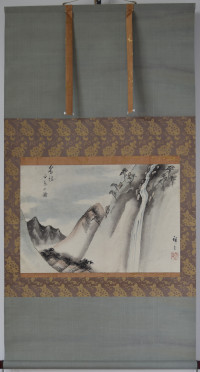
Click here to view image full size. An original painting, sumi and light colour on paper, image size 13.5 x 20 in; 34.3 x 50.8 cms. Shows the Shiraito no Taki waterfall at Hakone. The water, originating from Mount Fuji, flows over the edge of a 20 meter high cliff in thin white streams reminiscent of silk threads (hence the name Shiraito). Sold with the lid of a previous box which has a guarantee by Kazuo Inoue (a well known expert on Ukiyo-e [1889-1946] dated 1943 which gives the painting as having been done 1845-1848). In very good condition. Signed Hiroshige with Ichiryusai seal.   Status: Sold   Click here to view image full size. Click here to view image full size.

Utagawa HIROSHIGE (1797-1858)

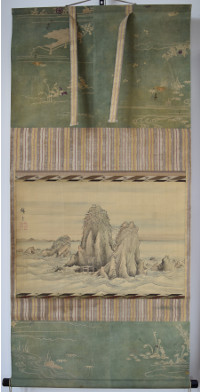
Click here to view image full size. An original painting, sumi and light colour on silk, 13.5 x 20.5 in; 34.5 x 52 cms. Shows the renowned Husband and Wife rocks, Meoto Iwa, “Married Couple Stones,” off Futami, Mie, Japan. At this time – c. late 1840s – many thin ropes were used to tie the couple together. They are now joined by a single large shimenawa – a rope of rice straw. The larger (male) rock called Izanagi has a small torii at the top. The smaller (female) rock is called Izanami. They are sacred to the Shinto religion and worshippers flock to the neighbouring Futami Okitama Shrine, which is dedicated to the food goddess Miketsu. The ancient Shinto custom of worshipping stones is called Iwakura. A fine Hiroshige painting.     Signed Hiroshige ga with large Ichiryusai seal. In good condition with interesting old mount.     Status: Sold     Click here to view image full size.

Utagawa HIROSHIGE (1797-1858)

Click here to view image full size. An original drawing, being a preparatory sketch for a painting, sumi and red under-drawing on paper, mounted as a kakemono. Image size 10.5 x 13 in; 26.5 x 33 cms. An unusual view of the Husband and Wife rocks, Meoto Iwa, “Married Couple Stones,” off Futami, Mie, Japan. They are sacred to the Shinto religion and worshippers flock to the neighbouring Futami Okitama Shrine, which is dedicated to the food goddess Miketsu. In this drawing the emphasis is on the worshippers and travellers seen here in the centre and right.     In very good condition. A spurious signature and seal bottom right. There are others drawings with the same signature and seal on otherwise perfectly genuine works.     Status: Sold     Click here to view image full size.

Utagawa HIROSHIGE (1797-1858)

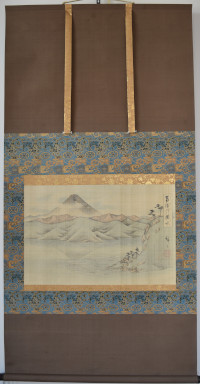
Click here to view image full size. An original painting, sumi and light colour on silk, 14.5 x 22 in; 36.8 x 55.9 cms. Labelled on the right Hakone no kosui, “The Lake of Hakone.” Shows the reflection of Fuji in Lake Kawaguchi with the Misaka mountain range. A similar view could be seen from Lake Ashi. Hokusai produced a version for for the Thirty-six Views of Fuji set and this area was the subject of a number of Hiroshige prints. Signed Hiroshige with Ichiryusai seal. In very good condition.   Status: Sold   Click here to view image full size.

Utagawa HIROSHIGE (1797-1858)

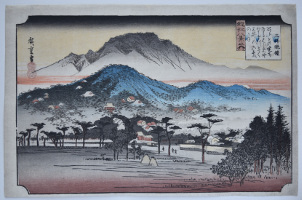
Click here to view image full size. Mii no bansho, “Evening Bell at Miidera Temple” from a set Omi hakkei no uchi, “Eight Views in Omi [Province].” Shows the temple hidden amongst hills on the southern side of Lake Biwa. Miidera is the common name for the Onjoji, a temple of the Tendai sect founded in 858. Published by Hoeido and Eikyudo in c. 1834-5. The “Eight Views” theme was derived (as so much else in Japanese art) from China and based on the Eight Views of Xiaoxiang paintings of the 11th century. The subject was transposed to Omi and then taken up by such artists as Harunobu, and later Hiroshige. It was often playfully alluded to in sets of eight prints in mitate-e style.     Very good impression, colour and condition, Signed Hiroshige ga.     Status: Sold

Utagawa HIROSHIGE (1797-1858)

Click here to view image full size. Mimasaka, Yamabushidani, “Mimasaka [Province], Yamabushi Valley.”A high wind and rain in the valley with a man on a raft on the Yoshi River. Other figures in the foreground, one having lost his hat. From a set of 69 prints [Dai Nihon] Rokujuyoshi meisho zue, “Famous Places in the Sixty-odd Provinces [of Japan]” published by Koshimuraya Heisuke between 1853 and 1856, this being 1853.   Fine, early impression. Fine colour and condition with large margins. Signed Hiroshige ga.   Status: Sold    

Utagawa HIROSHIGE (1797-1858)

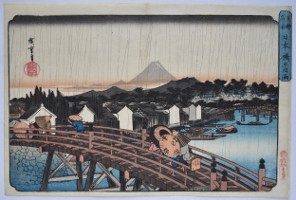
Click here to view image full size. Nihonbashi no hakuu, “Light Rain on Nihon Bridge.” From a Toto meisho set of 21 designs published between c. 1832 and 1839 by Kikakudo. The set was subsequently enlarged. Shows figures crossing Nihonbashi in rain, one figure carries an umbrella with the publisher’s name. Warehouses in the background and a distant view of Fuji. A beautiful print and very difficult to find in early impression: The title cartouche had a plug inserted beside the bottom three characters of the title on the left. This damage seems to have occurred when the block was cut and over time the spigot gradually slipped out leaving an unprinted area (which is sometimes painted in). In the earliest impressions the plug is hardly visible (as here). Also, the publisher’s seal at the bottom right should be in red, later editions having it in black. There was also an early variant edition with a yellow sky.     Fine impression and colour. Imperceptible centre fold, also near the right edge, otherwise very good condition. Signed Hiroshige ga.     Status: Sold    

Utagawa HIROSHIGE (1797-1858)

Click here to view image full size. Station Fukushima from Kisokaido rokujukyutsugi no uchi, “Sixty-nine Stations of the Kisokaido.” The set of seventy prints was started by Eisen and published by Hoeido in 1835, but in 1837 Hiroshige took over and completed the series with the publisher Iseya Rihei (Kinjudo). Fukushima was one of the four most important checkpoints in the country and travellers had to have their documents inspected and approved before they could continue. Superb impression. Very fine colour. Fine condition. Signed Hiroshige ga. Status: Sold

Utagawa HIROSHIGE (1797-1858)

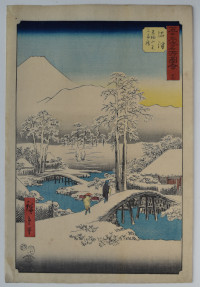
Click here to view image full size. Numazu Ashigarayama Fuji no yukibare, “Numazu: Mount Fuji and Mount Ashigara after Snow” from Gojusan tsugi meisho zue, “Famous Places on the Fifty-three Stations.” The so-called “Upright Tokaido.” Shows two travellers crossing a trestle bridge over the Kise River before entering Numazu village seen on the left. Mount Fuji in the distance. Published by Kichizo (Koeido Tsutaya), 1855. There are many late editions of this set with the skies on the two snow scenes printed black. A fine snow design.   Fine, early impression. Fine colour. Small thinned area bottom left margin and one pinhole, otherwise fine condition. Full margins. Signed Hiroshige ga.   Status: Sold    

Utagawa HIROSHIGE (1797-1858)

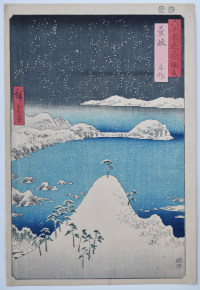
Click here to view image full size. Iki Shisaku, “Shisaku in Iki [Province]” from a set of 69 prints [Dai Nihon] Rokujuyoshi meisho zue, “Famous Places in the Sixty-odd Provinces [of Japan]” published by Koshihei between 1853 and 1856, this being 1856. A heavy snowfall over Iki island which lies to the northeast of the Kyushu coast in southern Japan.   Very fine impression and colour. Light album backing, otherwise fine condition. Signed Hiroshige ga.   Status: Sold  

Utagawa HIROSHIGE (1797-1858)

Click here to view image full size. Kai, Saruhashi, “Kai [Province], Monkey Bridge” from a set of 69 prints [Dai Nihon] Rokujuyoshi meisho zue, “Famous Places in the Sixty-odd Provinces [of Japan]” published by Koshihei between 1853 and 1856, this being 1853. The bridge spans the Katsura River and is an example of the hanebashi method of construction whereby cantilever beams are set in the opposing cliff faces. Called the Monkey Bridge because monkeys are originally supposed to have strung themselves across the gorge.   Very fine impression and colour. Light album backing, otherwise fine condition. Signed Hiroshige ga.   Status: Sold  

Utagawa HIROSHIGE (1797-1858)

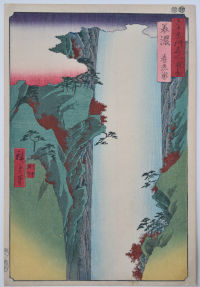
Click here to view image full size. Mino, Yoro no taki, “Mino [Province], Yoro Waterfall” from a set of 69 prints [Dai Nihon] Rokujuyoshi meisho zue, “Famous Places in the Sixty-odd Provinces [of Japan]” published by Koshihei between 1853 and 1856, this being 1853. The 32 metre fall is 4 metres wide and is located in Yoro Park, near Nagoya. Very fine impression and colour with blind-printing on the fall. Light album backing, otherwise fine condition. Signed Hiroshige ga. Status: Sold

Utagawa HIROSHIGE (1797-1858)

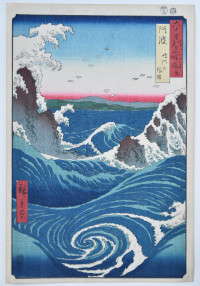
Click here to view image full size. Awa, Naruto no fuha, Naruto Whirlpools, Awa [Province]” from a set of 69 prints [Dai Nihon] Rokujuyoshi meisho zue, “Famous Places in the Sixty-odd Provinces [of Japan]” published by Koshihei between 1853 and 1856, this being 1855. The finest print from the set and one of Hiroshige’s most important designs. The phenomenon is caused by the tides that move large amounts of water through the Naruto Strait into and out of the Inland Sea.   Very fine impression and colour. Light album backing, otherwise fine condition. Signed Hiroshige ga.   Status: Sold  

Utagawa HIROSHIGE (1797-1858)

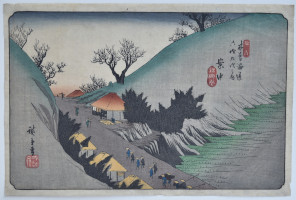
Click here to view image full size. Station Annaka from Kisokaido rokujukyutsugi no uchi, “Sixty-Nine Stations of the Kisokaido.” Published by Kinjudo, the set was started by Eisen in 1835 who designed twenty-four prints before Hiroshige replaced him and completed the set before 1843. Shows the entourage of a feudal lord progressing along the road between rest houses.   Very fine impression of the earliest printing. Fine colour and condition. Signed Hiroshige ga.   Status: Sold  

Utagawa HIROSHIGE (1797-1858)

Click here to view image full size. Hida, kago-watashi, “Basket Ropeway in Hida [Province]” from a set of 69 prints [Dai Nihon] Rokujuyoshi meisho zue, “Famous Places in the Sixty-odd Provinces [of Japan]” published by Koshihei between 1853 and 1856, this being 1853. Originating in China, Japan and northern India, travellers could cross deep ravines by suspending themselves in a harness which evolved into a basket. Very fine impression and colour. Light album backing, otherwise fine condition. Signed Hiroshige ga. Status: Sold

Utagawa HIROSHIGE (1797-1858)

Click here to view image full size. A snow scene from a set Edo komei kaitei zukushi, “Famous Teahouses of Edo,” Kameido uramon, Tamaya, “Back Gate of the Shrine at Kameido: The Tamaya Teahouse.” The set published by Shogendo, 1838-40. Very fine impression. Fine colour. Slight centre fold (strengthened au verso), otherwise very good condition. Signed Hiroshige ga. Status: Sold

Utagawa HIROSHIGE (1797-1858)

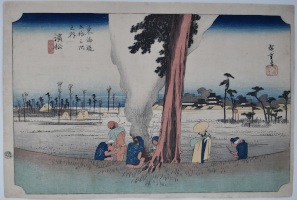
Click here to view image full size. Station Hamamatsu from Tokaido gojusan-tsugi no uchi, “Fifty-three Stations of the Tokaido.” This seminal work was possible because Hiroshige was asked to accompany an official procession along the Tokaido Road from Edo to Kyoto in 1832, and he made numerous sketches to document the journey. A winter scene with farmers warming themselves around a fire. Hamamatsu Castle in the distance. Because of the set’s popularity, it was reprinted many times and there are a plethora of late impressions. Early printings are hard to find. Published by Hoeido (Takenouchi Magohachi) and Tsuruya Kiemon (Senkakudo) 1833-34.   Fine, early impression. Fine colour and condition. Signed Hiroshige ga.   Status: Sold