Tsukioka YOSHITOSHI (1839-1892)

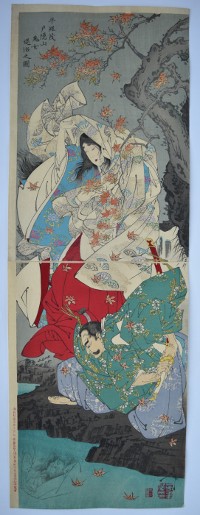
Click here to view image full size. A vertical diptych showing Taira no Koremochi discovering that a princess is, in reality, a demon. Taira Koremochi Togakushiyama kijo taiji no zu. The story relates how, while maple viewing on Mt. Togakushi in Shinano, Taira no Koremochi comes across a princess and her attendants. He joins them eating and drinking and finally falls into a deep sleep. He dreams that the princess is in fact a kijo (a young woman turned into an oni) and that she is intent on killing him. He awakes to see her true appearance reflected in the water of a nearby stream and kills her. Published by Matsui Eikichi, 1887. It was republished later by Hasegawa.     Very fine impression and colour. Perfect condition with ample room for joining of two sheets and full margin on left and top – which these designs must have. Signed Oju Yoshitoshi.     Status: Sold    
Tsukioka YOSHITOSHI (1839-1892)

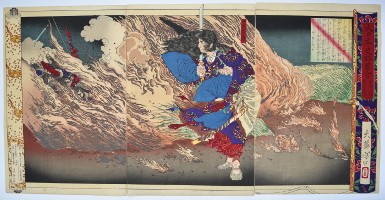
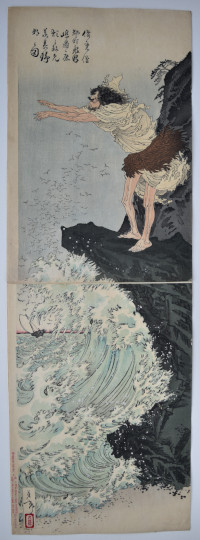
Click here to view image full size. A triptych from a set of ten: Dai Nippon shiryaku zue, “Short Illustrated History of Great Japan.” Each print is in the form of an unrolled makimono. This design shows the third son of the twelfth century Emperor Keiko, Yamato Takeru no mikoto (Wo-usu). His father was constantly sending him on dangerous missions making him suspect that he wished his death. One such journey was to the Emishi in northeast Japan. On complaining about this to his high-priestess aunt, Yamato-hime, she gave him the famous sword Ame no murakumo no hoken to aid him. On his arrival, the ruler of the Emishi lured him onto open grassland which he set on fire. Wo-usu used his sword to cut the grass, evade death, and start new fires to kill his enemy. Published by Kobayashi 1880. A fine design.     Fine impression of first edition. Fine colour. Slight album backing, otherwise very good condition. Signed Taiso Yoshitoshi.     Status: Sold    
Tsukioka YOSHITOSHI (1839-1892)

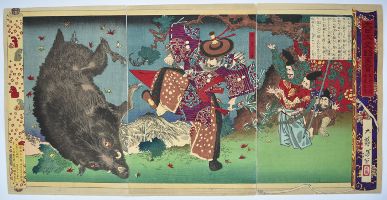
Click here to view image full size. A triptych from a set of ten: Dai Nippon shiryaku zue, “Short Illustrated History of Great Japan.” Each print is in the form of an unrolled makimono. This design shows the twenty-first Emperor Yuryaku-Tenno (457-479) out following his favourite diversion – hunting. The story relates how during 461 on Mount Katsuragi a large boar attacked him. He ordered his aid to shoot it but the man ran away, whereupon the Emperor kicked the boar onto its back and killed it. Published by Tsunashima 1879.     Fine impression of first edition. Fine colour. Slight album backing, otherwise very good condition. Signed Taiso Yoshitoshi.     Status: Sold    
Tsukioka YOSHITOSHI (1839-1892)

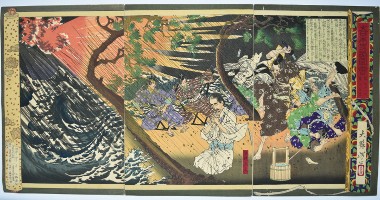
Click here to view image full size. A triptych from a set of ten: Dai Nippon shiryaku zue, “Short Illustrated History of Great Japan.” Each print is in the form of an unrolled makimono. This design shows the attempted execution of Nichiren during the reign of the ninetieth Emperor Kameyama (1249-1305). Details vary but essentially the attempt was made on the beach at Tatsunokuchi, Kamakura in 9 As the party were passing the shrine of the god Hachiman, Nichiren gave vent to his anger at being unprotected and called on various Buddhist deities. A luminous object shot across the sky and a fierce wind materialized. The soldiers fell to the ground and called off the execution. Published by Morimoto 1879. A fine design.     Fine impression of first edition. Fine colour. Slight album backing, otherwise very good condition. Signed Taiso Yoshitoshi.     Status: Sold    
Tsukioka YOSHITOSHI (1839-1892)

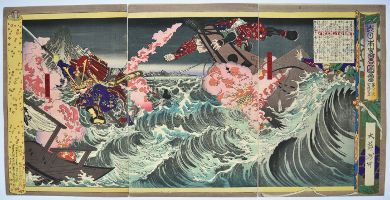
Click here to view image full size. A triptych from a set of ten: Dai Nippon shiryaku zue, “Short Illustrated History of Great Japan.” Each print is in the form of an unrolled makimono. This design shows the great battle of Dannoura in the Shimonoseki Strait off the southern tip of Honshu on April 25th, 1185. The engagement took place in the reign of the Emperor Antoku (who drowned in the battle, 1178-1185). The protagonists were the Minamoto clan (Genji) led by Minamoto no Yoshitsune and the Taira clan (Heike). The episode shown here is where Yoshitsune escapes the Heike general Noto no kami Noritsune by making the eight-boat leap. Published by Morimoto 1880.     Fine impression of first edition. Fine colour. Slight album backing, otherwise very good condition. Signed Taiso Yoshitoshi.     Status: Sold    
Tsukioka YOSHITOSHI (1839-1892)

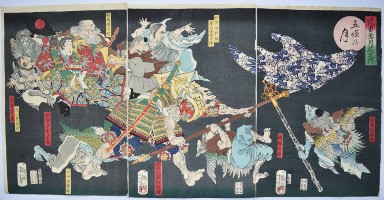
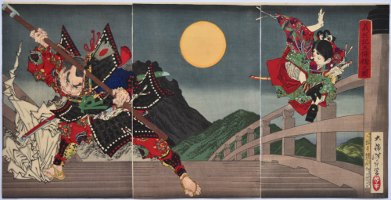
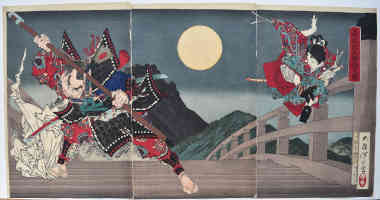
Click here to view image full size. A triptych from a set Buyu setsugekka, “Heroes for the Snow, Moon and Flowers,” this being Gojo no tsuki, “Moon Over Gojo [Bridge].” Published by Isaya Kanekichi c 1867. A popular subject for artists it tells of the battle between the young Yoshitsune and the warrior monk Benkei who had secured the bridge and fought each samurai wanting to cross in order to steal their sword. The 1000th was Yoshitsune who defeats Benkei and secures his loyalty for the ensuing years. Yoshitsune was taught martial arts by tengu in the forests outside Kyoto as a child and they are seen here aiding and abetting him in his duel.     Fine impression, colour and condition. Full size with added mica at top. Signed Ikkaisai Yoshitoshi hitsu.     Status: Sold    

Tsukioka YOSHITOSHI (1839-1892)

 Click here to view image full size. One of Yoshitoshi’s finest designs: Gikeiki Gojobashi no zu. The fight between Ushiwaka and Benkei on Gojo Bridge, Kyoto. The story relates how Benkei only needs one more blade to add to the 999 he has wrenched from samurai attempting to cross the bridge in order to fashion an invincible weapon. Benkei loses the fight and becomes Yoshitsune’s loyal retainer. Published 1881 by Morimoto Junzaburo.   Fine impression and colour. Very slight trimming, otherwise fine condition. Signed Taiso Yoshitoshi ga.   Status: Sold  

Tsukioka YOSHITOSHI (1839-1892)

Click here to view image full size. A diptych showing the Buddhist priest Dainin about to kill the girl Umegae. Daininbo Umegae o satsugai no zu, “Picture of the Priest Dainin Killing the Girl Umegae.” From a set of prints Shinsen azuma nishiki-e, “New Selection of Eastern Brocade Pictures.” The priest momentarily looks up at a passing cuckoo. The set published by Tsunashima Kamekichi between 1885 and 1889, this being 1886.     Very fine impression of the first edition. Fine colour and condition. Signed Yoshitoshi.     Status: Sold
Tsukioka YOSHITOSHI (1839-1892)

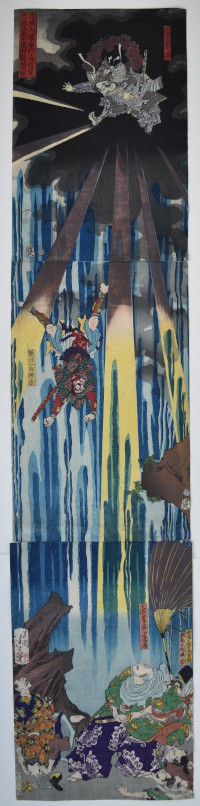
Click here to view image full size. A vertical triptych showing Taira no Kiyomori (1118-1181) watching Akugenta Yoshihira (“Wicked Genta of Kamakura”) (1140-1160) become the Thunder God and strike Namba no Jiro (1141-1160) down with a thunderbolt. An exceptional design of a subject that produced some excellent interpretations by Kuniyoshi and his pupils. Kiyomori nyudo Nunobiki no taki yuran Akugenta Yoshihira no rei Namba Jiro o utsu. The story originates from the Heiji Monogatari and relates how Minamoto no Yoshihira was defeated in the Heiji Rebellion of 1160 and decapitated by Namba no Saburo Tsunefusa, a retainer of Taira no Kiyomori. He pledges to return and kill Namba with a thunderbolt which he succeeds in doing in 1168 at the Nunobiki Waterfall. There is an alternative version of events that gives the decapitation and subsequent revenge killing as all taking place at the Nunobiki Waterfall. Published by Kinkyo (Omiya Kyujiro) in 1868. Of the utmost rarity: There might have been impressions circulating privately, but I have never seen an example for sale since I started dealing: Perhaps few impressions were printed, but the vertical triptych format is not conducive to it surviving intact. Another impression is in the MET, acc. no. 2007.49.307a-c. Possibly Yoshitoshi’s masterpiece.   Fine impression and colour. Some slight trimming. Oxidation and minor horizontal crease at bottom of centre sheet evident au verso, but otherwise in very good condition. Signed Tsukioka Yoshitoshi hitsu.   Status: Sold  

Tsukioka YOSHITOSHI (1839-1892)

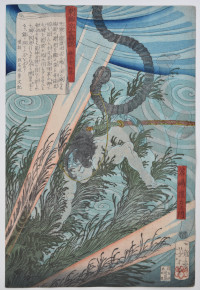
Click here to view image full size. Shows Wakashima Gonemon diving into a whirlpool in an attempt to fasten a rope to the old dragon-headed temple bell and haul it up from the bed of the Sumida River. The story relates how the Dragon King thwarted his attempt by cutting the rope. From a set Azuma nishiki Ukiyo Kodan, “Rough Tales of the Floating World Told on Eastern Brocades.” Kodan (traditional storytelling) raconteurs narrated Japanese folk stories, sometimes accompanying themselves with wooden blocks clapped together or a fan giving rhythm. Having been popular from around 1700 (and known as Koshaku), these performances gained renewed popularity in the 1850s with the classic standards augmented by contemporary stories of heroes and vigilantes. Here, the storyteller Hogyusha Torin, narrates a story by Kanagaki Robun, the text seen in the open book top left. The best design from the set. Published by seven different publishers (here: Masudaya Ginjiro) between 1867-1868 (here: 1867).   Fine impression, colour and condition. Signed Ikkaisai Yoshitoshi hitsu.   Status: Sold  

Tsukioka YOSHITOSHI (1839-1892)

 Click here to view image full size. The ronin Okuda Sadaemon Fujiwara Yukitaka ( number 42 ) from Seichu gishinden, “Tales of True Loyalty.” From a rare uncompleted set of the 47 Ronin published 6/1868 by Masudaya. Thirteen designs extant. It has been suggested that the set was completed but that the others are not known based on the fact that two of the prints are numbered 3 and 46. An error as artists did not commence and progress from number 1. Artists chose at random which numbers from a set to start with. Well known examples being Hiroshige’s Tokaido and Kisokaido. Very good impression and colour. Light album backing. Signed Ikkaisai Yoshitoshi hitsu. Status: Sold

Tsukioka YOSHITOSHI (1839-1892)

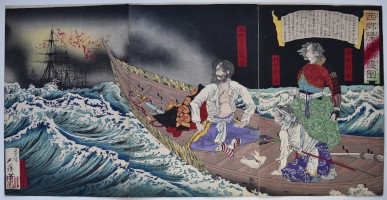
Click here to view image full size. A triptych showing Saigo Takamori about to commit seppuku in a boat. Next to him are Murata Shinhachito and Kirino Yoshiaki. Saigo Takamori seppuku no zu. The “last true samurai,” he was instrumental in overthrowing the Tokugawa Shogunate. However, he had a falling out with the new Meiji government and returned to his native Satsuma in 1877 and led the so-called Satsuma Rebellion. This failed after seven months and the three in the boat were the last survivors of the rebellion. Published by Okura Magohei, 1877. Very fine impression. Fine colour. Original album backing, otherwise good condition. Signed Oju Taiso Yoshitoshi. Status: Sold

Tsukioka YOSHITOSHI (1839-1892)

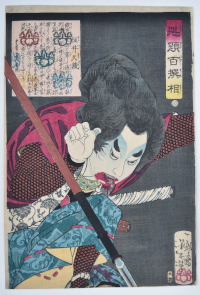
Click here to view image full size. The boy warrior Sakai Kuzo hurling a te-yari spear from a set Kaidai hyaku senso “Yoshitoshi’s Selection of One Hundred Warriors.” Sixty-five prints published by Ohashiya Yashichi (Odawaraya Yashichi) between 1868 and 1869, this being 1868. The text in the square cartouche in this set refers to prominent warriors in the internecine wars of the 16th century, but in fact the subjects are Shogitai soldiers (those that held out against the Imperial forces and were massacred at Ueno, 4/7/1868). An excellent set.   Fine impression, colour and condition. Signed Ikkaisai Yoshitoshi hitsu.   Status: Sold  

Tsukioka YOSHITOSHI (1839-1892)

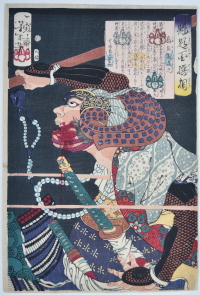
Click here to view image full size. Shows Shima Sakon Tomoyuki at the battle of Sekigahara, October 21, 1600. Shima was a commander of Ishida no Mitsunari’s forces against Tokugawa Ieyasu and was shot by riflemen (although his body was not found). He is shown being hit by a hail of bullets, his juzo (rosary) swinging in the air. From a set Kaidai hyaku senso “Yoshitoshi’s Selection of One Hundred Warriors.” Sixty-five prints published by Ohashiya Yashichi (Odawaraya Yashichi) between 1868 and 1869, this being 1868. The text in the square cartouche in this set refers to prominent warriors in the internecine wars of the 16th century, but in fact the subjects are Shogitai soldiers (those that held out against the Imperial forces and were massacred at Ueno, 4/7/1868). An excellent set.   Fine impression, colour and condition. Signed Ikkaisai Yoshitoshi hitsu.   Status: Sold    

Tsukioka YOSHITOSHI (1839-1892)

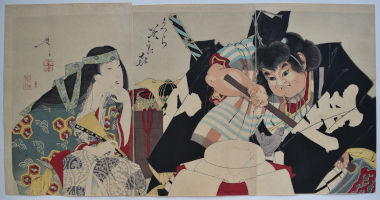
Click here to view image full size. A triptych showing Yamauba on the left and Kintaro about to wield a large axe to break a large Kaga mimochi, mirror rice cake. This is a traditional Shinto rite in January. January 11th is also the day the wealthy opened their storehouses to air their precious possessions (Kurabiraki). Published by Akiyama Buemon 1891.    Very fine impression with extensive burnishing. Fine colour and condition. Signed Yoshitoshi.    Status: Sold
Tsukioka YOSHITOSHI (1839-1892)

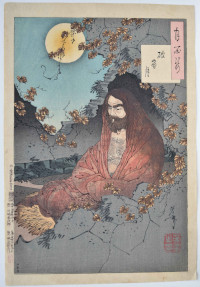
Click here to view image full size. Haso no tsuki, “Moon Through a Crumbling Window” from the set Tsuki hyakushi, the “Hundred Phases of the Moon.” The set published between 1885 and 1892 (this being 1886) by Akiyama Buemon. Shows Bodhidharma (Jap: Daruma), founder of Zen Buddhism, meditating in a cave for nine years after being refused entry to the Shaolin Monastery. He cut off his eyelids in anger after falling asleep two years into the meditation, and tea plants grew where they fell.   Fine impression with strong woodgrain showing in the sky and wall. The set was popular and many editions were printed and many late impressions exist. Great care was taken with the cutting of the blocks on this set and only early impressions do them justice. Fine colour and condition. An impression that has not been in an album. Full margins. Signed Yoshitoshi.   Status: Sold  
Tsukioka YOSHITOSHI (1839-1892)

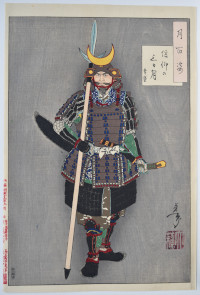
Click here to view image full size. Faith in the Third-day Moon from the set Tsuki hyakushi, the “Hundred Phases of the Moon.” The set published between 1885 and 1892 (this being 1886) by Akiyama Buemon. Shows the standing figure of the samurai Yamanaka Shikanosuke Yukimori. The moon appears both as a half crescent on his helmet, and also on his kamayari, “sickle spear.” The crescent moon was considered a lucky emblem (mikazuki) and Yukimori believed it would bring him good luck in battle   Very fine impression of the earliest printing with beautiful gradation around the figure – often missing on late editions. The set was popular and many editions were printed and many late impressions exist. Great care was taken with the cutting of the blocks on this set and only early impressions do them justice. Fine colour. Light backing and slight trimming at left, otherwise fine condition. Signed Yoshitoshi.   Status: Sold  
Tsukioka YOSHITOSHI (1839-1892)

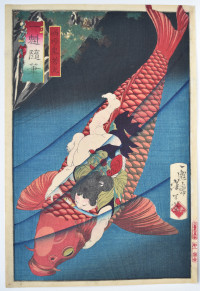
Click here to view image full size. Saito no Oniwakamuru from the set Ikkai zuihitsu, “A Miscellany by Ikkai.” (This being an early name of Yoshitoshi’s.) The young Saito Musashibo Benkei was given the moniker Oniwakamuru “Devil Child” because of his feats of strength and general behaviour. The episode depicted here, which was a popular theme for artists, shows the young Oniwakamaru battling a giant carp at the Bishamon Waterfall, where he has gone looking for his mother, Ohaya. On killing the carp, he discovers it has eaten his mother. A set published by Masadaya Heikichi, 1872-3 (this being 1872). Even amongst Yoshitoshi’s best work, this is an outstanding design.   Very fine impression of the first edition. Fine colour and condition. Signed Ikkaisai Yoshitoshi hitsu.   Status: Sold  

Tsukioka YOSHITOSHI (1839-1892)

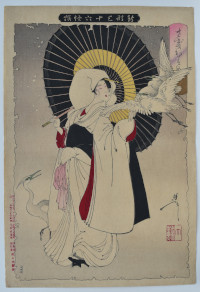
Click here to view image full size. Shows the famous Heron Maiden. There are different versions of this story but the most common tells how a young man finds an injured heron. He nurses it back to health and releases it. Some time later a beautiful young woman appears in his village. He falls in love and they marry. She makes fine brocade which they sell, but she does not allow him to see her making it. Tempted , he secretly views her only to discover she is the heron. This is the end of their marriage and the heron flies away. From the set Shingata sanjurokkaisen, “New Forms of Thirty-six Ghosts,” subtitle: Sagi-musume. The set published by Sasaki between 1889-1892 (this being 1889). This is the first edition.   Very fine impression, colour and condition. Signed Yoshitoshi.   Status: Sold  
Tsukioka YOSHITOSHI (1839-1892)

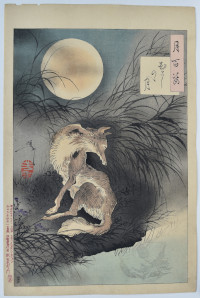
Click here to view image full size. Musashino no tsuki, “The Moon on Musashi Plain” from the set Tsuki hyakushi, the “Hundred Phases of the Moon.” The set published between 1885 and 1892 (this being 1892) by Akiyama Buemon. One of the three best designs from the set and one that relies most on the printer’s art – using extensive bokashi. The fox was capable of transmogrifying into human form and vice versa and was popular in Japanese folklore.   Very fine impression with beautiful gradation of the earliest printings on the grasses around the fox. (See Beauty & Violence, 1992, 54.97, p. 75 for an example of the more prosaic later printing.) The set was popular and many editions were printed and many late impressions exist. Great care was taken with the cutting of the blocks on this set and only early impressions do them justice. Fine colour and condition. An impression that has not been in an album. Full margins. Signed Yoshitoshi.   Status: Sold  
Tsukioka YOSHITOSHI (1839-1892)

Click here to view image full size. A fox priest from the set Tsuki hyakushi, the “Hundred Phases of the Moon.” The set published between 1885 and 1892 (this being 1886) by Akiyama Buemon. Based on the Kyogen farce Konkai, “A Foxe’s Cry” which tells of a hunter who is lectured on trapping foxes by his uncle, a priest. On his way home his uncle turns into his true form, a fox, and is snared in a trap. Yoshitoshi’s design shows the uncle transmogrifying into a fox. One of the best designs from the set.   Fine impression and colour from an early printing. The set was popular and many editions were printed and many late impressions exist. Great care was taken with the cutting of the blocks on this set and only early impressions do them justice. Fine colour and condition. An impression that has not been in an album. Full margins. Signed Yoshitoshi.   Status: Sold  
Tsukioka YOSHITOSHI (1839-1892)

Click here to view image full size. A triptych Gikeiki Gojobashi no zu, “Gojo Bridge in the Chronicles of Yoshitsune.” Shows Musashi-bo Benkei of herculean strength subdued by the young Onzoshi Ushiwaka Maru (Yoshitsune) on Gojo Bridge.The story relates how Benkei (1155-1189) wandered around Kyoto with the intention of relieving 1000 samurai of their swords. One night, with one more sword to go, he saw Yoshitsune playing a flute and wearing a golden sword at the Gojotenjin Shrine. They agreed to fight on Gojo Bridge in southern Kyoto. However, Yoshitsune was too agile for Benkei and had been educated in the secrets of fighting by the tengu. Following Yoshitsune’s victory Benkei became Yoshitsune’s retainer. Published by Morimoto Junzaburo, 1881. One of Yoshitoshi’s best designs.   Very good impression and colour. Later editions lack the black outline around the moon and have clouds added. (Interestingly, a feature usually found on the earliest states of prints, but in this case the reverse.) Very good condition. Signed Taiso Yoshitoshi ga.   Status: Sold  
Tsukioka YOSHITOSHI (1839-1892)

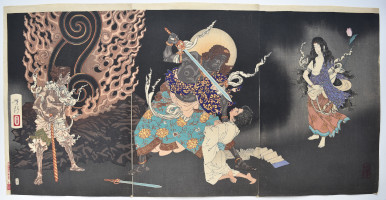
Click here to view image full size. A triptych showing the Japanese Buddhist deity Fudo Myo-o, one of the five “Kings of Wisdom,” above the novitiate priest Yuten Shonin (1637-1718) about to consume the sword of wisdom thereby gaining supernatural wisdom and enlightenment. (Often miscatalogued as threatening him.) On the right is the goddess of mercy, Kannon. The scene is set in the Zojoji Temple where Shonin goes on to become the Abbot. Published by Akiyama Buemon, 1885.   Fine impression with the publisher’s details intact in the left border of last sheet – often trimmed off. Fine colour and condition. Signed Yoshitoshi.   Status: Sold  

Tsukioka YOSHITOSHI (1839-1892)

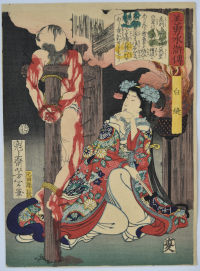
Click here to view image full size. A chuban from the set Byu Suikoden, “Beauty and Valour in the Novel Suikoden.” An adaption of the classic Chinese Water Margin novel. Shows the revengeful Lady Shiranui driving nails into the crucified body of Mutota. Published by Omiya Kyujiro (Kinkyu) 1866-67 (this being 1867). A fine set of 50 prints.Fine impression, colour and condition. Signed Ikkaisai Yoshitoshi hitsu. Status: Sold      
Tsukioka YOSHITOSHI (1839-1892)

Click here to view image full size. A vertical diptych Shunkan sozu Kikaigashima ni oite tamatama Yasuyori no shamen sembo kito no zu. Shows Shunkan watching a boat sail away from Kikai Island with his pardoned compatriots. Shunkan, the abbot of the Zen temple Hoshoji in Kyoto, was exiled to the barren island of Kikaigashima together with two confederates in 1177 for conspiring against Taira no Kiyomori. The following year Kiyomori pardons political prisoners but omits Shunkan. He is seen here beseeching the boat with his two conspirators to return. Published by Matsui 1886.   Fine impression of first state. Fine colour with splashed gofun and blind-printing. Fine condition with ample room for joining the two sheets. Signed Yoshitoshi.   Status: Sold  

Tsukioka YOSHITOSHI (1839-1892)

Click here to view image full size. Shows Asahina Saburo Yoshihide, the fabled warrior of superhuman strength, subjugating the King of Hell, Ema-o. He forces him to indicate the path to Heaven. This episode is from the kabuki play Asahina. From the set Ikkai zuihitsu, “Essays by Yoshitoshi.” (Ikkai was an early name of Yoshitoshi’s.) A set of thirteen prints published by Masadaya Heikichi 1872 A fine set.   Extremely fine impression and colour from the first edition. Most designs from the set have red seals in the margin and red seals over the signature. These were removed on later editions. Margins trimmed a little, otherwise fine condition. Signed Ikkaisai Yoshitoshi hitsu.   Status: Sold  

Tsukioka YOSHITOSHI (1839-1892)

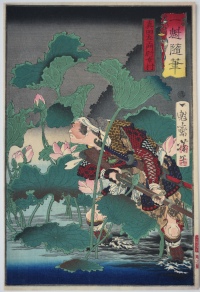
Click here to view image full size. Shows the famed warrior Sanada Saemon-no-jo Yukimura (in fact Nobushige) crouching down amongst giant lotus plants, holding a rifle, in order to ambush Tokugawa Ieyasu during the siege of Osaka castle. Initially, Yukimura was a follower of Ieyasu but was betrayed by having his land seized and so switched sides. He won many battles in which his army was outnumbered. From the set Ikkai zuihitsu, “Essays by Yoshitoshi.” (Ikkai was an early name of Yoshitoshi’s.) A set of thirteen prints published by Masadaya Heikichi 1872 A fine set.   Extremely fine impression and colour from the first edition. Most designs from the set have red seals in the margin and red seals over the signature. These were removed on later editions. Margins trimmed a little, otherwise fine condition. Signed Ikkaisai Yoshitoshi hitsu.   Status: Sold  

Tsukioka YOSHITOSHI (1839-1892)

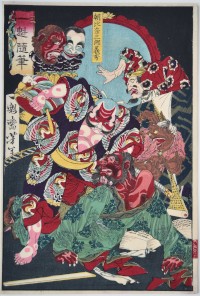
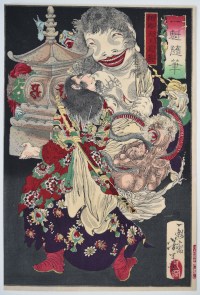
Click here to view image full size. Shows Chao Gai (Jap. Takuto Tenno Chogai), the Heavenly King and Suikoden hero, lifting a stone pagoda which releases a Pandora’s box of gruesome spirits: An enormous white figure with a face on its abdomen, various oni and a brown spirit, its chest holding a twisting snake. From the set Ikkai zuihitsu, “Essays by Yoshitoshi.” (Ikkai was an early name of Yoshitoshi’s.) A set of thirteen prints published by Masadaya Heikichi 1872 A fine set.   Extremely fine impression and colour from the first edition. Most designs from the set have red seals in the margin and red seals over the signature. These were removed on later editions. Trimmed on black border at left, otherwise fine condition. Signed Ikkaisai Yoshitoshi hitsu.   Status: Sold  

Tsukioka YOSHITOSHI (1839-1892)

Click here to view image full size. “Flood” from a series Seiu kandankei, “A Barometer of Emotions.” Shows Nakamura Shikan III as Abe Bungo no Kami riding his horse through waves. Published by Okura Magobei 1876-77 (this being 1876). A rare set with some striking designs comparing actors in theatrical roles with meteorological phenomena. Fine impression and colour. Slight trimming, otherwise fine condition. Signed Oju Yoshitoshi hitsu.     Status: Sold

Tsukioka YOSHITOSHI (1839-1892)

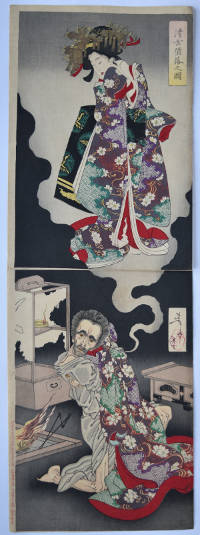
Click here to view image full size. A vertical diptych Seigen daraku no zu showing the priest Seigen of the Kiyomizudera Temple in Kyoto and the beautiful Sakura-hime (Princess Sakura). Several versions of the story exist. In one, Sakura-hime is Seigen’s long-deceased lover reincarnated as a young priest called Shiragiku. In another, Shiragiku is the dead lover reborn as Sakura-hime. The main thrust of the tale is that Seigen’s lust gets the better of him resulting in his removal from the temple. It was the basis of the play Sakura Hime azuma bunsho premiered 3 This is the rare first state of the first edition published by Matsui Eikichi, 1889. It was republished by Hasegawa Tsunejiro in 1889 with the publisher and date in left border and on most impressions a seal at top left reading “Reproduction not allowed.”     Very fine impression with hand-applied colour to the eyes, teeth and nails with gum overlay to eyes on Seigen. Fine colour. Minor edge wear to right, otherwise fine condition. Ample room for joining. Signed Yoshitoshi.     Status: Sold