
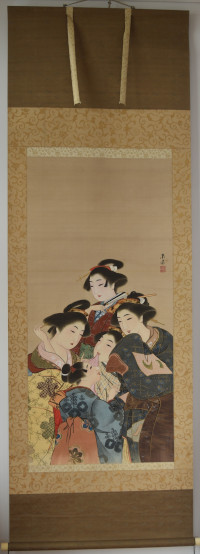
Watanabe NANGAKU (1767-1813)

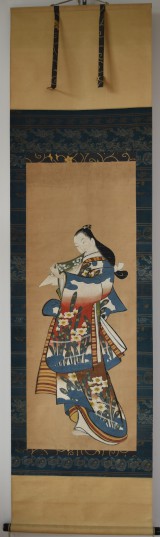
Click here to view image full size. A large original painting, full colour on silk, image size 46 x 21.75 in; 116.8 x 55.2 cms. This impressive painting shows two courtesans of the Shimbara (red-light) district of Kyoto and their attendants. Nangaku was one of Maruyama Okyo’s best pupils showing great dexterity in impromptu sketches (sekijo) as well as producing paintings of bijin which show ukiyo-e influences. He was responsible for the introduction of the Maruyama style to Edo where he lived for approximately three years late in his career before moving back to Kyoto where he died. He was included in the first exhibition in Edo of contemporary calligraphies and paintings organised by Sawara Kikuu in 1804. A comparable painting is in the Art Gallery of New South Wales, Australia, acc. no. 121.1980. (See Jack Hillier, The uninhibited brush, Hugh M. Moss, 1974, pp. 93-99.) In very good condition with double box. Signed Nangaku with seals Genzan and Iseki.   Status: Sold   Click here to view image full size.

Teisai HOKUBA (1771-1844)

Click here to view image full size. An original painting, full colour on silk, image size 37.5 x 12.75in; 95.2 x 32.3 cms. One of Hokusai’s earliest and best pupils. Produced a few surimono, also illustrated books, but is best known for his paintings of bijin, often shown promenading along the Sumida River, as here. Above is flowering cherry blossom setting the scene in late March or early April. The background is in Kano ink-wash showing boats on the river and below a ferry landing stage which she is presumably making her way towards. A similar painting is in the BM, illustrated in Ukiyo-e Paintings in the British Museum, Timothy Clark, 1992, p. 120, p. 169. Painted c 1830-44. In good condition. Signed Teisai with seal Hokuba gain.   Status: Sold   Click here to view image full size.

Mori SOSEN (1747-1821)

Click here to view image full size. An original painting, sumi and light colour on silk, image size 32 x 11.5 in; 81.3 x 29.2 cms. His life is not well documented but he is known to have studied under the Kano artist Yamamoto Joshunsai (? -1781) before being drawn into Mauyama Okyo’s (1735-1795) artistic circle and his style is more Shijo than anything else. His animal paintings were evidently highly valued by Okyo. He was an immediate favourite with eastern collectors because of his monkey paintings at which he excelled, although he was more versatile than literature implies and highly accomplished at drawing other animals. But his images of monkeys take precedence and he is considered the pre-eminent painter, east or west, on this subject. It is alleged that he lived in the woods for three years eating fruit and nuts to study the monkeys and other animals and is also supposed to have had a cage of monkeys at the back of his house to better observe them. Shows two Japanese macaque monkeys, known as the snow monkeys, eating chestnuts. Signed Sosen hitsu with seal Shusho. Minor cracks, otherwise very good condition.   Status: Sold   Click here to view image full size.

Ichiryusai HIROSHIGE (1797-1858)

 Click here to view image full size. An important original Hiroshige painting. Sumi and colour on grey silk, 22.5 x 13.75 inches, 57 x 35 cms. An atmospheric scene showing an evening view at Tamegawa. Villagers hurrying home across a bridge to avoid an approaching thunderstorm. Lightning flashing above. This is a well known painting and has been illustrated in a number of books, including Ukiyo-e Art, Number 18, Memorial Exhibition of Hiroshige, The Japan Ukiyo-e Society, 1968, pl.20. Very good condition; fully mounted with double box and ivory ends. Signed Hiroshige fude with Ichiryusai seal. Hiroshige signature c. 1848- 52.   Status: Sold    Click here to view image full size.  Click here to view image full size.  Click here to view image full size. here to view image full size.

Kawanabe KYOSAI (1831-1889)

 Click here to view image full size. A fine painting, sumi on paper, showing three crows on the boughs of a willow tree. Crows were one of Kyosai’s favourite subjects and, apart from paintings, he used them in various formats: fan prints, oban and dai-oban prints. There are also numerous copies of his crow paintings. Signed Kyosai ga. 51 x 18.5 inches, 129.5 x 47 cms. Very good condition with original mount and rollers. Status: Sold  Click here to view image full size.  Click here to view image full size.

Utagawa HIROSHIGE (1797-1858)

Click here to view image full size. An original painting, sumi and light colour on paper, 34.25 x 11.5 in; 87 x 29 cm. Shows a seated courtesan, her summer robe with a water wheel and wave motif. A beautiful poem above which has been translated by Joel Earle:   TITLE The title of the painting is 蓴 (jun, nunawa), the aquatic plant Brasenia schreberi, commonly known as watershield. TRANSCRIPTION 中々尓夢路耳河者ゝ袖飛きてい者まほし幾尓あ那ら聲尓天 Naka naka ni / yumeji ni kawamono wa / sode hikite / iwama hoshiki ni / anara koe nite TRANSLATION Ah, how vexing! In the path of dreams where I travel towards you, you draw near like a flowing river and tug at my sleeve. I long to speak—but your alluring voice leaves me breathless. COMMENTARY Title The painting’s title, nunawa, is a metaphor for a courtesan, kawaramono who inhabits in the Floating World of Water, referring to the lively, impermanent realm of riverside quarters, performers, and night-time entertainment. Text 中々に naka naka ni. Conveys a sense of frustration, of “things not going as one wishes”, especially in love. 夢路に yumeji ni. “On the path of dreams”. Not just “in a dream” but on the classical path in which one travels to meet a beloved in dreams, and by extension, the road to the pleasure quarters. 河者ゝ kawamono ya. This term is tricky and layered. It literally evokes a river’s flow, something that comes toward you, but in Edo usage, 河者 kawamono or 河原者 kawaramono could be a derogatory term for performers, kabuki actors, entertainers, etc.—people who “flow in and out” of the pleasure world. 袖ひきて sode hikite. A classic gesture: pulling the sleeve to invite or entice. 言はまほしきに iwama hoshiki ni. A clear wish or desire: “I want to speak (to you)”. あなら聲にて anara koe nite. A seductive,…

Kawanabe KYOSAI (1831-1889)

Click here to view image full size. An original painting, full colour on silk, image size 41.25 x 16.2 in; 114.8 x 41 cms. A draughtsman of great dexterity with a wild, often bizarre, imagination. Loved sake, sometimes painting under its influence. At an early stage studied under Kuniyoshi, then Maemura Towa and later Kano Chinshin before becoming an independent painter at 27. Adept at highly finished paintings but also produced a large corpus of spontaneous paintings. This is one of Kyosai’s favourite themes: to juxtapose a beauty with an unlovely character; in this case a seated skeleton smoking. Signed Seisai Kyosai ga with seal Kyosai in. In very good condition apart from some minor creases. Status: Sold Click here to view image full size.

Maki BOKUSEN (1736-1814)

 Click here to view image full size. A fine original painting, full colour on silk, 40.5 x 12.5 in; 102.9 x 31.7 cms showing a beauty reading a long (love ?) letter. Her maid on the floor beside her. Bokusen was a pupil of both Utamaro and Hokusai although he had an independent style with Hokusai elements in his painting. He was not only a painter but printmaker and book illustrator with such books as: Bokusen gafu (1809), Hitoyo banashi (1810) etc. Painted c1810s.   Very good condition. Signed and sealed Bokusen. See my Blog on this update.   Status: Sold    Click here to view image full size.  Click here to view image full size. here to view image full size.  Click here to view image full size.
Matsui KEICHU (Active 1785-1819)

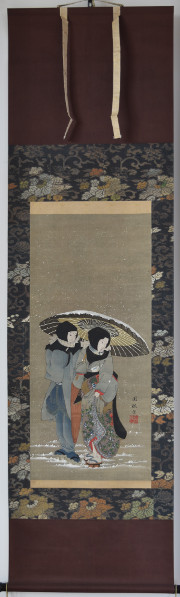
Click here to view image full size. A wonderful original painting, full colour on silk, image size 35 x 12.75 in; 89 x 32.5 cms. Shows three of the leading actors around 1800: Segawa Kikunojo III (above); Iwai Kumesaburo I (below left); Ichikawa Hakuen I (below right). The first two onnagata dressed in female attire. Kikunojo is the subject of the famous bust portrait by Sharaku showing him as Oshizu, the wife of Tanabe Bunzo. Hakuen (Ichikawa Danjuro V) was one of the most famous and popular actors of his time. He is having tea served to him from a teapot by Kumesaburo watched by Kikunojo. Keichu, a Nagasaki painter, is known for his famous painting of a tiger cleaning its paw in the Minneapolis Institute of Art. A highly accomplished painting in very good condition. Sealed Matsui Keichu. Status: Sold     Click here to view image full size.
Katsushika TAITO II (Active c. 1810-1853)

Click here to view image full size. An original fan painting, sumi and light colour on prepared paper, 7.5 x 21.5 in; 19 x 54.5 cms. Shows a badger disguised as a priest. This is the same story as is illustrated in Yoshitoshi’s Shingata sanjurokkaisen, “Thirty-six Supernatural Beings in New Forms” showing the badger at Morinji Temple that could turn itself into a teakettle. Taito II was given the go of Taito by Hokusai, whose pupil he was, in 1820. The fan has the original rib marks and has minor wear, but is in generally good condition. The paper treated with mica. Signed Taito hitsu with Hyaku seal.   Status: Sold  
Katsushika HOKUSAI (1760-1849)

Click here to view image full size. An original painting, full colour on paper, 48.75 x 13.75 in; 124 x 35 cms. Shows Kintaro (aka Sakata no Kintoki) riding a large Chinese shishi lion. Kintaro was a child of prodigious strength who had a vermillion-coloured body. He is often depicted with the mountain creatures from Mount Ashigara where he was raised and in particular wrestling with giant mountain bears. He carries his huge battle-axe. Riding lions/tigers is illustrated elsewhere: specifically Kato Kiyomasa (Watonai) hunting and eventually subduing tigers in Korea. There are also images of Kintoki riding a bear. Signed Hachijuhachi rojin Manji hitsu, “Brush of Manji, old man of eighty-eight.” Seal Hyaku, “Hundred.” Twenty-six paintings are known from his eighty-eighth year, although given the attrition rate for paintings, he probably produced many more.   The painting is a wonderful example of Hokusai’s free handling of the brush style on a full kakemono. Some slight creasing, otherwise good condition.   Status: Sold   Click here to view image full size.

Utagawa HIROSHIGE (1797-1858)

Click here to view image full size. An important pair of original paintings, light colour on silk, 35.5 x 12.75 in; 90 x 32.5 cms. The left painting shows Asukayama in the Eastern Capital (Edo). This was one of the top areas to view the abundant cherry trees, the first of which were planted by the Shogun Tokugawa Yoshimune. A fir tree is seen to the left with cherry trees on the lower slope and a majestic Fuji in the distance. A large foreground object, often only partly shown, is a characteristic of many Hiroshige paintings and prints: They lead the eye into a composition and give perspective. The right-hand painting shows the Sumida River in the Eastern Capital (Edo) with a flowering cherry tree in the foreground. (See the comment above.) The sakura flowers from the end of March to early May and the sakura-zensen, blossom forecast, by the weather forecasters is watched assiduously as the blossom is so transient.   Each painting signed Ryusai with Hiroshige seal. Hiroshige produced a number of paintings in this format with this signature and seal, c. early 1850s. In good condition.   Status: Sold   Click here to view image full size. Click here to view image full size.
Tsukioka YOSHITOSHI (1839-1892)

Click here to view image full size. A fine and large original painting, sumi and light colour on silk. Image size 45.5 x 20.25 in; 115.5 x 51.5 cms. Shows Kato Toranosuke (1562-1611) and Yamaji Shogen (1546-1583) locked in combat having fallen over a cliff into a river. A full moon above. Toranosuke (Kiyomasa), a bodyguard of Toyotomi Hideyoshi, was one of the “Seven Spears of Shizugatake,” Shizugatake no shichi-hon-yan. His adversary is Yamaji Shogen of Katsuie Shibata’s army. (In fact, he defected to Katsuie from Hideyoshi during the battle and was killed there – presumably by Toranosuke .) The battle of Shizugatake was in 1583.     Signed Ikkaisai Yoshitoshi hitsu. Signature of c. mid 1860s. Recently remounted and in fine condition. The detail on the armour and accoutrements is exceptional.     Status: Sold     Click here to view image full size. Click here to view image full size.
Ishikawa TOYONOBU (1711-1785)

Click here to view image full size. A very fine original painting, sumi and colour on paper with extensive laquer and a large emossed gold floral pattern on the bijin’s kimono; other areas in gold. Image size 35.25 x 17.75 in; 89.5 x 45 cms. Shows an elegant beauty holding up an haori to slip it over the shoulders of a seated nobleman. There is a great feeling of tenderness between the couple in this beautiful painting. In fact Toyonobu produced a print of this exact subject but showing the actors Nakamura Kiyosaburo I as Okiku and Ichimura Kamezo I as Kosuke, a pair of lovers, who were in the play Fujito nikki in 7 Toyonobu must have liked the design and produced this painting but of just the protagonists. See this link in google for the published print. Toyonobu was a pupil of Nishimura Shigenaga and his style is also indebted to Okumura Masanobu. Produced some of the most exquisite kakemono-e, hashira-e and large obans of this period which, when they come onto the market, fetch considerable sums of money. (See, for example, Christies auction, N.Y., 18/9/2002, lot 6, ex Vever collection.) For a fine collection of his work, see The Clarence Buckingham Collection of Japanese Prints. The Primitives, 1955, A.I.C., pp. 199 – 229, nos. 1 – 58. Signed Ishikawa Shuha Toyonobu zu with seals Ishikawa uji and Toyonobu. Illustrated in colour in the exhibition catalogue of the Fuchu Art Museum, Artists of the Three Capitals-Learning About Edo Through Kyoto and Osaka, Kaneko, Nobuhisa, Oto, Yumiko, 2012, No. 67, p. 92. The cataloguing gives the play as Hiyoku no kagamon but this is most likely a dance that served as the finale. Hiyoku can mean “wings abreast” and hiyoku no tori, the “hiyoku birds” were a mythical couple…

Utagawa KUNITSUGU (1800-1861)

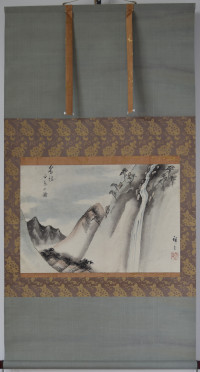
Click here to view image full size. An original painting, sumi and colour on silk with extensive splashed and applied gofun. Image size 29.25 x 13.25 in; 74.25 x 33.75 cms. A rare pupil of Toyokuni. Another fine painting by him is in the Minneapolis Institute of Art showing Lady Tokiwa fleeing with her children in the snow. Gift of the Clark Center for Japanese Art and Culture, 2013.29.170. Shows an eloping (?) couple standing in heavy snow shielded by his umbrella. Signed Kunitsugu fude. Seal unread. Very good condition.     Status: Sold     Click here to view image full size. Click here to view image full size.

Utagawa HIROSHIGE (1797-1858)

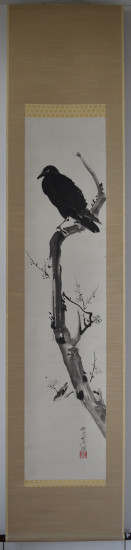
Click here to view image full size. An original painting, sumi and light colour on paper, image size 13.5 x 20 in; 34.3 x 50.8 cms. Shows the Shiraito no Taki waterfall at Hakone. The water, originating from Mount Fuji, flows over the edge of a 20 meter high cliff in thin white streams reminiscent of silk threads (hence the name Shiraito). Sold with the lid of a previous box which has a guarantee by Kazuo Inoue (a well known expert on Ukiyo-e [1889-1946] dated 1943 which gives the painting as having been done 1845-1848). In very good condition. Signed Hiroshige with Ichiryusai seal.   Status: Sold   Click here to view image full size. Click here to view image full size.

Kawanabe KYOSAI (1831-1889)

Click here to view image full size. An original painting, sumi on paper, image size 36.75 x 12 in; 93.3 x 31.7 cms. A draughtsman of great dexterity with a wild, often bizzare, imagination. Loved sake, sometimes painting under its influence. At an early stage studied under Kuniyoshi, then Maemura Towa and later Kao Chinshin before becoming an independent painter at 27. Adept at highly finished paintings but also produced a large corpus of spontaneous paintings. Shows a crow perched on a branch with a singing sparrow below. This was the subject he was most famous for and there were many copies.   In very good condition, remounted and with futomaki. Signed Joku Kyosai zu with seal Bankoku tobu, “Flying in, or to, many lands.”   Status: Sold   Click here to view image full size. Click here to view image full size.

Nishiyama KAN’EI (1834-1897)

Click here to view image full size. A gajo (album) of 21 original paintings by Nishiyama Kan’ei, the son and pupil of Nishiyama Hoen. They both worked in Osaka and Kan’ei carried on the Shijo school tradition. Relatively few paintings and drawings by Kan’ei survive but based on these and his fine Kan’ei gafu, published in 1886, it is evident he was an accomplished artist. The postscript to the album is an authentication by Takebe Hakuoh (1871-1927) stating that they are original works by the master. He studied under Kan’ei. Comes with the original box. The album and box in excellent condition. Sumi and light colour on paper mounted on gold-flecked boards. All paintings sealed Kan’ei.     Status: Sold     Click here to view image full size. Click here to view image full size. Click here to view image full size. Click here to view image full size. Click here to view image full size.

Katsukawa SHUNSHO (1726?-1792)

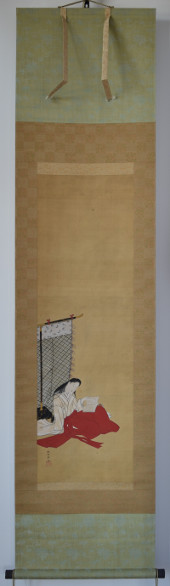
Click here to view image full size. An original painting, sumi and full colour on silk, 32.25 x 10 in; 82 x 25.5 cms. An important print artist and his paintings being considered one of the glories of Ukiyo-e. Produced a considerable number of hosoban actor prints from the late 1760s on as well as collaborating on the Ehon butai ogi illustrated book with Buncho in 1770 and Seiro bijin awase sugata kagami with Kitao Shigemasa in 1776. He had many pupils including Shunko, Shun’ei and Hokusai. Shows a court beauty reclining and reading a book. The painting of the face, hair and the lacquer stand holding the cloth screen are exceptional. Painted c. 1789. In very good condition.     Signed Katsu Shunsho ga with seal Jui.     Status: Sold     Click here to view image full size.

Utagawa HIROSHIGE (1797-1858)

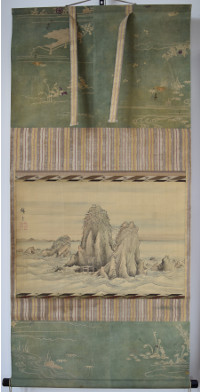
Click here to view image full size. An original painting, sumi and light colour on silk, 13.5 x 20.5 in; 34.5 x 52 cms. Shows the renowned Husband and Wife rocks, Meoto Iwa, “Married Couple Stones,” off Futami, Mie, Japan. At this time – c. late 1840s – many thin ropes were used to tie the couple together. They are now joined by a single large shimenawa – a rope of rice straw. The larger (male) rock called Izanagi has a small torii at the top. The smaller (female) rock is called Izanami. They are sacred to the Shinto religion and worshippers flock to the neighbouring Futami Okitama Shrine, which is dedicated to the food goddess Miketsu. The ancient Shinto custom of worshipping stones is called Iwakura. A fine Hiroshige painting.     Signed Hiroshige ga with large Ichiryusai seal. In good condition with interesting old mount.     Status: Sold     Click here to view image full size.

Ichiryusai HIROSHIGE (1797-1858)

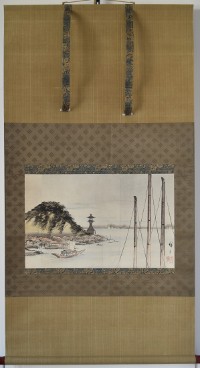
Click here to view image full size. An original painting showing the old lighthouse at Tempozan, Osaka. To the left is the mount which was formed by earth dredged from the Ajigawa in 1831 to allow easier access for ships. In the foreground masts of moored vessels. There appear to be few images of this lighthouse. It was replaced by a lighthouse designed by the British engineer Richard Henry Brunton, the “Father of Japanese Lighthouses” in 1872. Sumi and light colour on paper, 12.75 x 20.25 in ; 32.4 x 51.4 cms.     Signed Hiroshige ga with Ichiryusai seal. Very good condition.     Status: Sold     Click here to view image full size. Click here to view image full size.

Ichiryusai HIROSHIGE (1797-1858)

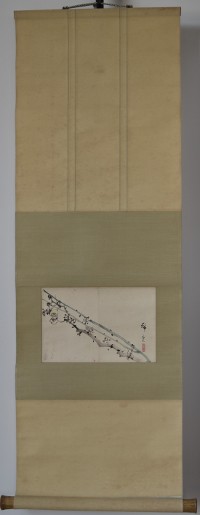
Click here to view image full size. A charming small painting in shijo style obviously from a gajo of such sketches. Shows a flowering plum branch loosely tied to another branch. Sumi and light colour on paper, 5.5 x 8 in; 14 x 20.25 cms. Signed Hiroshige ga with Ichiryusai seal. Slight centre fold (of course) otherwise good condition. Old mount with bamboo ends.     Status: Sold     Click here to view image full size.

Mori SOSEN (1747-1821)

Click here to view image full size. A large and extremely fine painting, sumi and light colour on silk, 48 x 22 in; 122 x 56 cms. Shows monkeys on rocks and a large tree beside a mountain stream. Sosen’s life is not well documented but he is known to have studied under the Kano artist Yamamoto Joshunsai (?-1781) before being drawn into Maruyama Okyo’s (1735-1795) artistic circle and his style is more Shijo than anything else. His animal paintings were evidently highly valued by Okyo. He was an immediate favourite with eastern collectors because of his monkey paintings at which he excelled, although he was more versatile than literature implies and highly accomplished at painting other animals. But his images of monkeys take precedence and he is considered the pre-eminent painter, east and west, on this subject. It is alleged that he lived in the woods for three years eating fruit and nuts to study the monkeys and other animals, and is also supposed to have had a cage of monkeys at the back of his house to better observe them. There are many copies of Sosen’s monkey paintings but no one could duplicate the way Sosen builds up their fur with multiple fine brush strokes. Signed Sosen with seals Sosen and Morizo. In extremely good condition. The painting authenticated by the artist Yamamoto Baiso (1846-1921) on the inside lid of the box. Status: Sold Click here to view image full size. Click here to view image full size.

Santo KYODEN (Kitao MASANOBU) (1761-1816)

Click here to view image full size. An original painting, full colour on paper, image size 47 x 15.5 in; 119.5 x 39.5 cms. A pupil of Kitao Shigemasa, he was one of the leading authors and illustrators of kibyoshi, ehon and kyoka anthologies. Also produced prints of beauties including the fine set of double-oban prints of courtesans in 1783-4: Yoshiwara keisei shin bijin awase jihitsu kagami. A controversial figure who ran foul of the authorities in 1789; he subsequently ceased using the name Kitao Masanobu and thereafter his paintings are always spontaneous in an abbreviated style, often quite slight and signed Kyoden. The example offered here showing a parading courtesan with her lantern behind her is more finished than most. The calligraphy above by Kyoden. In very good condition with box guaranteed by Tosuke Kimura.     Signed Kyoden gasan, “Painted and inscribed by Kyoden.” Seals Santo Kyoden, Seishu koji and another.     Status: Sold     Click here to view image full size. Click here to view image full size.

Utagawa HIROSHIGE (1797-1858)

Click here to view image full size. An original drawing, being a preparatory sketch for a painting, sumi and red under-drawing on paper, mounted as a kakemono. Image size 10.5 x 13 in; 26.5 x 33 cms. An unusual view of the Husband and Wife rocks, Meoto Iwa, “Married Couple Stones,” off Futami, Mie, Japan. They are sacred to the Shinto religion and worshippers flock to the neighbouring Futami Okitama Shrine, which is dedicated to the food goddess Miketsu. In this drawing the emphasis is on the worshippers and travellers seen here in the centre and right.     In very good condition. A spurious signature and seal bottom right. There are others drawings with the same signature and seal on otherwise perfectly genuine works.     Status: Sold     Click here to view image full size.

Hosoda EISHI (1756-1829)

Click here to view image full size. An original painting, full colour on silk, 32.5 x 10 in; 82.5 x 25.5 cms. Shows a promenading courtesan under a full moon – presumably on the way to an assignation. She wears a vivid red over-garment decorated with iris and the under-garment has heavy mica applied. Eishi was of unusually high rank for an Ukiyo-e artist and is noted for his refined beauties – both painted and in woodblock form. They often have ink-wash backgrounds in the Edo-Kano technique learned as a pupil of Kano Eisen’in Michinobu (1730-90). His corpus is extensive and there are also many copies of his work. He had around thirty pupils including Eisho, Eiri and Eisui. Minor flaking of mica but in otherwise good condition. Signed Chobunsai Eishi hitsu with Eishi seal. Status: Sold     Click here to view image full size. Click here to view image full size.

KAIGETSUDO School

Click here to view image full size. An original painting, full colour on paper, 39.75 x 15.25 in; 101 x 38.75 cms. Shows a beauty erotically biting a cloth. The kimono is decorated with a strong motif of flowering plants. The school was founded by Kaigetsudo Ando (1671-1743). He had a tight-knit atelier of artists who followed his style of large single standing beauties with bold drapery and small faces. There are many copies of the leading Kaigetsudo artists and it’s refreshing to have an unquestionably authentic painting of the period, c early 1710s. Minor imperfections but all in line with the age of the painting, otherwise good condition. Status: Sold     Click here to view image full size.

Torii KOTONDO (1900-1976)

Click here to view image full size. An original painting, full colour on silk with touches of gold, 45.5 x 14.5 in; 115.5 x 36.75 cms. Shows the famous story of the demon Ibaraki of Rashomon (a gate south of the Imperial Palace in Kyoto). The tale relates how Watanabe no Tsuna cuts off the arm of the demon Ibaraki near the Rashomon Gate in 976 to free the neighbourhood of the beast. Watanabe locks the arm in a box. Subsequently he is visited by his wet nurse who asks to see the arm, whereupon she seizes it and flies off revealing her true guise as that of the demon. The story was made into a No play, Ibaraki, and later a Kabuki play. Kotondo is famous for his beauty prints of the late 1920s and early 1930s. In fine condition. Signed Kotondo ga with Kotondo seal. Status: Sold     Click here to view image full size. Click here to view image full size.

Ichiryusai HIROSHIGE (1797-1858)

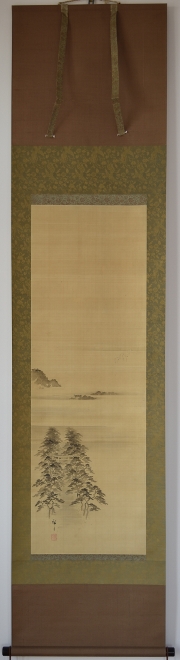
 Click here to view image full size. A fine original painting by Hiroshige I, sumi on silk, image size 38 x 12.5 in; 96.5 x 31.75 cms. Shows an avenue of trees leading to a small bridge beneath a torii; bands of mist, and, in the distance, another torii and a lake or open sea with sails. A beautiful composition. I have not been able to identify the location: It was not unknown for Hiroshige to paint imaginary landscapes or use poetic license.   Signed Hiroshige ga with Ichiryusai seal. In very good condition having been recently remounted.   Status: Sold    Click here to view image full size.  Click here to view image full size.

Mori SOSEN (1747-1821)

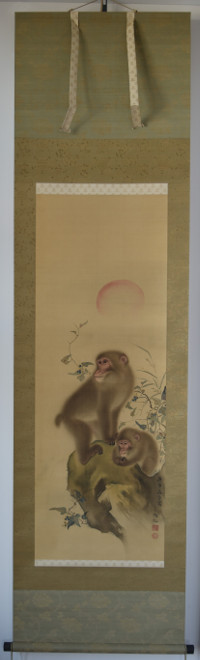
Click here to view image full size. A fine original painting, sumi and light colour on silk; 41.75 x 15 in; 106 x 38.1 cms. His life is not well documented but he is known to have studied under the Kano artist Yamamoto Joshunsai (? -1781) before being drawn into Maruyama Okyo’s (1733-1795) artistic circle and his style is more Shijo than anything else. His animal paintings were evidently highly valued by Okyo. He was an immediate favourite with eastern collectors because of his monkey paintings at which he excelled, although he was more versatile than literature implies and highly accomplished at drawing other animals. But his images of monkeys take precedence and he is considered the pre-eminent painter, east or west, on this subject. He is said to have lived in the woods for three years eating fruit and nuts to better study the monkeys and other animals at close quarters. (Even if this is apocryphal it underlines the appreciation of his commitment to understanding the monkey.) Shows two monkeys on a bough beneath a large red sun. In very good condition. Genuine Sosens (and there are many copies) show a great skill in the way their fur coats are built up with hundreds of fine strokes. The box that goes with the painting has an inscription on the lid: “A painting of monkeys by Mori Sosen” and on the underside of the lid is a guarantee by Ayaoka Yushin (a Shijo painter and pupil of Shibata Zeshin, [1846-1910]) signed Ayaoka with seal Yutoku and dated June 1891. The painting signed “Painted by Mori Sosen early spring [=January] 1800” with seals Mori Shusho and Sosen.     Status: Sold     Click here to view image full size. Click here to view image full size. Click here to view…