
Kawamura BUMPO (1779-1821) and Watanabe NANGAKU (1763-1813)

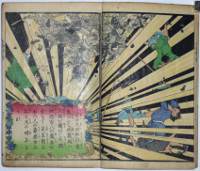
Click here to view image full size. One volume complete Kaido kyoka awase, “Comparison of Kyoka Poems on the Highway.” Three pages preface signed Bumpo and thirty-six double-page illustrations alternating by Nangaku and Bumpo; last page colophon dated Bunka 8 (1811) with artists Nangaku Tseki and Bumpo Basei. Publishers Kawachiya Kihei, Osaka, and Yoshidaya Shimbei, Kyoto. Original embossed yellow covers with original title slip. Originally published in two volumes with the poems in volume one and almost immediately reissued as a one volume work, as here. Numerous collectors’ seals: Tanido Kyohitsu, Seiyo Kosetsu, and Edmond de Goncourt with his brocade binding and imitation wood slipcase. A beautiful example of this fine Shijo book in very good condition.     Status: Sold     Click here to view image full size. Click here to view image full size. Click here to view image full size. Click here to view image full size.

Utagawa TOYOKUNI (1769-1825)

 Click here to view image full size. One of Toyokuni’s most famous books: 2 volumes bound as one, Yakusha Awase Kagami, “A Mirror of Actors’ Physiognomy.” Published Kyowa 4 (1804) by Bunshundo and Yamadaya Sanshiro. Vol. I, 4pp. preface, undated, 18 single-page half-length portraits of actors below kyoka poems. Vol. II, 15 single-page half-length portraits, followed by single page poem signed Ichikawa Hakuen (Danjuro V), 4pp. postscript, signed Kankoku. Lacking original covers with publisher Toto Banshundo on inside cover of Vol. I. Also lacking 2pp. second postscript by Banshundo and colophon. Very minor soil and three portraits with colour turned, otherwise very fresh impressions. Extremely Rare.   Status: Sold    Click here to view image full size.  Click here to view image full size.  Click here to view image full size.

Tsukioka YOSHITOSHI (1839-1892)

 Click here to view image full size. One volume Shuzo suiko meimei den, Shohen, “ Portraits of the Characters in the Suikoden, First Series.” Original embossed orange covers with yellow title slip. Inside front cover title and signature within a western-style surround. Preface 6 pp. including two double-page colour illustrations, last sheet dated Keio 3 ( 1867 ). And 18 numbered pages with 36 illustrations of Suikoden warriors on yellow grounds. Inside back cover advertisements. Published by Odawaraya Yashichi, Edo. In extremely good condition. Superb engraving ( by Egawa Ichigoro ). Presumably a response to the copper plate books and prints being circulated at the time. There is a two volume variant of this book printed in just sumi and blue. However, judging from the impressions in this one volume version with woodgrain showing and blind printing, this must be a very early printing.   Status: Sold    Click here to view image full size.  Click here to view image full size.  Click here to view image full size. here to view image full size. here to view image full size. here to view image full size.

[Shiba] Shin nigao-e (Published 1915)

 Click here to view image full size. Five volumes complete: [Shibai] Shin nigao-e. Published in Tokyo Taisho 4 (1915) and illustrated by Natori Shunsen, Yamamura Koka, Torii Kotondo, Ishida Hakutei and others.   Volume one: 18.5 x 12.5 cm. Original covers, beige. The abbreviated title: Shin nigao and volume number are printed directly on the cover. On the right is the publication date, June 1, Taisho 4 (1915), and a note that subsequent numbers will be published on the first day of each month. Table of contents. Preface by Kinoshita Sataro. The fourteen colour woodcut portraits are by Natori Shunsen (5), Matsuda Seifu (4), Yamamura Koka (3), Torii Kotondo (1), and Ogawa Heibei (1). Block cutter: Igami Bonkotsu. Printer: Namamura Sanjiro. The text on actors and roles are mainly printed on tissue interleaves. Colophon page, dated June 1, Taisho 4 (1915). Compiler: Egawa Kinpei. Published by Nigao-do.   Volume two: 25.2 x 18.7 cm. Covers, light blue. The abbreviated title and volume number are printed directly on the cover. The first actor print is pasted to the cover, credited internally to Natori Shunsen. Front endpaper, table of contents. The forteen woodcut portraits are by Shunsen (4, including the cover), Koka (3), Terazawa Kotaro (2), Isshii Hakutei (2), Matsuda Seifu (2), Heibei (1). Colophon, dated July 1, Taisho 4; otherwise as Vol. one.   Volume three: 25.2 x 18.7 cm. Covers, beige. Title and volume number as for Vol. two. The first actor print is pasted to the cover, as above. The fourteen actor portraits are by: Shunsen (5), Seifu (3), Hakutei (3), Koka (2), and Heibei (1). Colophon dated August 1; otherwise, as above.   Volume four: 25.2 x 18.5 cm. Covers light blue in the same format as above. The fourteen actor portraits are by: Shunsen (5), Koka (4),…

Cho GESSHO (1772-1832) and Kazaore YUJO (fl. c. 1790-1800)

Click here to view image full size. 5 vols. complete: Zoku Koya Bunko, “The Sequel to Koya Library.” Vol. 1: 52 sheets; 48 illus. Vol. 2: 49 sheets; 48 illus. Vol. 3: 53 sheets; 51 illus. Vol. 4: 53 sheets; 52 illus. Vol. 5: 56 sheets; 54 illus. Preface, 5 pp. by Kogetsutei, dated Kansai 9 (1797). Artists: Kazaore Yujo and Cho Gessho. Published by Fugetsu Magosuke, Nagoya, Kansai 10 (1798), together with other publishers in Edo, Osaka and Kyoto. The greatest anthology of printed haiga (haiku poems accompanied by illustrations based on simple, yet often profound, observations of everyday life). The anthology was started by Yujo but taken over by Gessho on his death. Most of the work is Gessho’s. This is one of the few books where the block-cutter and printer must take pride of place beside the artist. The most striking effects were achieved by these artisans by imaginative working of the block surface and wiping of the blocks to produce distinctive variations in texture and formless adumbrations of trees, plants and landscapes, all in sumi. Other examples: Duret 464 (5 vols. 1799); Gonse (III), 438 (4 vols., 1798); Holloway 18; Ryerson, pl. XI. Original covers and title slips. Some slight damage to covers and slight restored wormage at bottom of first sheets of vol. 1. But otherwise an exceptionally fine and clean copy with hardly any thumbing on corners. A lovely and rare set.     Status: Sold     Click here to view image full size. Click here to view image full size. Click here to view image full size. here to view image full size. here to view image full size. here to view image full size. here to view image full size. here to view image full size.

Katsukawa SHUNCHO (Fl. c. 1780-1795)

 Click here to view image full size. A chuban print showing a group of beauties caught in a downpour on the banks of a river. The centre figure has an umbrella with the publisher’s name Izumi [ya Ichibei] and address Shiba Jinmeimae which was in front of Shiba Daijingu Shrine. One of a set Nana Komachi, “The Seven Komachi,” being episodes in the life of the famous waka poetess Ono no Komachi (c. 825-c. 900). Little is known of Shuncho’s life except that he was a pupil of Katsukawa Shunsho and was then heavily influenced by Kiyonaga. He produced some particularly fine triptychs and pillar prints. Published c. early 1790s.   Superb impression, colour and condition: As the day it was printed. Signed Shuncho ga.   Status: Sold  

Katsushika HOKUSAI (1760-1849)

 Click here to view image full size. Two volumes complete: Toto shokei ichiran, “Fine Views of the Eastern [Edo] Capital at a Glance.” Shows famous places in Edo with accompanying kyoka poems at the top. Volume 1: 10 sheets, 1 p. preface. Volume 2: 11 sheets with colophon giving date Kwansei 12 (1800). Publishers Tsutaya Jusaburo, Suharaya Mohei and Suharaya Ihachi. Ando Enshi engraver and artist Hokusai shinsei. This book was first published with title Toto meisho ichiran by Tsutaya Jusaburo. Shortly afterwards the title was changed and the two other publishers joined Tsutaya Jusaburo. This is the edition offered here. Original hand-painted covers with a decoration of iris flowers and water (only found on the original edition). The blocks were subsequently sold to the Nagoya publisher Hishiya Kinbei who reissued it in 1815 together with Suharaya Mohei and Ihachi. The blocks were yet again sold, this time to Kawachiya Mohei who issued another reprint in 1840 with the above publishers. A lovely early example of this famous book. Cover and title slips in very good condition.   One wormhole affecting last 4 pages at the top outside image area, otherwise contents fine and clean. Provenance: Large seal of Hayashi Tadamasa at the start to each volume.   Status: Sold    Click here to view image full size.  Click here to view image full size.  Click here to view image full size.  Click here to view image full size.  Click here to view image full size.
Takehisa YUMEJI (1884-1934)

 Click here to view image full size. One volume complete Sakura-saku shima : Haru no kawatare. Title page: Within purple borders, the subtitle and Yumeji-saku in reddish brown. Frontispiece: colour woodcut across two pages entitled TUMABIKI, “Finger-plucking” in roman letters, with decorative seal. One page introduction by Yumeji. The remaining 50 pages (unnumbered) with poems by Yumeji and ten double-page and four single-page b/w woodcuts, all dealing with emotions associated with springtime. Colophon dated Meiji 45 (1912), first printing. Artist/author: Takehisa Yumeji. Publisher Kawamoto Kamenosuke. Publishing house Rakuyodo. One page ad for the four books then planned but only this and the following Sakura-saku shima: Mi shiranu sekai were produced. Original pale blue covers with original title slip. In very good condition. Wonderful early designs before becoming overly cloying.   Sold together with: Sakura-saku shima: Mi shiranu sekai. Title page: Within black borders, the subtitle and Yumeji-saku in black, flanked by images of two demons, one red, the other green. Frontispiece: colour woodcut across two pages entitled UNKNOWN WORLD in roman letters, with decorative seal. The remaining 46 pages (unnumbered) with poems by Yumeji and ten double-page b/w woodcuts dealing with family relations and images of souls in hell. Colophon dated Meiji 45 (1912), first printing. Artist/author: Takehisa Yumeji. Publisher: Kawamoto Kamenosuke. Publishing house: Rakuyodo. Original yellow covers with title slip. In very good condition.   Status: Sold    Click here to view image full size.  Click here to view image full size.  Click here to view image full size.  Click here to view image full size.  Click here to view image full size.  Click here to view image full size.

Ichiryusai HIROSHIGE (1797-1858)

 Click here to view image full size. One volume complete, Ehon tebikigusa, “A Model Book of Plants.” Published by Iseya Rihei, 1849. Signed on inside of front cover Ichiryusai Hiroshige hitsu with three page preface signed Ryukatei Tanekazu (1807-1858) plus one page introduction by Hiroshige on how he was asked to design a book as a guide to drawing for children. (See Strange, The Colour Prints of Hiroshige, Cassell, 1925, p. 112-114 for a full translation.) Thirty-five pages of flowers, grasses and fish plus two page view of Mt. Fuji and last page signed Ichiryusai. This is the rare first edition: It was republished by Shojuya Shoshichi, lacking the introduction. Original embossed grey covers and blue title slip.   Extremely fine impressions. Some slight edge wormage at end, otherwise very good condition.   Status: Sold    Click here to view image full size.  Click here to view image full size.  Click here to view image full size.

Kitao MASAYOSHI (1764-1824)

 Click here to view image full size. One volume complete Choju ryakugashiki, “Simplified Forms of Drawing Birds and Flowers.” Published Kwansei 9, 1797, by Suharaya Ichibei. Illustrated by Kuwagata Keisai ( Masayoshi ). These influential books of Masayoshi’s were popular and were reprinted many times. Fine early copy. Original title slip and lemon-yellow covers ( some wear ). Some thumbing at bottom especially towards front, and other minor marks, otherwise good condition. Unidentified collectors’ seals at end and small annotation on back cover of a previous (?) collector: L. de la Bedollier. Status: Sold  Click here to view image full size.  Click here to view image full size.  Click here to view image full size.  Click here to view image full size.
Teisai HOKUBA (177 -1844)

 Click here to view image full size. One volume complete Kyoka sumidagawa meisho zue, ” Humorous Poems on Famous Views of the Sumida River.” Colophon dated Bunsei 6, 1823, published by Shunsuien. Extremely rare. Original covers with a printed design of chidori. Original title slip. Very good condition. Status: Sold  Click here to view image full size.  Click here to view image full size.  Click here to view image full size.

Utagawa HIROSHIGE (1797-1858)

Click here to view image full size. One of a set: Edo Murasaki meisho Genji, “Murasaki’s Genji in Famous Places of Edo.” Mitate Ukifune Sumidagawa no watashi, “A Parody of Ukifune Crossing the Sumida River.” Shows a beauty on a ferry crossing the Sumida River in heavy snow, representing Ukifune, one of the court ladies of the Genji Monogatari. Stylised clouds above and below copying the traditional kiri-gane gold found on Yamato-e scrolls. These Genji pictures were popular at this time to circumvent the reforms of 1842. Published by Kinseido (his seal also appearing on the umbrella bottom right). A rare set.     Fine impression. Very good colour. Minor soil, otherwise very good condition. Signed Hiroshige ga.     Status: Sold

Katsushika HOKUSAI (1760–1849)

 Click here to view image full size. One volume complete Ehon Suikoden, “A Picture Book of the Suikoden”, published by Kadomaruya Jinsuke, Bunsei 12, 1829 showing 108 Chinese brigands. Some fine designs. Signed Katsushika Zen Hokusai I-itsu fude. Fine impressions. Original covers lacking title slip. Some slight foxing and minor marks. Status: Sold  Click here to view image full size.  Click here to view image full size.  Click here to view image full size.
Ichiryusai HIROSHIGE (1797-1858)

 Click here to view image full size. Autumn from a set of four triptychs, Edo meisho shiki-no nagame, “Famous Places in Edo in the Four Seasons.” An evening scene with beauties on a balcony overlooking the bay at Takanawa. Birds are descending across a full moon. Published by Marujin, 1848-9. All four triptychs from this set are masterpieces.   Fine impression. Perfect colour. Slight thinning and creasing, otherwise fine condition. Signed Hiroshige ga.   Status: Sold  

Ichiryusai HIROSHIGE (1797-1858)

 Click here to view image full size. A copy of Ryakuga Korin-fu Ryusai hyakuza, the One Hundred Abbreviated Drawings by Ryusai [Hiroshige]. 1 vol. complete: 21 sheets; inside front cover title and illustrator Hiroshige (also given on last page). 3pp. preface dated Kaei 4 (1851) and signed Ryukatei Tanekazu and 20 pages, numbered, with illustrations in sumi, blue and pink. Colophon inside back cover with a list of bookshops (?) in Osaka and Edo and publisher Yoshidaya Genpachi. According to Brown (L.N.Brown, Block Printing And Book Illustration In Japan , George Routledge & Sons Ltd. 1924, p. 195) this book was republished as vol. IV of Sohitsu gafu. Original covers, missing title slip. Contents very good with only minor marks.   Status: Sold    Click here to view image full size.  Click here to view image full size.  Click here to view image full size. here to view image full size.
Utagawa KUNIYOSHI (1797-1861)

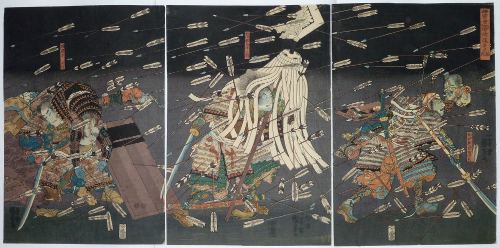
 Click here to view image full size. Nanke yushi Shijo-nawate nite uchijini. The last stand of the Kusunoki clan at Shijo-nawate in 1348. Kusunoki Masatsura, shown on the far left propped against his fallen horse under a rain of arrows, continues his father’s struggle against the Ashikaga forces. Wada Shinbochi (Genshu) leads the way holding enemy heads followed by Masatomo with a battle standard. Their blue complexions anticipate their imminent demise. Published by Fujioka-ya Keijiro, 1851-2. Robinson T271. Fine impression. One small backed wormhole on title, otherwise very good condition. Full size. Signed Ichiyusai Kuniyoshi ga. Status: Sold

Tsukioka YOSHITOSHI (1839-1892)

 Click here to view image full size. An original painting showing what is probably the most famous encounter in Japanese mythology: The scene is evening on Gojo Bridge in Kyoto where the twenty year old Benkei ambushes samurai to steal their swords. He is shown approaching the flute-playing Yoshitsune. A fight ensues which Yoshitsune wins due to his leaping ability taught to him by the mountain tengu. Yoshitsune pardons Benkei and they become loyal friends. This painting, in shades of sumi, beautifully evokes the crepuscular gloom. On silk, 7 x 9.5 in; 17.75 x 24.1 cms. Painted c late 1870s. Signed Yoshitoshi with Taiso seal. Status: Sold  Click here to view image full size.  Click here to view image full size.
Katsushika HOKUSAI (1760-1849)

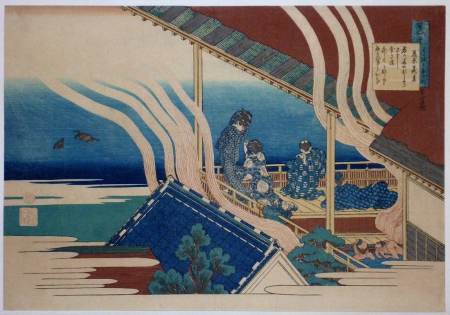
 Click here to view image full size. A poem by Fujiwara no Yoshitaka (954-974) from Hyakunin isshu uba ga etoki, the “Hundred Poems Explained by the Wet Nurse.” Published by Eijudo and Iseri, c 1835-6. Although obviously intended to be a set of 100 prints, only 27 are known plus drawings for others. The poet speaks of a trivial life prior to meeting his lover. Two women and their companions relax after a bath admiring the view across water. Steam rises from the bath and two cormorants are seen on the left. A languid scene and one of Hokusai’s most beautiful designs. Fine impression, colour and condition. Full size. Two states are known: the printers quickly discovered that the red seal at left was not easily discernable and cut the green block to correct this. Signed Zen Hokusai. Status: Sold
Utagawa KUNIYOSHI (1797-1861)

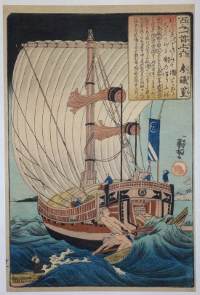
 Click here to view image full size. The stern of a large sailing-junk and a smaller vessel infront. A poem by Sangi Takamura (Ono no Takamura) from Hyaku-nin isshu, “The Hundred Poets” published by Ebine c 1838. Depending which story one reads, either Takamura, who was a customs official for ships trading to and from China, went missing on a mission or was reported for being an extortioner and banished to the Oki Islands. Either way, he was subsequently pardoned. One of the best designs from this fine set. Robinson S19.11 and illustrated in Robinson (1961), no. 59. Fine impression. Very good colour. Remargined top and bottom, otherwise very good condition. Signed Ichiyusai Kuniyoshi ga. Status: Sold
Keisai EISEN (1790-1848)

 Click here to view image full size. Itahana from Kisokaido rokujukyutsugi no uchi, “Sixty-Nine Stations of the Kisokaido.” The set of seventy prints was started by Eisen and published by Hoeido in 1835, but in 1837 Hiroshige took over and completed the series with the publisher Iseya Rihei (Kinjudo). One of the best designs from the set. This design is never signed, even, as here, on the first edition. Rare. Fine impression and colour. This is the first edition with gradation on the river and the river bank. Slight centre fold, otherwise fine condition. Ex Pulverer collection and purchased from me in 1974. Status: Sold

Cho Jun and Ri Ki wrestling underwater

In the new offerings is a vertical Yoshitoshi diptych of Cho Jun and Ri Ki wrestling underwater. This is the earliest known state of what is considered one of Yoshitoshi’s best designs – before the first publisher’s name (Matsui Eikichi) and date (20,2,1887) in lower left margin was printed. This gives an opportunity to examine the differences in printing between the earliest and last editions. (The diptych was subsequently reprinted by Hasegawa Tsunejiro in 1,9,1887.)   From the late 18th century there was a history of publishing some prints in a deluxe edition and a more affordable version of the same design: Paper, pigments and nuances in printing could all be adjusted. And by the time we come to some of Hiroshige’s better known sets we find the first editions had great care lavished on them with extra bokashi (grading the pigment by hand), better pigments and paper. The Hundred Views of Edo is a prime example of this: Every care was taken to convey the atmosphere of a scene. Later editions lack these subtleties with commercial considerations taking precedent. This is certainly true of many of Yoshitoshi’s sets as well.   The impression offered here shows all the attributes of the earliest printing: Extremely beautiful and careful wiping of the blue block to render the currents of water; careful modulation of the gradation on the fish at top and also on the sea-weed at the bottom. The later printings – even the first with Matsui Eikichi – lack finesse in the printing of the water and in the republished version there is often no attempt to gradate the foreground sea-weed. The pigments are also of a finer quality on this early state , a better red being used on Cho Jun’s trousers. It was the job of the printers…

A Twist of Figured Cloth – Shunga wood blocks

This is the first of an occasional blog that I hope clients will find interesting. In the current update is an important and rare set of six original wood blocks for a shunga (erotic) book Aya no odamaki “A Twist of Figured Cloth” by Terasawa Masatsugu (active c1760-1790) published in 1776 in black and white, so these are the key-blocks (or sumi-blocks) which constitute reversed or mirror-images of the book. It is pure serendipity that a few original blocks have survived. Many were planed down to recut as wood became more expensive during the 19th century and a lot more were probably used for kindling or destroyed by fire. There is also an apocryphal story that the Victoria and Albert Museum, here in London, burnt a large number of blocks after the Second World War to free up storage space. Early blocks, such as these, are particularly rare. Blocks that survive with big names attached – Harunobu or Hiroshige, for example, are invariably for copies. Shunga blocks are of added rarity. Indeed, this is the only set I have seen . The blocks have a great beauty in their own right and are from the wood of the single-petaled white mountain cherry (shiro-yamasakura or Prunus mutabilis). During the Edo period outlines were cut following the direction of the brush strokes of the original drawing, the knife being drawn towards the block-cutter. The block- cutter followed the drawing (hanshita-e) which was pasted face downward onto the block and partially peeled or rubbed with hempseed oil to render it more visible. Cutting was deeper in the 18th century and became shallower during the 19th, probably due to the cost of wood and the gradual sophistication of the cutters. In Japan wood was cut with the grain; this method is fundamentally similar to…

Tsukioka SETTEI (1710-1786)

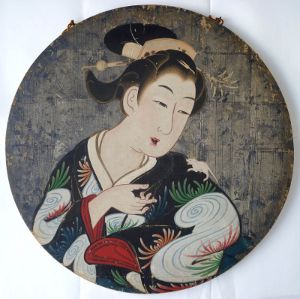
 Click here to view image full size. An interesting large painting, full colour on paper mounted on a wooden frame, 25.5 in; 62cms in diameter showing a bust portrait of a beauty with elaborate coiffure and a white mouse. Although not signed, the attribution is unquestionable, painted between 1767-1773 in Osaka. It appears to have been commissioned to hang in a hairdresser’s or cosmetic shop and has metal eyes at the top. The oxidised silver leaf background was meant to resemble a mirror and the idea of busts reflected in mirrors and silver grounds was later employed by Utamaro and Sharaku. Besides silver, gum and raised painting is applied. Such signboards appear in an illustrated book by Hasegawa Mitsunobu published in Osaka in 1752. This new discovery has been written about by Dr. Yamamoto Yukari in vol.27 of Minzoku Geijutsu (Ethno-Arts) in 2011. Minor surface marks all over but astonishingly good condition given their age and use. Extremely rare. Status: Sold  Click here to view image full size.

Totoya HOKKEI (1780-1850)

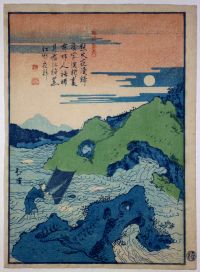
 Click here to view image full size. A fisherman with a scoop and net seemingly trying to catch the moon’s reflection. One of an excessively rare chuban series with title Toshi gafu no uchi, “Drawing Album for Chinese Poems” printed in red, and sub-title Toshin denshi. Printed in tones of blue except for a light flush on the horizon. Another impression ( trimmed ) was in the Vever collection ( ex Hayashi ), Sotheby’s, Part III, lot 295. Other impressions ( damaged ) are in the BM, ref: 1937, 0710,0,230 and Honolulu Museum of Art, ref: 14463. Hokkei was one of Hokusai’s best pupils and designed many fine surimono. Fine impression, colour and condition. Signed Hokkei. Status: Sold

Utagawa KUNIYOSHI (1797-1861)

 Click here to view image full size. Daimotsu-no-ura o-kassen. A triptych showing the battle of Dan-no-ura. The clash between the Minamoto (Genji) clans and the Heike (Taira) clans happened in 24/3/1185 when the Taira were defeated by Yoshitsune. He is shown here on the left making his leap pursued by Noritsune. The Imperial barge is in the background. Published by Moriya Jihei, 1856. Robinson T337. Fine impression and colour. Slight trimming, otherwise very good condition. Signed Ichiyusai Kuniyoshi ga. Status: Sold

Utagawa YOSHIHIDE (1832-1902)

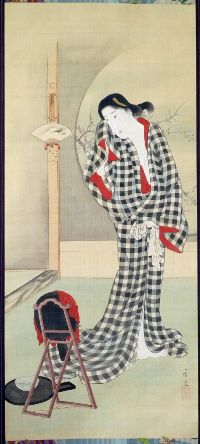
 Click here to view image full size. A painting in full colour on silk, 33.75 x 14.4 in; 85.6 x 36.6 cms. Shows a beauty after a bath looking down at her mirror. Yoshihide was a pupil of Kuniyoshi. In extremely good condition. Signed and sealed Sesso. Inscription guarantee on inside of box: “Late February in the 56th Year of the Showa era (1981).” Appraised, signed and sealed by Mr Tosuke Kimura. Status: Sold  Click here to view image full size.  Click here to view image full size.
Yanagawa SHIGENOBU (1787-1832)

 Click here to view image full size. A European couple in flagrante from a set Yanagi no arashi, “Storm of Willows” published c 1832. This highly unusual shunga print with chiaroscuro modelling is obviously based on imported woodcuts and engravings from Europe. There also exist several other shunga prints showing Dutchmen. See Shunga sex and pleasure in Japanese art, Timothy Clark et al, BM, 2013, no 120, p. 402. Very good impression, colour and condition. Mica applied to the vulva. The set is unsigned but generally accepted as being by Shigenobu. Status: Sold

Tsukioka SETTEI (1710-1786)

 Click here to view image full size. An interesting large painting, full colour on paper mounted on a wooden frame, 25.5 in; 62cms in diameter showing a bust portrait of a beauty with elaborate coiffure hanging paper acrobats. Although not signed, the attribution is unquestionable, painted between 1767-1773 in Osaka. It appears to have been commissioned to hang in a hairdresser’s or cosmetic shop and has metal eyes at the top. The oxidised silver leaf background was meant to resemble a mirror and the idea of busts reflected in mirrors and silver grounds was later employed by Utamaro and Sharaku. Besides silver, gum and raised painting is applied. Such signboards appear in an illustrated book by Hasegawa Mitsunobu published in Osaka in 1752. This new discovery has been written about by Dr. Yamamoto Yukari in vol.27 of Minzoku Geijutsu (Ethno-Arts) in 2011. Minor surface marks all over but astonishingly good condition given their age and use. Extremely rare. Status: Sold  Click here to view image full size.

Utagawa KUNIYOSHI (1797-1861)

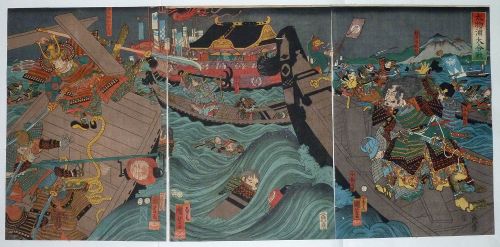
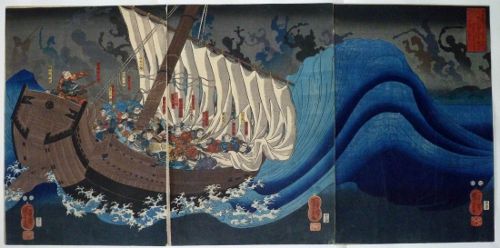
 Click here to view image full size. A triptych showing the ghosts of the Taira (Heike) warriors attempting to sink Yoshitsune’s ship off the coast of Settsu on his way to Shikoku. This is one of Kuniyoshi’s great designs – amongst the three or four best triptychs and is illustrated in numerous publications. The scene is the outcome of a great battle at Dan-no-ura where the Minamoto (Genji) clans clashed and defeated the Taira clans a few years earlier. The spirits of the drowned warriors rose up to seek revenge only to be pacified by Benkei reciting exorcisms with his rosary. Published 1849-52 by Enshuya Hikobei. Robinson T242. Rare. Very good impression and colour although slightly mismatched blue on the first and second sheets. Very good condition. Full size. There appear to be three states of this design: The main difference being in the shape of the ghosts and lines in the waves only on the first state. In this (the second state) the ghosts lack some of the features that are on the first and a large spirit appears above the wave over the ship on the centre panel. The third state has further differences in the ghosts and lacks this figure. Also, the colour of the boat gets greyer. Signed Ichiyusai Kuniyoshi ga. Status: Sold

Terasawa MASATSUGU (active c 1760-1790)

 Click here to view image full size.  Click here to view image full size. An original two-sided sumi block for printing pages 21, 22, 23, and 24 for the shunga book Aya no odamaki, “A Twist of Figured Cloth.” (See Sex and the Floating World, Timoin Screech, BM, 1999, p. 32-33.) The book was published in 1776. Also illustrated and described in Eiri Shunga Ehon Mokuroku, Tokyo 2007, p. 79. Extremely rare. Sold “as is” with imperfections (mostly wormage). See my blog. Status: Sold