Utagawa YOSHIKAZU (Active c. 1850-1870)

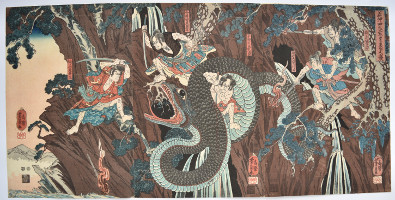
Click here to view image full size. A triptych showing The Four Heavenly Kings, loyal retainers of Kiso Yoshinaka (1154-1184) killing a giant snake. Yoshinaka no Shitenno Kiso okuyama ni kore o taiji su. Yoshinaka was a general of the Minamoto Clan. Published by Amatsu, 1851-2.     Fine impression. Very good colour. Sheets attached, otherwise very good condition. Signed Isshunsai Yoshikazu ga.     Status: Sold

Utagawa KUNISADA (1786-1864)

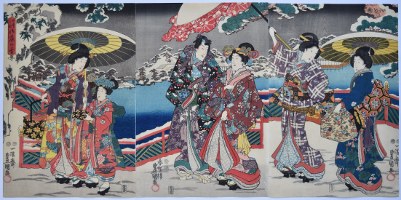
 Click here to view image full size. Winter from a set of the four seasons showing Prince Genji and attendants in the snow-covered grounds of a palace. Published by Enshuya Hikobei, c 1849-50.   Fine impression and colour. Slight trimming, otherwise fine condition. Signed Ichiyusai Toyokuni ga.   Status: Sold  

Ichiyusai KUNIYOSHI (1797-1861)

Click here to view image full size. A triptych Buzen no kuni oki manaita ga se, “The Chopping Block Shoals off the Coast of Buzen Province.” Shows the pilot and nobleman Yoshibei leaping to a rock and sacrificing himself to save his ship which was travelling to the capital from Kyushu when it was caught in a violent storm. Published c. 1850 by Mikawaya Tetsugoro. A wonderful and rare triptych.     Fine impression, colour and condition. Signed Ichiyusai Kuniyoshi ga.     Status: Sold

Utagawa TOYOKUNI I (1769-1825)

 Click here to view image full size. A surimono in the form of an ema (literally “picture-horse”) which were votive tablets left at Shinto shrines. The upper right plaque shows an actor in Shibaraku role with characters reading ganshu (temple petitioner) Bunri. Below, ten poems by poets from Edo, Kyoto and Osaka. The poem below the actor is signed Shikan which was the stage name and literary name of Nakamura Shikan I (Utaemon III, 1778-1838) who is most likely the actor portrayed. The text on the top left panel begins with San kudari indicating the 3rd came back, suggesting a return by Utaemon to Edo from acting in Kyoto or Osaka. Issued c 1810s. Very rare.   Very good impression, colour and condition. Signed Toyokuni ga.   Status: Sold  

Utagawa KUNIYOSHI (1797-1861)

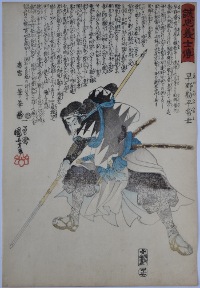
 Click here to view image full size. The ghost of Hayano Kampei Tsuneyo lunging forward with his spear. From the set Seichu gishi den, “Biographies of Loyal and Righteous Samurai” in other words, The forty-Seven Ronin. Published by Ebiya Rinnosuke, c 1847-8. Robinson S53.47.   Very good impression, colour and condition. This design is beautifully printed, the blue and sumi graded off to indicate the ghostly status of Tsuneyo. Signed Ichiyusai Kuniyoshi ga.   Status: Sold  

Ichiryusai HIROSHIGE (1797-1858)

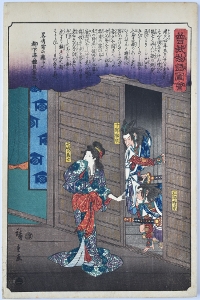
 Click here to view image full size. Oiso no Maihime telling the Soga brothers the whereabouts of Suketsune. From a set Soga monogatari zue, “The Revenge of the Soga Brothers.” A set of 30 prints published by Ibaya Senzaburo, 1848. This famous story has many versions but basically it tells how Kawazu Sukeyasu was murdered by his cousin Kudo Suketsune. Sukeyasu left two sons and his widow remarried a man named Soga. He adopted the two children and they waited patiently for an opportunity to kill Suketsune which came when he was hunting near Mt Fuji. They killed him but were themselves slain in the ensuing battle. This is the first edition, it was republished in 1858 by Yamaguchiya Tobei.   Fine impression and colour. Light album backing, otherwise fine condition. Signed Hiroshige ga.   Status: Sold  

Ichiryusai HIROSHIGE (1797-1858)

 Click here to view image full size. Kewaizaka no Shosho cuts her hair to become a nun. From a set Soga monogatari zue, “The Revenge of the Soga Brothers.” A set of 30 prints published by Ibaya Senzaburo, 1848. This famous story has many versions but basically it tells how Kawazu Sukeyasu was murdered by his cousin Kudo Suketsune. Sukeyasu left two sons and his widow remarried a man named Soga. He adopted the two children and they waited patiently for an opportunity to kill Suketsune which came when he was hunting near Mt Fuji. They killed him but were themselves slain in the ensuing battle. This is the first edition, it was republished in 1858 by Yamaguchiya Tobei.   Fine impression and colour. Light album backing, otherwise fine condition. Signed Hiroshige ga.   Status: Sold  

Ichiryusai HIROSHIGE (1797-1858)

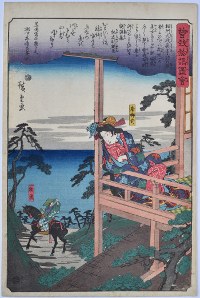
 Click here to view image full size. Soga no Juro on a horse lower left bids farewell to his lover, Tora Gozen. From a set Soga monogatari zue, “The Revenge of the Soga Brothers.” A set of 30 prints published by Ibaya Senzaburo, 1848. This famous story has many versions but basically it tells how Kawazu Sukeyasu was murdered by his cousin Kudo Suketsune. Sukeyasu left two sons and his widow remarried a man named Soga. He adopted the two children and they waited patiently for an opportunity to kill Suketsune which came when he was hunting near Mt Fuji. They killed him but were themselves slain in the ensuing battle. This is the first edition. It was republished in 1858 by Yamaguchiya Tobei.   Fine impression and colour. Light album backing, otherwise fine condition. Signed Hiroshige ga.   Status: Sold  

Ichiryusai HIROSHIGE (1797-1858)

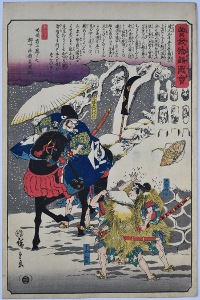
 Click here to view image full size. Soga no Juro and Soga no Goro attack Suketsune in the snow. From a set Soga monogatari zue, “The Revenge of the Soga Brothers.” A set of 30 prints published by Ibaya Senzaburo, 1848. This famous story has many versions but basically it tells how Kawazu Sukeyasu was murdered by his cousin Kudo Suketsune. Sukeyasu left two sons and his widow remarried a man named Soga. He adopted the two children and they waited patiently for an opportunity to kill Suketsune which came when he was hunting near Mt Fuji. They killed him but were themselves slain in the ensuing battle. This is the first edition , it was republished in 1858 by Yamaguchiya Tobei.   Fine impression and colour. Light album backing, otherwise fine condition. Signed Hiroshige ga.   Status: Sold  

Ichiryusai HIROSHIGE (1797-1858)

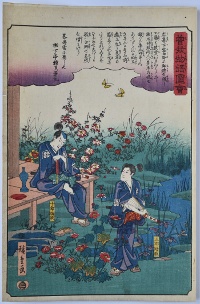
 Click here to view image full size. The Soga brothers bidding farewell to the summer foliage. From a set Soga monogatari zue, “The Revenge of the Soga Brothers.” A set of 30 prints published by Ibaya Senzaburo, 1848. This famous story has many versions but basically it tells how Kawazu Sukeyasu was murdered by his cousin Kudo Suketsune. Sukeyasu left two sons and his widow remarried a man named Soga. He adopted the two children and they waited patiently for an opportunity to kill Suketsune which came when he was hunting near Mt Fuji. They killed him but were themselves slain in the ensuing battle. This is the first edition, it was republished in 1858 by Yamaguchiya Tobei.   Fine impression and colour. Light album backing, otherwise fine condition. Signed Hiroshige ga.   Status: Sold  

Utagawa YOSHITSUYA (1822-1866)

 Click here to view image full size. A fine design showing the outlaw Yasusuke Hakamadare surrounded by a giant snake amidst falling leaves. He was able to disguise himself using the skins of animals and this translated into the notion that he could transform himself into these creatures or conjure them up as in the case of the battle between Raiko and Hakamadare where he invocates a giant snake. (The subject of another triptych design by Yoshitsuya.) From a rare set: Dai Nihon jutsu zukushi, “An Assortment of Magic in Great Japan.” This talented pupil of Kuniyoshi had a penchant for snakes, and produced some striking prints. Published 1861.   Fine impression. Very good colour and condition. Full size with extra paper around. Signed Ichieisai Yoshitsuya ga.   Status: Sold  

Utagawa HIROSHIGE (1797-1858) and Utagawa KUNISADA (1786-1865)

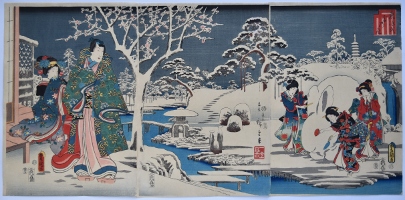
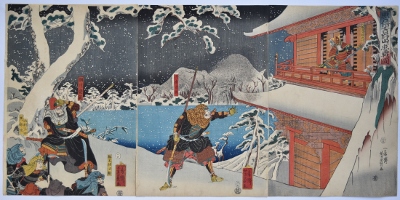
 Click here to view image full size. A triptych showing Mitsuuji, the romantic hero of the Inaka Genji (“A Rustic Genji”) accompanied by a beauty looking out across a snow-covered garden where a group of girls are building a giant snow rabbit. Hiroshige and Kunisada collaborated on a number of these Genji triptychs in the 1850s and this is one of the most charming. Published by Moriya Jihei of Kinshodo, 12/1854 (and therefore probably in anticipation of the following year, which was a Year of the Rabbit).   Very good impression, colour and condition. Signed Toyokuni ga and Yuki no kei oju, “Snow landscape by request” Hiroshige hitsu.   Status: Sold  

Ichiryusai HIROSHIGE (1797-1858)

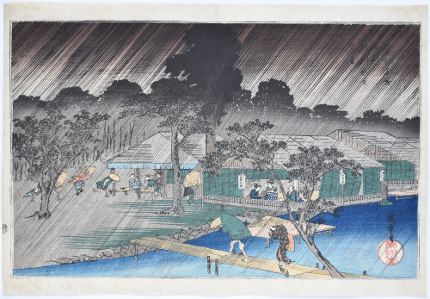
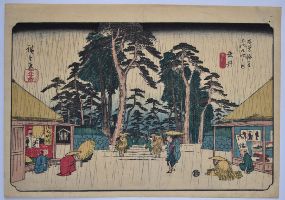
 Click here to view image full size. Tadasugawara no yudachi, “Evening Shower on the bank of the Tadasu River” from the early set Kyoto meisho no uchi, “Famous Views of Kyoto.” The set of ten masterpieces was published by Eisendo, c 1834. Shows figures running in the rain to get to the tea-houses which lined the banks here where the Kamo River and Takamo River joined.   Very good impression. The extremely rare first state of this print has the publisher’s seal in red in the upper left margin. This early state has the kiwame seal in left margin. This was removed on later editions and the seal after Hiroshige’s signature has the characters reversed white on red. Very good colour. Imperceptible centre fold, otherwise very good condition. Signed Hiroshige ga.   Status: Sold  

Utagawa YOSHIKAZU (Fl. 1850-1870)

 Click here to view image full size. The battle in snow at the Go-ju-no Pagoda on Mt. Yoshino. Sato Shirobyoe Tadanobu, a follower of Minamoto no Yoshitsune, swiches armour with Yoshitsune to do battle with the warrior monks led by Yokogawa Kakuhan. Published 1858 by Maruya Jinpachi.   Extremely fine impression with extensive splashed and sprayed gofun. Fine impression and condition. Signed Ichijusai Yoshikazu ga.   Status: Sold  

Utagawa YOSHIKAZU (Fl. 1850-1870)

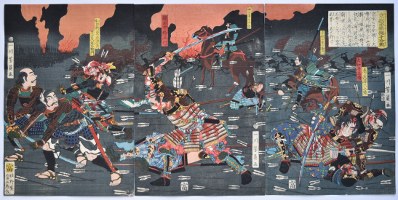
 Click here to view image full size. A triptych showing the battle of Shijo Nawate at Yoshino, Nara. Shows Kusunoki Masatsura of the Southern army in the centre amidst a hail of arrows battling the Northern armies in 1348. He was killed in this fight at the age of 22. Published by Sanoya Tomigoro, 1862.   Very good impression and colour. Very slight trimming, otherwise very good condition. Signed Ichikawa Yoshikazu ga.   Status: Sold  

Taiso YOSHITOSHI (1839-1892)

 Click here to view image full size. A triptych entitled Autumn Moon. A famous subject showing the aristocrat Fujiwara no Yasumasa playing his flute on a lonely moor and the bandit Hakamadare Yasusuke creeping up on him. So entranced was Hakamadare by the music that all he could do was to follow Yasumasa home. This is a version of a design published in 1868 with partially new blocks and an uncluttered background. It is regarded as a new design. Published by Katada Chojiro, 1884.   Fine impression and colour. Slight edge soil, otherwise very good condition. Signed Yoshitoshi.   Status: Sold  

Utagawa KUNIYOSHI (1797-1861)

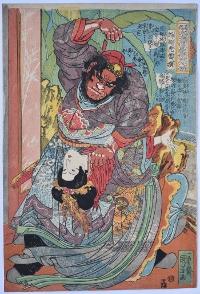
 Click here to view image full size. Soshiko Raio (Chinese: Lei Heng) gripping the throat of Lady Hakushuyei and about to strike her. A design from the fine set Tsuzoku Suikoden goketsu hyaku-hachi-nin no hitori, “The Hundred and Eight Heroes of the Popular Suikoden, One by One.” Based on the Chinese novel Shui Hu Zhuan, attributed to Shi’Nai’an, which tells of a band of 108 brigands who operated from Liangshan Marsh. Published by Kagaya Kichiyemon, 1827-30. Robinson S2.67.   Fine impression and colour. Full size (unusual as these prints are overlarge obans and usually trimmed down to the common denominator in albums). Signed Ichiyusai Kuniyoshi ga.   Status: Sold  

Utagawa KUNIYOSHI (1797-1861)

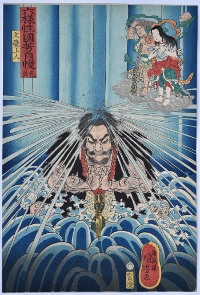
 Click here to view image full size. The priest Mongaku Shonin doing thirty-seven days penance under the freezing Nachi waterfall near Kyoto. He is helped by Fudo Myo-o’s two attendants Seitaka and Kongara seen here top right. This act of self-mortification is because he accidentally killed his beloved cousin Kesa. Published by Uoya Eikichi, 1860. A fine design.   Superb impression of the first state with splashed gofun over Mongaku’s head. Fine colour. Lightly backed and imperceptible centrefold, otherwise fine condition. Signed Chooro Kuniyoshi ga.   Status: Sold  

Taiso YOSHITOSHI (1839-1892)

 Click here to view image full size. Yamauba and Kintoki from a set of thirteen prints Ikkai zuihitsu, “A Miscellany by Ikkai,” this being an early name of Yoshitoshi’s. A strange print in more ways than one: Not only is this his most “Westernized” design, but the impression is a puzzle. There is a thought that the design is based on Raphael’s Santa Familia but it could as easily be a Botticelli. Certainly it looks to be after Madonna and child images he has seen. Also, this set has numerous variations in seals. Basically, it seems those with red or black seals in the margin are the earliest. However, this is a fine impression and has no seals. Published by Masadaya Heikichi, 1872.   Fine impression and colour (with Kintoki a deeper red than on other impressions). Very good condition. Signed Ikkaisai Yoshitoshi hitsu.   Status: Sold  

Utagawa TOYOKUNI I (1769-1825)

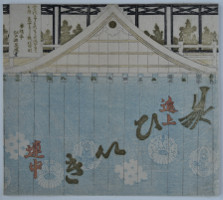
Click here to view image full size. Click here to view image full size. An extremely rare and unusual e-goyomi surimono for the year of the Horse, 1822, the long and short months running along the top of the theatre curtain. The surimono shows the Ichimura Theatre in Edo. The theatre curtain over the stage is a flap that hinges up to reveal the actors within. The characters on the curtain in pink and gold read: Shinjo hiiki renchu, “An offering from the [associated] patronage clubs.” (In fact, three fan clubs plus a daimyo, Mori Narimoto, whose poem top left is signed with his art name Ryuotei Edo No Hananari.) The three actors revealed are, from left to right, Seki Sanjuro II, Onoe Kikugoro V, and Ichikawa Danjuro VII in the play Three Famed Warriors Crossing Paths. However, they are not shown in character but dressed casually. Their emblems appear on the curtain: the waterfall-ascending carp for Danjuro; the chrysanthemum for Kikugoro; and the crosshatch for Sanjuro. Another impression is illustrated in The Private World Of Surimono, Sadako Ohki and Adam Haliburton, Yale University Press, 2020, no 59, p. 213. An impression missing the flap is illustrated in Surimono: Prints By Elbow, Edythe Polster and Alfred H. Marks, Lovejoy Press, 1980, F-D 1933-4-898, p. 441 and 437. Provenance: Ex H. Beres collection, sold Sothebys, Paris, 27/11/2002, lot 85. Seal on reverse.     Very good impression and colour with gold and silver. Very good condition. Signed Toyokuni ga.     Status: Sold    

Totoya HOKKEI (1780-1850)

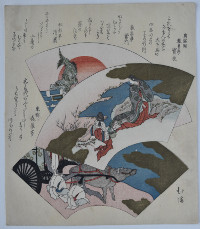
Click here to view image full size. A surimono showing three overlapping fans. The top fan shows the first sunrise of the new year behind a shachi on a castle roof. Usually called dolphins, they in fact had the head of a tiger and body of a carp. The second shows a court lady and attendant collecting young pines on the first day of the year. The third shows an imperial ox cart. Possibly for the Ox year 1829. Another impression was in the Adolphe Stoclet sale, Sothebys 8th June 2004, lot 463, p. 242. Poems by Shinshukei, Shigekado and Shinratei Manzo (leader of the Manjiren club).     Very fine impression and colour with gold and silver. Fine condition. Signed Hokkei.     Status: Sold

Yashima GAKUTEI (1786-1868)

 Click here to view image full size. A surimono – one of a series that Gakutei designed in the curved shape of a folding fan. Shows a seated poet before Mt. Fuji holding a fan and dressed in courtly robes with a New Year pattern of pine trees and an eboshi cap. Two others from the set are illustrated in The Art of Surimono, Roger Keyes, Sothebys, 1985, pl. 47, p. 89; and Sammeln Magazin, Nr. 6, Juni 1985, p.15. Issued c. 1821. Provenance: Ex Toni Strauss Negbaur collection, seal au verso.   Fine impression with Mount Fuji blind-printed. Very good colour and condition. Signed Gakutei.   Status: Sold  

Ichiryusai HIROSHIGE (1797-1858)

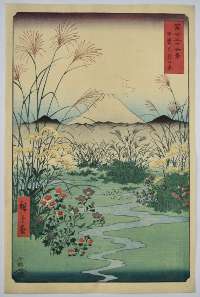
 Click here to view image full size. Kai Otsuki no hara, “The Otsuki Plain in Kai Province”. A meandering stream with flowers and pampas grass from Fuji sanjurokkei, “Thirty-six Views of Fuji” published by Tsutaya Kichizo, 1858. The set was started 5 months before Hiroshige’s death and early impressions were printed very carefully as a tribute to Hiroshige. One of the six best designs from the set.   Fine impression, colour and condition. Signed Hiroshige ga.   Status: Sold  

Ichiryusai HIROSHIGE (1797-1858)

 Click here to view image full size. Ishiyama no shugetsu, “Autumn Moon at Ishiyama” from a set of prints Omi hakkei no uchi, “Eight Views in Omi Province.” Shows Lake Biwa with Seta Bridge and Mount Hira in the distance. To the left is the temple where Murasaki Shikibu wrote her famous Tales of Genji. Published by Takenouchi, c. 1834-5. A guarantee label and seal au verso from the now deceased dealer M. Nakazawa.   Fine impression: There is a curious feature on this print in that the blue sky block is invariably printed short of the mountain, top left, giving a white gap around the mountain. This is one of the few impressions I have seen where it is barely visible. Fine colour. Slight edge soil, otherwise very good condition. Signed Hiroshige ga.   Status: Sold  
Ichiryusai HIROSHIGE (1797-1858)

 Click here to view image full size. The year-end festival, Toshi-no-ichi, at Asakusa, Edo. This Buddhist temple was dedicated to bodhisattva Kannon. From the set Rokuju yoshu meisho zue, “Famous Places in the Sixty-odd Provinces.” Published by Koshimuraya Heisuke between 1853-1856 (this being 1853). Thousands gathered at this time of year to pray one last time and to purchase New Year goods.   Extremely fine, early impression. Probably a variant first edition: without bokashi clouds as on Pulverer’s impression, but with the purple block partly printed over the trees left and right which is lacking on Pulverer’s. This maybe the earliest state. Fine colour and condition. Signed Hiroshige ga.   Status: Sold  

Ichiryusai HIROSHIGE (1797-1858)

 Click here to view image full size. Wakasa, gyosen karei ami, catching flatfish in Wakasa Province. From the set Rokuju yoshu meisho zue, “Famous Places in the Sixty-odd Provinces.” Published by Koshimuraya Heisuke between 1853-1856 (this being 1853). This province was famous for its flatfish caught in the offshore waters and was considered a winter delicacy.   Fine, early impression. Fine colour and condition.Signed Hiroshige ga.   Status: Sold  

Ichiryusai HIROSHIGE (1797-1858)

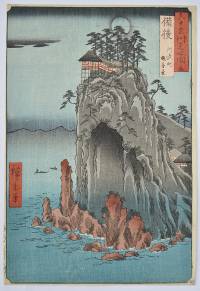
 Click here to view image full size. Bingo Abumon Kannondo. The temple of Kannon at Abumon, Bingo Province. From the set Rokuju yoshu meisho zue, “Famous Places in the Sixty-odd Provinces.” Published by Koshimuraya Heisuke between 1853-1856 (this being 1853).   Fine, early impression. The earliest states have a cloud printed top left (as here). Very good colour. Slight centre fold and trimmed close, otherwise good condition. Signed Hiroshige ga.   Status: Sold  

Ichiryusai HIROSHIGE (1797-1858)

 Click here to view image full size. Mitake from Kisokaido rokujukyu-tsugi no uchi, “Sixty-nine Stations of the Kisokaido.” The set of seventy prints was first published by Hoeido in 1835 with Eisen, but in 1837 Hiroshige took over and completed the series with the publisher Iseya Rihei (Kinjudo). The conjecture is that Hiroshige was the better known and more commercial artist, reinforced by the fact that Eisen’s name was removed from the designs already published. Hence, only the first editions have his signature on those prints. Shows a post station near to the famous Gankoji Temple. The inn and teahouse is advertising lodging.   Fine, very early impression. Fine colour and condition. Signed Hiroshige ga.   Status: Sold  
Ichiryusai HIROSHIGE (1797-1858)

 Click here to view image full size. Tarui from Kisokaido rokujukyu-tsugi no uchi, “Sixty-nine Stations of the Kisokaido.” The set of seventy prints was first published by Hoeido in 1835 with Eisen, but in 1837 Hiroshige took over and completed the series with the publisher Iseya Rihei (Kinjudo). The conjecture is that Hiroshige was the better known and more commercial artist, reinforced by the fact that Eisen’s name was removed from the designs already published. Hence, only the first editions have his signature on those prints. Shows a daimyo’s cortege entering the station. On either side the villagers can be seen deferentially kneeling. This print is one of the few designs to show prints for sale. In this case on either side of the road, the shops doubling as teashops. The publisher’s mark Kinjudo can be seen on the left-hand shop.   Very good impression, colour and condition. Signed Hiroshige ga.   Status: Sold  

Okumura MASANOBU (1686 -1764)

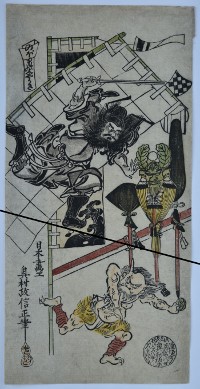
Click here to view image full size. An hosoban showing banners for the Boy’s Festival held on the fifth day of the fifth month. These depicted Shoki, the Demon Quellor. One Shoki has come alive and leaps down from the banner to attack an oni – his traditional foe. At the top left on a small banner is the title: Nobori no Shoki, “Shoki the Devil-Quellor.” Masanobu was one of the most influential artists in Ukiyo-e. His long life covered hand-coloured prints through to full colour printing in the mid 1760s and he was one of the first to use the block-printing process after 1740 and pioneer the benizuri-e picture. Extremely innovative: he pioneered the uki-e print, pillar print and ishizuri-e. Not only was he a print artist, he also illustrated books, albums and produced paintings. He started his own publishing house, Okumuraya, which gave him greater control over the printing process. The popularity of his work led to many copies by other publishers, and he had to certify his work as being the “genuine” article. Published c 1725 by Tori-shio-cho, kongen Okumura hammoto. Kono ho no e nise han soro aida hyotan shirushi idashi soro. Provenance: Ex Schindler collection with seal au verso. See Masterpieces Of Ukiyoe-e Prints from The Schindler Collection, Nihon Keizai Shimbun Inc., 1985, no. 8, page 22. Extremely rare.     Very good impression and colour. Urushi: hand coloured with yellow, tan, green and sumi wash. Small edge repair top left, otherwise very good condition. Signed Nihon gwako Masanobu sho-hitsu with Okumura seal.     Status: Sold