Santo KYODEN (Kitao MASANOBU) (1761-1816)

Click here to view image full size. A pair of original paintings, full colour on silk, image size 38.5 x 15.5 in; 97.75 x 39.5 cms. Shows a courtesan on the left with a portrait of a novelist on the right. The paintings are signed “By special request” and were presumably commissioned by the novelist showing his paramour. I have not identified the novelist. Masanobu was a pupil of Shigemasa and was one of the leading authors and illustrators of kibyoshi, ehon and kyoka anthologies as well as being a painter and print artist. He illustrated the fine set of double-oban prints of courtesans in 1783-4: Yoshiwara keisai shin bijin awase jihitsu kagami. These painting must come from around this date as the pose of the courtesan is very similar to some of the figures in the above album. A controversial figure who ran foul of the authorities in 1789, subsequently ceasing to use the name Kitao Masanobu and thereafter his paintings are always spontaneous in an abbreviated style, often quite slight and signed Kyoden. Paintings fully finished like this are rare. In generally very good condition, although some loss of gofun. Signed Oju Kyoden Masanobu ga on each painting.     Status: Available Price:  £4,200     Click here to view image full size. Click here to view image full size.

Kubo SHUNMAN (1757-1820)

Click here to view image full size. One of a series of surimono with title: Guncho gafu, “ Pictorial Record of a Swarm of Butterflies.” (In fact butterflies and moths.) Shunman is recognised as possibly the greatest designer of surimono and the prints from this set are amongst the most beautifully printed in this field. His family were printers and this would explain their particular excellence. In fact it is possible that Shunman engraved and printed himself which would account for his seal on other artists’ surimono. Issued c 1810s by the Kasumi-ren poetry club. (Their seal above the signature, top right, Kasumi-ren guncho gafu.) There are copies of the prints from this set which can be very misleading. Two other genuine impressions are in Harvard, 1933.4.1375 and the Met, JP2356.   Very fine impression. Fine colour. Slight discolouration and crinkling at the corners, otherwise good condition. Signed Sho Shunman sei.   Status: Available Price:  £7,200  

Sakai HOITSU (1761-1828)

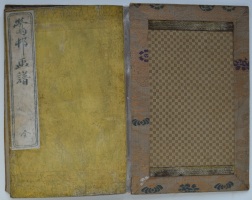
Click here to view image full size. One volume complete Oson gafu, “Drawing Book of Oson.” (This being one of the artist’s names taken from the village Uguisu-mura where he lived in retirement.) The Rimpa artist Hoitsu revived the work of Ogata Korin (1658-1716). Dated on the first preface Bunka 13 (1816) and was originally published by Izumiya Shojiro, but this is an early reissue published by Tohekido (Eirakuya Toshiro in Nagoya). Another impression is in the BM, 1942,0918,0.2. Twenty-five double-page illustrations in muted tones of birds, flowers, figures, etc. Original yellow covers with title slip. Bound in Japanese brocade boards. This was a method used by the leading French collectors of Japanese books such as Javal, Duret, Haviland, Gonse, etc, hence, this will have come from one of those collectors. A very nice copy with only minimal marks.   Status: Available Price:  £1,450   Click here to view image full size. Click here to view image full size. Click here to view image full size. Click here to view image full size.

Utagawa KUNISADA II (1823-1880)

Click here to view image full size. A triptych showing the fight on the roof of the Horyukaku Tower of Koga Castle beside the Tone River. A popular scene from the complex novel Nanso Satomi Hakkenden, “The Diary of Eight Dogs” by Takizawa Bakin (1767-1848). The macabre tale revolves around the eight offspring of a supernatural marriage between a princess and her father’s dog and their commitment to restore the fortunes of the samurai house of Satomi. Shows Inuzuka Shino Moritaka defending himself against the chief of police Inukai Kempachi Nobumichi. Published by Tsutaya Kichizo 1854.   Very good impression, colour and condition. Signed Ichijusai and Baichoro Kunisada ga.   Status: Available Price:  £2,300  

Ryuryukyo SHINSAI (1764-1820)

Click here to view image full size. An original painting, sumi and light colour on silk, 32 x 11 in; 81.3 x 28 csms. Shows three classes in Japanese society: Farmer’s wife, Priest and a Samurai, forced to shelter together at the entrance to a Shinto shrine from a sudden downpour of rain. Above, a rooster and hen also shelter. These birds were allowed to roam freely around Shinto Temples. Shinsai was one of Hokusai’s best pupils. Known for his fine surimono and paintings. Signed Ryuryukyo Shinsai with Ryuryukyo seal. In good condition.   Status: Available Price:  £1,800   Click here to view image full size.

Utagawa KUNIYOSHI (1797-1861)

Click here to view image full size. The priest Nichiren standing on the rocky promontory at Reizan in Kamakura and having his prayers for rain answered. The event occurred in 1271. His disciples surround him and protect him from the deluge with a large umbrella. Bunei hachi Kamakura Reizan-ga-saki uki. The second best design from Koso [Nichiren] goichidai ryakuza, “Illustrated Abridged Biography of the Founder.” Nichiren (1222-1282) was the founder of the Buddhist Nichiren sect (Nichiren shu – Kuniyoshi being a follower) and indeed the set of ten prints may have been commissioned to mark the 550th anniversary of his death. Published by Iseya Rihei, c 1831.   Fine impression, colour and condition. Ample room on top border for the umbrella which protrudes beyond the border and is often trimmed off, as is the information on right border. Signed Ichiyusai Kuniyoshi ga.   Status: Available Price:  £4,800  

Kitagawa FUJIMARO (1790-1850)

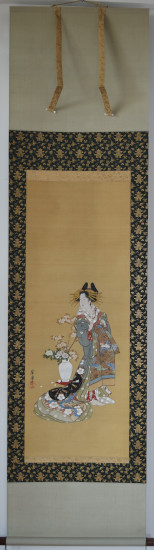
Click here to view image full size. An original painting, full colour on silk, image size 35.25 x 13.5 in; 89.5 x 34.5 cms. Fujimaro was a talented late pupil of Utamaro. More than a dozen paintings are recorded by him including an example in the Portland Art Museum, acc. number 69.51. His best-known work is in the collection of the Tokyo National Museum depicting Yujyo risshi-zu and another four paintings of beauties in the four seasons is in the collection of the Ota Memorial Museum of Art, Tokyo. Shows a standing courtesan beside a vase containing peonies and cherry blossom. On her sumptuous costume are the black wheels of a hanaguruma, “flower cart.” These vehicles carried baskets with often elaborate arrangements of flowers. It seems more than coincidence that the vase is placed where the basket would have been on the cart.     Painted c 1820. Signed Fujimaro with seal Yozan. Newly remounted and in fine condition with new box and futo-maki (thick wooden roll to preserve the painting from damage).     Status: Available Price:  £9,500     Click here to view image full size.

Kikukawa EIZAN (1787-1867)

Click here to view image full size. An original painting by Eizan, sumi and full colour on silk, 37 x 13 in; 94 x 33 cms. Eizan was the leading exponent of bijinga in the early 1800s. He founded the Kikukawa School with Eisen his best known pupil. He was left-handed which was somewhat unusual. Shows a standing geisha, her shamisen case at her feet. This musical instrument was frequently associated with the world of courtesans.     Very minor marks, otherwise very good condition. Signed Kikukawa Eizan with seals Kikukawa Toshinobu.     Status: Available Price:  £12,000     Click here to view image full size.

Matsumura GOSHUN (1752-1811)

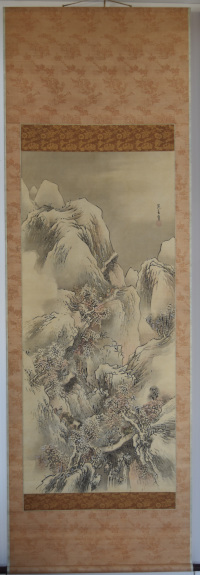
Click here to view image full size. An original painting, sumi and light colour on silk, 49 x 22 in; 124.5 x 56 cms. Shows a mountainous landscape in snow with figures on a narrow footpath between overhanging cliffs. Goshun was a highly influential artist, known for his geniality and mastery, not only of painting, but of poetry and calligraphy. A pupil of Yosa Buson and then much influenced by Okyo. Founded the Shijo School (named after the street on which he lived in Kyoto). His mature style dates from around 1795.   A large and excellent example of his work in very good condition. Signed Goshun utsusu with seal Goshun.   Status: Available Price:  £6,800   Click here to view image full size.

Maekawa SENPAN (1888-1960); Okamoto IPPEI (1886-1948); Kondo KOICHIRO (1884-1962) et al

Click here to view image full size. A set of two handscrolls in original paulownia storage box, 30 feet x 10 in; 914.4 x 25.4 cms. Sumi and full colour on paper by 18 artists of the Tokyo Manga Association, produced in 1921: 27 paintings in scroll 1; 28 paintings in scroll 2. The scrolls are a modern manga rendering of the Tokaido Road in homage to Hiroshige, the artists following and interpreting the same route that Hiroshige walked. Satirical and comedic showing the modernisation of Japan at a time manga was gaining popularity due to publications like the Jiji Manga newspaper supplement, previously known as the Ponchi, “Punch.” 150 sets were produced (although some sources give as many as 250-300 being made). No two sets are exactly the same ; indeed, some artists changed their designs substantially. Tokaido gojusan-tsugi Manga emaki, “Manga Handscrolls of the Fifty-three Stations of the Tokaido Highway.” Inside lid inscription: Tokaido emaki, dojin juhachi mei hitsu, “Tokaido handscrolls, painted by eighteen members.” Tokyo Chuo Bijutsukai dated Taisho 10 (1921).   A fascinating historical document. Some slight separation in the scrolls, but otherwise in very good condition. Various signatures and seals.   Status: Available Price:  £2,200     Click here to view image full size. Click here to view image full size. Click here to view image full size. Click here to view image full size.

Utagawa HIROSHIGE (1797-1858)

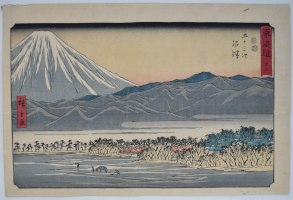
Click here to view image full size. Station Numazu from a set Tokaido gojusan tsugi, “The Fifty-three Stations of the Tokaido Road,” aka the Reisho Tokaido from the clerical script used in the title, or the Marusei Tokaido after the publisher Maruya Seijiro (Marusei) who published the set 1847-52. An impressive view of Mount Fuji seen from the plains of Suruga. The village of Numazu is seen on the right amongst the trees.   Very fine impression. Fine colour and condition. Signed Hiroshige ga.   Status: Available Price:  £1,500  
Utagawa HIROSHIGE (1797-1858)

Click here to view image full size. Station Okitsu from a set Tokaido gojusan tsugi, “The Fifty-three Stations of the Tokaido Road,” aka the Reisho Tokaido from the clerical script used in the title, or the Marusei Tokaido after the publisher Maruya Seijiro (Marusei) who published the set 1847-52. The Kiyomi Barrier and Seiken Temple near Okitsu.   Very fine impression. Fine colour and condition. Signed Hiroshige ga.   Status: Available Price:  £1,800  

Utagawa HIROSHIGE (1797-1858)

Click here to view image full size. Station Ejiri from a set Tokaido gojusan tsugi, “The Fifty-three Stations of the Tokaido Road,” aka the Reisho Tokaido from the clerical script used in the title, or the Marusei Tokaido after the publisher Maruya Seijiro (Marusei) who published the set 1847-52. Located on the west side of Suruga Bay, close to the famous beauty spot of Miho no Matsubara.   Very fine impression. Fine colour and condition. Signed Hiroshige ga.   Status: Available Price:  £1,500  

Utagawa HIROSHIGE (1797-1858)

Click here to view image full size. Station Kanbara from a set Tokaido gojusan tsugi, “The Fifty-three Stations of the Tokaido Road,” aka the Reisho Tokaido from the clerical script used in the title, or the Marusei Tokaido after the publisher Maruya Seijiro (Marusei) who published the set 1847-52. Kanbara, Fujikawa funawatashi, “Kanbara, Ferryboat on the Fuji River.”   Very fine impression. Fine colour and condition. Signed Hiroshige ga.   Status: Available Price:  £1,800  

Tsukioka YOSHITOSHI (1839-1892)

Click here to view image full size. A silhouetted fireman faces a conflagration; in his left hand he holds a matori, a three-dimensional standard which identifies him and his location. Enchu no tsuki, “Moon and Smoke” from Tsuki hyakushi, “One Hundred Aspects of the Moon.” Published by Akiyama Buemon (Akiyama Seikichi) 1885-1892, this being 1886. The firemen’s heavily-quilted jackets were soaked in water to better enable them to withstand the heat. They were notorious for their rowdy behaviour and rivalrous nature leading to open hostility with other groups such as sumo wrestlers. Fires were a constant threat due to the building materials used, and firefighters were not above starting fires themselves in order to be the first on the scene (especially if they were in the construction business).   Fine impression, colour and condition. Signed Yoshitoshi. A gourd-shaped collector’s seal (unread) in the extreme left bottom which is found on other early impressions of this set.   Status: Available Price:  £2,400  
Utagawa KUNISADA (1786-1864)

Click here to view image full size. The actor Ichikawa Ebizo V (Ichikawa Danjuro VII) in a Shibaraku scene as the warrior Usui Arataro Sadamitsu (Taira no Tadamichi) adopting the cross-eyed mie expression to show great emotion. From an untitled set of large-head portraits of actors, past and present, published by Ebisuya Shoshichi (Kinshodo) between 1860 and 1865, this being 1860. Kunisada, in his old age, planned this set to have 150 designs but only 72 were completed (with the help of Utagawa Yoshitora). Only the best materials and most experienced engravers and printers were employed, the cost being mitigated by the Mitani copper and iron merchant family.   Fine impression with heavy burnishing on the hair. Very slight fading, otherwise very good colour. Very good condition. Signed Toyokuni ga.   Status: Available Price:  £5,800  

Utagawa KUNIYOSHI (1797-1861)

Click here to view image full size. The warrior Eda Genzo Hirotsuna avoiding a hail of arrows during the defence of Minamoto Yoshitsuna’s palace at Horikawa, Kyoto in 1185. He was killed during the night attack. Horikawa seiran, “Clearing Weather at Horikawa” from the set Yobuhakkei, “Military Brilliance for the Eight Views.” Each of the eight prints has an association, either pictorially, thematically or by place with the famous Eight Views originating from China. Published by Enshuya Hikobei (Enhiko) 1852. Unidentified collector’s seal au verso.   Very fine impression, colour and condition. There are later states lacking the subtleties of the first printings. Signed Ichiyusai Kuniyoshi ga.   Status: Available Price:  £1,900  
Keisai EISEN (1790-1848)

Click here to view image full size. Jakko Nunobiki no taki, “The Hanging Cloth Waterfall at Jakko Shrine.” So-called because it falls in seven-tiers. The shrine is seen below the fall. From a set of five prints: It was probably intended to be a set of three prints but another two were added, possibly with the intention of going on to emulate Hokusai’s waterfall set. Nikkosan meisho no uchi, “Celebrated Views in the Nikko Mountains.” Published by Yamamotoya Heikichi (Eikyudo) c. 1843-47. In contrast to Hokusai’s set, Eisen’s have a more muscular appearance. See: The Japanese Print: A New Approach, J. Hillier, Bell & Son, 1960, Chapter XVI, where Jack Hillier discusses Eisen and his landscapes and considers this set “… is perhaps the crowning achievement of his career as a designer of landscape prints.”   Fine impression. (Late impressions are not known of this set, probably due to not having the popularity of Hokusai’s set.) Slight fading, otherwise very good colour. Very good condition. Signed Keisai Eisen utsusu.   Status: Available Price:  £6,800  
Keisai EISEN (1790-1848)

Click here to view image full size. The Kirifuri waterfall, Kirifuri no taki, santaki no sono ikkei, “The Falling Mist Waterfall, View of One of the Three Falls.” From a set Nikkosan meisho no uchi, “Celebrated Views in the Nikko Mountains.” A group of travellers admire the fall from below. From a set of five prints: It was probably intended to be a set of three prints but another two were added, possibly with the intention of going on to emulate Hokusai’s waterfall set. Published by Yamamotoya Heikichi (Eikyudo) c. 1843-47. In contrast to Hokusai’s set, Eisen’s have a more muscular appearance. See: The Japanese Print: A New Approach, J. Hillier, Bell & Son, 1960, Chapter XVI, where Jack Hillier discusses Eisen and his landscapes and considers this set “… is perhaps the crowning achievement of his career as a designer of landscape prints.”   Fine impression. (Late impressions are not known of this set, probably due to not having the popularity of Hokusai’s set.) Very good colour and condition. Signed Keisai Eisen utsusu.   Status: Available Price:  £9,000  

Tsukioka YOSHITOSHI (1839-1892)

Click here to view image full size. A triptych showing horse racing in Tokyo. Tokyo Shokonsha [the original name of the Yasukuni Shrine] naigaijin keiba no zu, “Horse Racing for Foreigners and Japanese in Shokonsha Tokyo.” From Tokyo kaika kyoga meisho, “Comic Pictures of Civilised Tokyo.” Published by Maruya Jinpachi (Marujin) 1871. The first Western-style horse racing was established by – mainly British – residents in the form of the Yokohama Race Club in 1862.   Fine impression: Later states lack the wood-pattern background on the title panel. Fine colour and condition. Signed Oju Keisai Yoshitoshi.   Status: Available Price:  £2,200  

Utagawa YOSHITSUYA (1822-1866)

Click here to view image full size. A triptych Uto Yasukata chugi den, “The Tale of Faithful Uto Yasukata.” Shows Shogun Taro Taira no Yoshikado (centre); Princess Takiyasha right); and Uto Yasukata and his wife (far left) turning into birds. Set in the ruins of Soma Palace. Takiyasha releases a ghost from a cauldron. A difficult triptych to interpret. (More information is available on the Lyon collection website: woodblockprints.org.) Published by Tsujiokaya Bunsuke (Tsujibun) 1852-53.   Fine impression and colour. Small edge binding holes on centre sheet, otherwise very good condition. Signed Ichieisai Yoshitsuya ga.   Status: Available Price:  £3,000  

Toyohara KUNICHIKA (1835-1900)

Click here to view image full size. A diptych showing the actor Ichikawa Danjuro IX as Kamakura Gongoro Kagemasa in the drama Shibaraku, “Just a moment.” The large sansho (three square) motif was the symbol of the Danjuro clan and is repeated around the border. In the background are peonies, also associated with the Danjuro clan. Published by Tanaka Katsuzo, 1878.   Fine impression, colour and condition. Signed Oju Toyohara Kunchika hitsu.   Status: Available Price:  £1,250  

Tsukioka YOSHITOSHI (1839-1892)

Click here to view image full size. A triptych showing carp swimming beneath wisteria. A rare and extremely unusual subject in Yoshitoshi’s canon of work. Koi are symbols of love and friendship in Japan. The breeding of ornamental carp began in the 1820s. The outside world was unaware of the advances in breeding colour variations until an annual exposition in Tokyo in 1914. Published by Akiyama Buemon, 1889. There is an original drawing, most likely for this triptych, elsewhere on this site. A much sought after design.   Very fine impression. Fine colour. Completely untrimmed with the extra margins around. Fine condition. Signed Yoshitoshi ga.   Status: Available Price:  £12,500  

Keisai EISEN (1790-1848)

Click here to view image full size. An amorous couple from an unsigned abuna-e (from abunai, risqué) set of twelve prints Keisai higo, “Secret Words of a Courtesan” published c. 1822-25. Although coming under the heading of shunga, each print is without any graphic details. She adjusts his hair with her hairpin while he smokes a pipe.   Fine impression, colour and condition. (Without centre fold, which is often encountered on this set.   Status: Available Price:  £1,800  

Mori SOSEN (1747-1821)

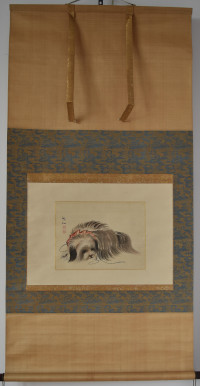
Click here to view image full size. An original painting, sumi and light colour on silk, image size 8 x 10.75 in; 20.5 x 27.5 cms. His life is not well documented but he is known to have studied under the Kano artist Yamamoto Joshunsai (? -1781) before being drawn into Mauyama Okyo’s (1735-1795) artistic circle and his style is more Shijo than anything else. His animal paintings were evidently highly valued by Okyo. He was an immediate favourite with eastern collectors because of his monkey paintings at which he excelled, although he was more versatile than literature implies and highly accomplished at drawing other animals (as here). But his images of monkeys take precedence and he is considered the pre-eminent painter, east or west, on this subject. It is alleged that he lived in the woods for three years eating fruit and nuts to study the monkeys and other animals and is also supposed to have had a cage of monkeys at the back of his house to better observe them.   Shows a Japanese Chin. These small dogs are supposed to have been introduced to the Japanese court from China early on but their distinctive features were developed in Japan. Signed Sosen with seals Shusho. In very good condition.   Status: Available Price:  £2,800  

Tsukioka YOSHITOSHI (1839-1892)

Click here to view image full size. Uesugi Kenshin Nyudo Terutora. Shows Uesugi no Terutora (aka Kenshin) riding into battle through clouds of smoke against his long-standing adversary Takeda Shingen. From a set of 33 prints Yoshitoshi musha burui, “Yoshitoshi’s Courageous Warriors.” Published by Kobayashi Tetsujiro between 1883 and 1886, this being 1883. A fine design.   Very fine impression of the first edition. (Which should have a three-colour cartouche; two red seals and the publisher’s address in blue in the left margin.) It was reprinted by Tsunajima Kamekichi in 1886 and there are many late printings of the set. Fine colour and condition. Full size with extra paper at left. Signed Taiso Yoshitoshi ga.   Status: Available Price:  £1,400  

Tsukioka YOSHITOSHI (1839-1892)

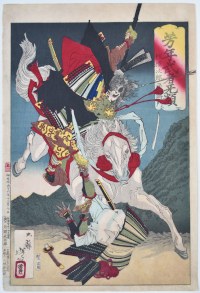
Click here to view image full size. Shows Sagami Jiro Taira no Masakado on horseback attacking an opponent and having cut his sword in two. From a set Yoshitoshi musha burui, “Yoshitoshi’s Courageous Warriors.” Published by Kobayashi Tetsujiro, 1883.   Very fine impression: This is the first edition with three-colour cartouche and small red seals in left margin. There are late editions of this set. It was republished by Tsunajima Kamekichi in 1886. Fine colour. Slight soil bottom edge, otherwise very good condition. Signed Taiso Yoshitoshi ga.   Status: Available Price:  £1,400  

Toyohara KUNICHIKA (1835-1900)

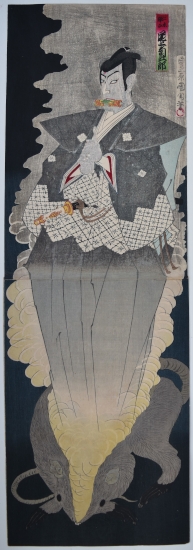
Click here to view image full size. A vertical diptych showing the actor Onoe Kikugoro V as the archvillain and sorcerer Nikki Danjo emanating in a cloud of smoke from his alter ego – the giant rat. He holds in his mouth the scroll containing the names of the conspirators given to Masaoka which he has purloined. This is one of the great scenes in Kabuki from the play Meibuku Sendai hagi, “Precious Incense and the Bush Clover of Sendai.” Kikugoro rises through a trapdoor (suppon) which is on the hanamachi leading out from the Kabuki stage. Published by Fukuda Kumajiro, 1887. Rare.   Very good impression and colour. Heavy oxidation, otherwise very good condition. Signed Toyohara Kunichika fude.   Status: Available Price: £4,200  

Utagawa KUNIYOSHI (1797-1861)

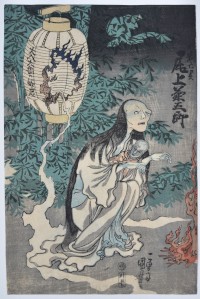
Click here to view image full size. The actor Onoye Kikugoro III as the ghost of Oiwa from a production of Yotsuya kaidan at the Morita Theatre, 1836. Probably the most famous Japanese ghost story. It was adapted by the playwright Tsuruya Nanboku IV for his friend Kikugoro in 1825. The left panel of a diptych (the right panel being boring and usually ignored). A scene on Snake Mountain showing Oiwa, disfigured by poison, emerging from a burning lantern to haunt her husband, Tamiya Lemon, who had murdered her father. Published by Kawaguchi-ya Chozo, 1836.   Very good impression, colour and condition. Signed Ichiyusai Kuniyoshi ga.   Status: Available Price:  £1,350  

1764-65 – a pivotal year for Ukiyoe-e

The years 1764/5 are now recognised as the most pivotal in the development of Ukiyo-e. Prior to this year fully polychrome prints were rarely produced. The ability to ‘key’ more than one block been known had for some time using the simple expedient of kento marks cut in relief – a right-angle in the corner, and a horizontal line down the side. However, around 1764/5, a number of favourable circumstances – namely a period of permissiveness in the arts and the proliferation of literary and poetry clubs – gave rise to the e-goyomi print (calendar-print), probably instigated by Jinshiro Tadanobu (Kikurensha Kyosen), founder of the Kikuren Club.   Calendar-prints were a government-controlled monopoly. The none-government clubs this circumnavigated by hiding the dai-sho (long and short months) numerals in various parts of a print’s design. Also, in the development of the colour print process, a tweak was made to the kento marks by the insertion of a sliver of wood; this enabled finer adjustments to be made with the keying of the blocks to compensate for expansion or contraction of the paper (or indeed the blocks). This refinement made it possible for numerous blocks to be used. The clubs commissioned the printers to use the thicker more luxurious hosho paper and a wide range of new pigments. These luxurious prints also often used over-printing and blind-printing.   Harunobu was in the right place at the right time to fully exploit these advances and the next few years would see a huge increase in Harunobu’s output, from initially designing the private e-goyomi to having them commercially sold and going on to produce a large corpus via commercial publishers. Harunobu died in 1770 but the decade saw some of the most exquisite compositions by him that were seldom surpassed in the refinement of…