Utagawa HIROSHIGE (1797-1858)

Click here to view image full size. Kozuke, Harunasan setchu, “Kozuke [Province], Mount Haruna Under Snow.” From a set of 69 prints [Dai Nihon] Rokujuyoshi meisho zue, “Famous Places in the Sixty-odd Provinces [of Japan]” published by Koshihei between 1853 and 1856, this being 1853. A red bridge spans a gorge with precipitous cliffs and a fast flowing river. Fantastic crags point upwards into the sky. In the distance is Mount Haruna – a sleeping volcano.   Very fine impression and colour. Light album backing, otherwise fine condition. Signed Hiroshige ga.   Status: Sold  

Oku BUMMEI (?-1813)

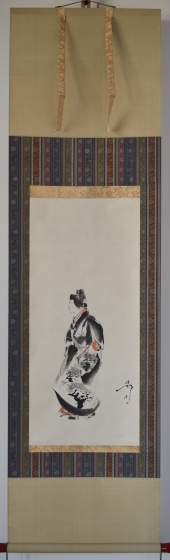
Click here to view image full size. A Maruyama school artist and “One of the ten most notable pupils of Okyo.” A contributor to the anthology Keijo gaen of 1814. Shows a strolling courtesan composed of almost limpid brush strokes creating an ethereal image of the floating world. Sumi and light brown-red on paper, 41.25 x 11.75 in; 104.75 x 29.75 cms. Mount and painting in very good condition. Signed Bummei and undecipherable seal.   Status: Available Price:  £1,500 Click here to view image full size. Click here to view image full size. Click here to view image full size.

Ichiunsai KUNIHISA II (1832-1891)

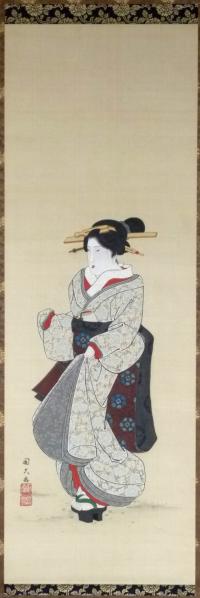
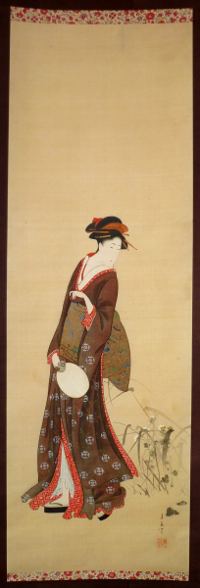
Click here to view image full size. A fine work of the artist, c 1850s. The pupil and son-in-law of Kunisada. A beauty promenading. Sumi and full colour on silk. Image size 34 x 11.75 in; 86.5 x 29.5 cms. Fine condition. New mount and box. Signed Kunihisa ga. Seals unread.     Status: Available Price:  £1,900     Click here to view image full size. Click here to view image full size. Click here to view image full size.

Ichiryusai HIROSHIGE (1797-1858)

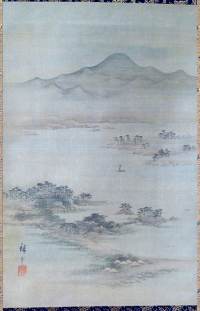
 Click here to view image full size. An original painting, sumi and light colour on light green-coloured silk, 21.37 x 13.62 in; 51.8 x 34.7 cms. The location is unidentified but shows an inland sea with a promontory and shrine. A beautiful, lyrical landscape probably painted in Kaei era (1848-54). In good condition and has recently been remounted with a futo-maki wooden role. Signed Hiroshige with Ichiryusai seal.   Status: Sold    Click here to view image full size.  Click here to view image full size.  Click here to view image full size.

Unknown

 Click here to view image full size. An interesting folding map showing Edo Tokyo. Sumidagawa in the East and Shinagawa in the West, all dominated by the Tokugawa Shogun’s residence at the centre, with civic information and measurements from Nihonbashi, and annual events. Dated Ox 8 (1853). Good condition.     Status: Available

Some ways to identify first and early impressions

First and early impressions best convey the intentions of the artist and publisher. High quality impressions can be identified by clear, unbroken key-block outlines, especially on any faces or title cartouches; visible wood-grain – the ‘finger print’ of every Japanese print and the depth of impression, which can often be sensed with the fingertip, especially when thicker, or deluxe hosho was used. The following techniques are indicative of and are best demonstrated on only the earliest editions: Bokashi – subtleties of careful gradation, sometimes merging colours one to another or shaded to give form and depth. Fukibokashi – the spraying of pigments or the splashing of gofun (white pigment). The addition of rice flour or mica to give sparkle to colours.   Example of a First Edition Print: Ichiryusai Hiroshige – “Ferryboats to Zenkoji Temple at Kawaguchi”     How many impressions were produced?   Dealers in ukiyo-e are often asked how many impressions were produced or what is the edition? This is a difficult question to answer because of the limit to the information available to us, however the writings of Mr Tokuno (1893)[1] and Mr Watanabe(1936)[2] give us good insight into the printing process and the number of impressions produced.   Before the 20th century, no Japanese print was numbered except to denote the chapter in a series or a station on a highway. In the 19th century mainstream print production was structured to sell as many copies as possible for modest amounts – some prints being sold then for the cost of a bowl of noodles. Ukiyo-e can be seen to have been one of the most democratic art forms and vast numbers of prints were produced.   The consensus of opinion is that ‘editions’ (ippai) of around 200 prints were pulled concurrently. The number of editions…

Watanabe SEITEI (1852-1918)

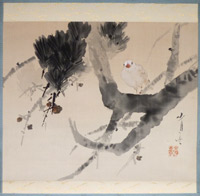
 Click here to view image full size. A complete set of 12 paintings showing birds and plants representing the months of the year. Seitei ( Shotei ) specialised in kachoga; was famous in this area, and regarded as the leading exponent. Technically brilliant. January shows a dove on a pine tree with pine cones. February depicts narcissus. March is represented by cherry blossom. April is a display of yamabuki, Japanese mountain rose, with bees. May shows a cuckoo with a falling ginkgo leaf. June is wisteria and a butterfly. July has a beetle climbing a leaf on an iris plant. August shows Japanese morning glory, Asagao. September has a grasshopper on an edamame ( soybean ) plant. October appears to be a wild chrysanthemum and beetle. November depicts what is probably a nuthatch climbing down a tree. And December is represented by a snipe. Each painting sumi and colour on silk. Image size 33.8 x 27.4 cms; 13.25 x 10.75 in. Each painting signed and sealed Seitei. Matching mounts. Slight staining on one or two paintings ( primarily July ) otherwise in very good condition. New box but retaining original lid with Seitei signature and seal and inscription Shiki no kacho, “Birds and Flowers of the Four Seasons.” It is rare to find complete sets of such paintings which are usually conceived as handscrolls. Status: Sold  Click here to view image full size.  Click here to view image full size.  Click here to view image full size.  Click here to view image full size.  Click here to view image full size.  Click here to view image full size.  Click here to view image full size.  Click here to view image full size.  Click here to view image full size.  Click here to view image full size.  Click here to view…

Nishikawa SUKENOBU (1671-1750)

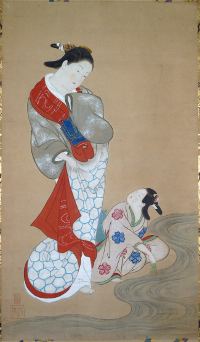
 Click here to view image full size. The pre-eminent painter in the Kyoto area during the first half of the eighteenth century. He enjoyed a great reputation in his lifetime and his (over 100) illustrated books influenced many artists, not only in the Kyoto-Osaka area but also in Edo. Many of his books were published by Hachimonjiya in Kyoto such as Hyakunin joro shina sadame (1723). Other famous books being: Tokiwa gusa (1731); Asakayama (1739); Chiyomi-gusa (1740). His paintings were collected by his contemporaries with Yanagisawa Kien (in his Hitorine, c. 1726) calling him the “supreme master” of Ukiy-e, superior to Okumura Masanobu, Torii Kiyonobu, Hanekawa Chincho and Kaigetsudo. Full colour on silk, 30.25 x 17.5 in; 76.7 x 44.3 cms. Shows a typically refined and elegant beauty watching her assistant washing a tea-whisk in a stream. Suihen bijin zu. There are two other versions of this design by Sukenobu: One was auctioned in 1933 at the Osaka Art Club from the W. Sturgis collection and there is another from Nagano, Japan, illustrated in Kokka, no. 18, 2011, p. 10. Other examples are in major museums such as the Metropolitan, Philadelphia, Freer, Honolulu, British, etc. Although Sukenobu produced many paintings, genuine works are now rare. Painted c late 1730s. Minor marks and creases and some loss of gofun, but in very good condition for an early 18th century painting. Sealed Nishikawa shi in and Sukenobu. Illustrated and exhibited in Nikuhitsu Ukiyoe Beauty, Tokyo Fuji Art Museum, 1983, no. 21, ex Hirano collection, Akita Prefecture.   Very good condition. Signed and sealed Bokusen. See my Blog on this update. here   Status: Sold    Click here to view image full size.  Click here to view image full size.  Click here to view image full size. here to view image full size.

Hasegawa SADANOBU II (active 1867-1880s)

 Click here to view image full size. An original painting by Sadanobu II. A reclining beauty reading a book. There appears to be nothing else like this by Sadanobu, and indeed, there are very few bijin-ga prints by him. A beautiful painting. Sumi and colour on silk. Image size 13 x 9.25 inches; 33 x 24 cms. Slight loss of gofun and minor marks. Mounted onto board.   Signed Ho Utamaro Sadanobu, “copied [ or imitating ] Utamaro, Sadanobu” with Sadanobu seal.   Status: Sold    Click here to view image full size.

Toensai KANSHI (Fl. mid-18th century)

Click here to view image full size. A rare, highly talented and enigmatic painter who produced only a few masterpieces. There is some confusion over his active working life with differing dates from 1748 to 1780, but he was certainly painting in the 1760s. This unusual composition shows a beauty adjusting her hair by obliquely looking in a mirror held by her maid who stares unnervingly straight at the viewer. This painting is well known and is illustrated in Nikuhitsu Ukiyoe, Collection of Ukiyo-e Paintings Classified by Artist and Schools, Vol. 4 (of 10): Katsukawa school, Suzuki Harunobu and Isoda Koryusai, pl. 83, edited and published by Shueisha, 1982. It is also mentioned on page 113 in Ukiyo-e Large Encyclopaedia, Vol. 2, edited by Japan Ukiyo-e Society, published by Taishukan, 1982. Another Kanshi painting showing a beauty collecting bamboo shoots in the snow was exhibited at the Metropolitan Museum of Art, NY, in 2014, in an exhibition: The Flowering of Edo Period Painting: Japanese Masterworks from the Feinberg Collection.     Full colour on paper with mica on the mirror, image size 14.5 x 20 in; 37 x 51 cms. In extremely good condition with double box. Painted c 1765.       Status: Sold     Click here to view image full size.

Kawamata TSUNEMASA (Fl. 1716-48)

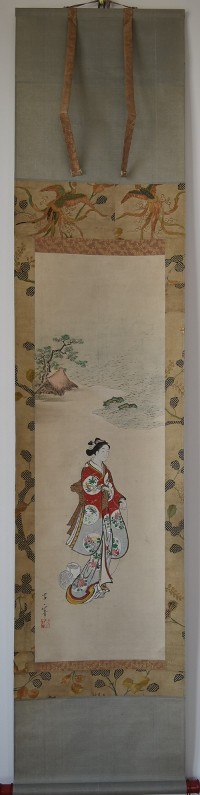
Click here to view image full size. Shows a beautiful salt-water gatherer, her hut behind her on the seashore. A member of the Kawamata school, he probably worked in Kyoto and specialised in bijinga.   Sumi and full colour on paper. Outlines picked out in gold. 32.5 x 10.5 in; 82.5 x 26.5 cms. Fine old brocade mount. Old box. Signed and sealed Tsunemasa. Status: Sold Click here to view image full size. Click here to view image full size.

Watanabe SEITEI (1851-1918)

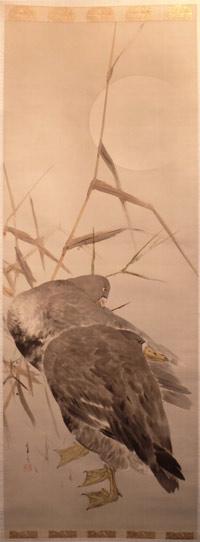
 Click here to view image full size. Two geese – possibly Greater White-fronted Geese ( although the legs should be a little more orange ) with tall reeds and a large misty moon. Sumi and light colour on silk, 43 x 16 in; 109 x 40.5 cms. Signed and sealed Seitei. In fine condition with original box signed and sealed by Seitei. Status: Sold  Click here to view image full size.  Click here to view image full size.

Tsukioka SETTEI (1710-1786)

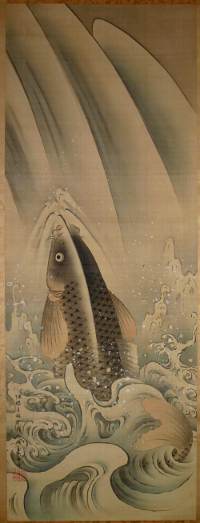
Click here to view image full size. An original painting, sumi and light blue on silk. Image size 38.75 x 14.25 in; 98.4 x 36.2 cms. Shows a carp leaping a waterfall. This was a favourite subject for Japanese artists being a symbol of achievement against adversity. Carp were bred for their colour in Japan and, interestingly, Koi that are returned to the wild revert back to their grey colour. They are known to live for up to a hundred years or more. Settei produced many illustrated books but after around 1765 turned to painting beauties, courtesans and geishas. They are of the utmost refinement – the faces and limbs picked out in red, their costumes with areas of gold, and invariably have the wide lantern-locks (toro-bin) hairstyle. Signed Hogen Tsukioka Sessai jinen rokuju-nana (painted aged sixty-seven, hence 1777). Seal Masanobu no in. In good condition with splashed gofun.     Status: Sold     Click here to view image full size. Click here to view image full size. Click here to view image full size.

Katsushika HOKUSAI (1760-1849); Kyokutei BAKIN (1767-1848); Jippensha IKKU (1765-1831)

 Click here to view image full size. An original painting by Hokusai showing the back view of a courtesan. Above are inscriptions by Bakin and Ikku, the two leading writers of the day. ( Bakin is famous for writing Chronicles of the Eight Dog Heroes of the Satomi Clan of Nanso and Ikku for writing the most humorous book in the Japanese language: Shank’s Mare Journey on the Tokaido.) This painting was originally sold at the Tokyo Bijutsu Club, December 3rd, 1928. It is illustrated in Katsushika Hokusai Paintings, Mainich Shimbun, 1975. It is signed Toyo Katsushika Hokusai ga, “Painted by Katsushika Hokusai of Orient” and the seal, Katsushika Hokusai, is the same seal as that used on the pair of hand scrolls, Day and Night, in the Museum of Fine Arts, Boston. Colour and sumi on paper, 11.12 x 11.5 in; 28.2 x 29.2 cms. An intriguing old mount and sold with original sales slip from 1928 and a copy of the 1975 catalogue.   The inscriptions translate as:   I went out dressed up very lightly just to show off for the sake of cherry blossom viewing party. However, I ended up catching a cold and all my efforts to enjoy the cherry blossoms went for nothing.   Jippensha Ikku   Yoshiwara is located in the north of Mount Kinryu, and it is a very grassy place. Here I live inside the fence of Miuraya, I am worshiped by so many guests. Even though I devote myself completely to seek popularity every day, I am a louse whose heart cannot be stolen by money alone. This is my mettle as a courtesan.   Kyokutei Bakin   Status: Sold    Click here to view image full size.  Click here to view image full size.  Click here to view image…

Utagawa HARUSADA (1830-1887)

 Click here to view image full size. An exceptionally beautiful painting of a standing beauty by this pupil of Kuniyoshi. An ukiyo-e artist who worked in Kyoto. Real name Okamoto Syotaro. Full colour with touches of gold on silk. Image size 40.5 x 13.5 in; 102.8 x 34.2 cms. Very minor brown area otherwise in fine condition. Signed Harusada ga. Seal unread.   Status: Sold    Click here to view image full size.  Click here to view image full size.  Click here to view image full size.

Kubo SHUMMAN (1757-1820) and Kameda BOSAI (1752-1826)

 Click here to view image full size. An original painting showing a parading oiran on the first day of the eighth month, Hassaku (hachigatsu sakuhi). It was common on this day to wear a white kimono. This festival still takes place in the Gion quarters of Kyoto. The calligraphy, above, is by Bosai (Hosai), an amateur artist and noted scholar and writer. Full colour on silk, 35.25 x 12.5 in; 89.5 x 31.7 cms. In good condition. Signed Shumman painted by himself with Shumman seal.   Status: Sold    Click here to view image full size.  Click here to view image full size.  Click here to view image full size.

Takehara SHUNCHOSAI (Fl. c 1772-1818)

 Click here to view image full size. An original painting showing beauties enjoying the cool of the evening on the riverbank and shallows of the Komo-gawa in Kyoto. An exceptional and rare painting by an artist best known for his guides to Osaka and Kyoto, Miyako meisho zue and Naniwa no kagami, published 1778 and 1780. Full colour on silk, 51 x 19.75 in; 129.5 x 50.2 cms. In very good condition. Signed Bunsei tei inoshishi chushu hatsumikka kyoshinioite Shunchosai Takehara Nobushige. Painted 1818.   Status: Sold    Click here to view image full size.  Click here to view image full size.  Click here to view image full size.

Utagawa TOYOKUNI II (TOYOSHIGE) (1777-1835)

 Click here to view image full size. An original painting on paper, unmounted, showing Asahina Saburo (Wada no Saburo Yoshihide), a famous warrior of the early Kamakura period (1185-1333). Image size 11.5 x 15.5 in; 29.2 x 39.5 cms. Signed Toyokuni suichu hitsu, “Toyokuni painted while being drunk.”   Status: Sold  

Matsumura KEIBUN (1779-1843)

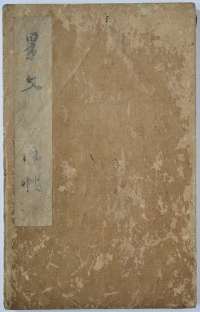
 Click here to view image full size. A fine gajo, 10.75 x 6.75 in; 27 x 17 cms, folding out to 10.75 x 13.5 in; 27 x 34 cms. Consisting of 24 paintings in sumi and light colour of birds, animals and fish, starting with the Twelve Signs of the Zodiac: Rat; Ox; Tiger; Hare; Dragon; Snake; Horse; Goat; Ape; Cock; Dog; Boar. Keibun studied with his older brother Matsumura Goshun as well as Maruyama Okyo. Highly talented, especially in kachoga, and went on to consolidate the Shijo style. Original covers and title slip. End sheet signed by the original owner: Sichikudou, Naniwa (the place that was to become Osaka) with his seal. Another unidentified large seal inside front cover. Some slight wormage not affecting any image and some appropriate scuffing of covers; otherwise very good condition. Painted probably late 1830s.   Status: Sold    Click here to view image full size.  Click here to view image full size.  Click here to view image full size. here to view image full size. here to view image full size. here to view image full size. here to view image full size.

Tsukioka SETTEI (1710-1786)

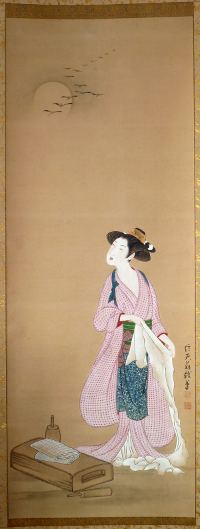
Click here to view image full size. A very fine large painting showing a standing beauty holding a cloth. At her feet is a fulling-block (kinuta) and several mallets. She looks skyward at the geese flying across the moon. One of the traditional symbols of autumn in Japan. There seems to have been a frisson in depicting these beauties fulling cloth near streams, as well as awabi divers and the women of Ohara collecting faggots. Settei produced many illustrated books but after around 1765 turned to painting beauties, courtesans and geishas. They are of the utmost refinement – the faces and limbs picked out in red, their costumes with areas of gold, and invariably have the wide lantern-locks (toro-bin) hairstyle. All these characteristics are found here. Full colour on paper, image size 48.75 x 18.25; 124 x 47.5 cms. Painting and mount in extremely good condition. The box comes with a registration form showing the work seems to have been put up for sale at the Tokyo Bijutsu Club in Tokyo about 70 or 80 years ago. Painted c 1770. Signed Shinten’o gihitsu (painted for amusement by Shinten’o). Seals Hokkyo Settei and Kidashi (family name).     Status: Sold   Click here to view image full size. Click here to view image full size. Click here to view image full size.

Tsukioka SETTEI (1710-1786)

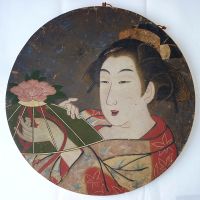
 Click here to view image full size. An interesting large painting, full colour on paper mounted on a wooden frame, 25.5 in; 62cms in diameter showing a bust portrait of a beauty with elaborate coiffure holding a child and a rattle. Although not signed, the attribution is unquestionable, painted between 1767-1773 in Osaka. It appears to have been commissioned to hang in a hairdresser’s or cosmetic shop and has metal eyes at the top. The oxidised silver leaf background was meant to resemble a mirror and the idea of busts reflected in mirrors and silver grounds was later employed by Utamaro and Sharaku. Apart from silver, gold leaf and gum is applied. Such signboards appear in an illustrated book by Hasegawa Mitsunobu published in Osaka in 1752. This new discovery has been written about by Dr. Yamamoto Yukari in vol.27 of Minzoku Geijutsu (Ethno-Arts) in 2011. Minor surface marks all over but astonishingly good condition given their age and use. Extremely rare. Status: Sold  Click here to view image full size.

Tsukioka SETTEI (1710-1786)

 Click here to view image full size. An interesting large painting, full colour on paper mounted on a wooden frame, 25.5 in; 62cms in diameter showing a bust portrait of a beauty with elaborate coiffure and holding a hat for a street festival. Although not signed, the attribution is unquestionable, painted between 1767-1773 in Osaka. It appears to have been commissioned to hang in a hairdresser’s or cosmetic shop and has metal eyes at the top. The oxidised silver leaf background was meant to resemble a mirror and the idea of busts reflected in mirrors and silver grounds was later employed by Utamaro and Sharaku. Besides silver, gum and raised painting is applied. Such signboards appear in an illustrated book by Hasegawa Mitsunobu published in Osaka in 1752. This new discovery has been written about by Dr. Yamamoto Yukari in vol.27 of Minzoku Geijutsu (Ethno-Arts) in 2011. Minor surface marks all over but astonishingly good condition given their age and use. Extremely rare. Status: Available  Click here to view image full size.

Teisai HOKUBA (1771-1844)

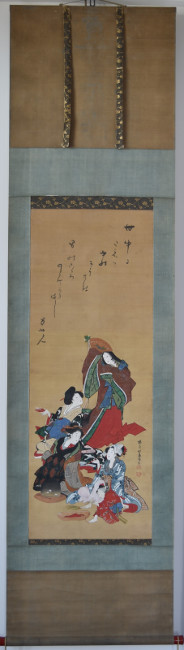
Click here to view image full size. An original painting on silk in full colour. Image size 36.5 x 13.5 in; 92.75 x 34.25 cms. A fine painting showing beauties from different social strata: A farmer’s wife; a courtesan; an elegant wife; and a Heian period court beauty. Hokuba was one of the earliest and best of Hokusai’s pupils. A printmaker, but only of surimono, book illustrator, and, most importantly, a fine painter. Above is a kyoka poem by Ota Nanpo (1749-1823), a famous poet and fiction writer. Silk slightly browned and minimal loss of some pigment but in otherwise good condition. Old mount: Would benefit from remounting. Painted Bunsei period, c. early 1820s.     Signed Teisai Hokuba ga with seals Hoku Ba.     Status: Sold     Click here to view image full size. Click here to view image full size. Click here to view image full size.

Utagawa KUNINAO (1793-1854)

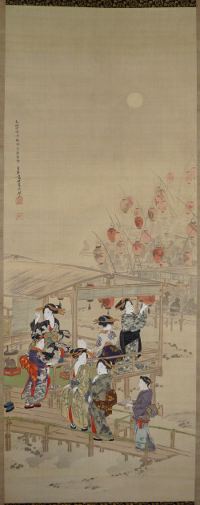
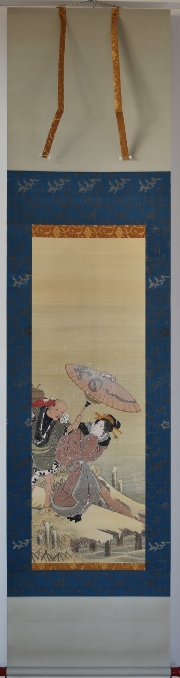
Click here to view image full size. Click here to view image full size. A pair of original paintings: One showing a beauty being followed by her servant down a jetty into a waiting boat. He protects her with an umbrella in one hand and carries food on a tray with the other. The whole scene under heavy snow. The other painting shows a beauty composing a poem. Above a wild goose flies before a full moon. Probably originally two of three setsu-getsu-ka, “Snow, Moon, Flowers.” A theme popular with ukiyo-e artists and originally derived from China. Kuninao studied under Toyokuni and then Hokusai and is also known for many illustrated books. His paintings now rare. Each painting full colour on silk, image size 36.5 x 12.75 in; 92.5 x 32.5 cms. In excellent condition. Beautifully presented with new mounts. One painting signed Kohsoen hitsu with seal Shohzan.     Status: Sold     Click here to view image full size. Click here to view image full size. Click here to view image full size.

Utagawa HIROSHIGE (1826-1869)

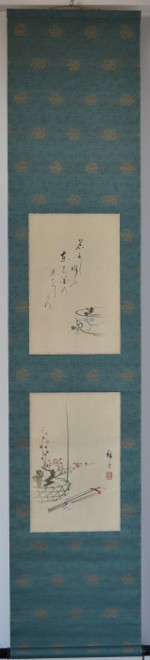
Click here to view image full size. Click here to view image full size. A pair of original kakejiku with two paintings on each. Possibly from the front and back cover pages of a first edition “One Hundred Famous Views of Edo” set. Sumi and colour, image size of each painting 13.5 x 8.75 in; 34.25 x 22 cms. Shows top left a bowl with – possibly – turnips and a poem. Below a wicker basket and bowl with a miniature plum tree and an adonis plant (the most popular plants for the New Year). On the right, at the top are two chidori with poem and below a sake barrel and a plum branch. The bottom two paintings are signed Hiroshige with Ichiryusai seal. In fact, there is another version of the chidori painting associated with a painting of a kago and lantern illustrated in the exhibition catalogue, Hiroshige – A Poetic Ukiyo-e Artist, Fukushima Minpo, 1971, no. 16. These are also possibly from the ends of a first edition set of prints. Hiroshige and Hiroshige II were known to make these paintings, presumably for special clients. Provenance: Ex Takeoka Toyota collection (1844-1931). The box dated (Taisho 11, 1922) and guaranteed by him. He was a famous collector from the Meiji to early Showa era. Paintings and mounts in very good condition.     Status: Sold     Click here to view image full size. Click here to view image full size. Click here to view image full size.

Katsushika HOKUSAI (1760-1849)

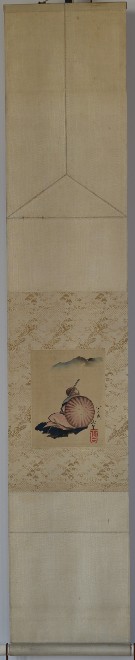
 Click here to view image full size. A small original painting of an old sage (possibly the poet Saigyo Hoshi [1118-1190]) seated, holding a bamboo pole and with a large hat on his back. He looks up wistfully at a mountain range with what appears to be a hanging bridge over a gorge. Light colour on silk; predominantly the pink, brown and sumi tints he was fond of. Image size 7.5 x 5.75 in; 19 x 14.5 cms. Provenance: From the estate of Jeanne Nicole Ledoux, daughter of Jean Pierre Ledoux, who was the son of the famous ukiyo-e collector Louis V. Ledoux. Mounted as a kakemono. In good condition. Signed Hachijukyusai Manji hitsu, “Brush of old man Manji, aged eighty-nine years.” And with seal Hyaku (“Hundred”). A fan painting in the Museum of Fine Arts, Boston, acc. No. 11.7470, has the same seal and signature.   Status: Sold    Click here to view image full size.

Tsukioka YOSHITOSHI (1839-1892)

Click here to view image full size. An original painting, sumi and touches of red on paper, 26 x 11.5 in; 66 x 29.2 cms. A spontaneous painting of a beauty raising the hem of her kimono as she rushes to an appointment. Several small restorations only viewable obliquely, otherwise good condition. Signed in cursive script which he used from 1887: Yoshitoshi ga. Small seal too indistinct to read. Status: Sold Click here to view image full size.

Hishikawa MORONOBU (C. 1618-1694)

 Click here to view image full size. An important figure and pioneer of the ukiyo-e school. He was born into a family of embroiderers and textile dyers at Hota in Awa Province, but departed for Edo, c. 1658, to study painting. A prolific artist, he illustrated a large number of books, as well as being the first to design single-sheet prints. Turned to painting c. 1670. Shows a promenading beauty, knees slightly bent and the long face typical of Moronobu. The delicately painted kimono has serrated roundels with images of Heian court life or abstract patterns interspersed with small gold flower heads.   An original painting on silk, image size 23.5 x 10.75 in; 59.75 x 27 cms with an old elaborately embroidered mount. Unsigned, as is often the case with 17th century paintings. In very good condition.   Status: Sold    Click here to view image full size.  Click here to view image full size.

Matsumura KEIBUN (1779-1843)

Click here to view image full size. A handscroll comprising twelve mostly nature studies. ( Four shown. ): An isolated village; redstart and camellia; a rock; iris; rose; bamboo; lobster; sparrow and begonia; a village covered in snow; a scholar reading; white camellia; hibiscus. Sumi and light colour on paper, 14 x 441.2 in; 35.5 x 1120 cms. Keibun was a leading Kyoto artist who had many talented pupils. He studied with his older brother Matsumura Goshun and also Maruyama Okyo. The paintings show all the spontaneity and brevity of a leading exponent of the shijo school and the subject matter is typical. Minor marks; slight edge damage on one painting, but generally good condition. Each painting sealed Kei Bun . Ivory rollers and stickered box. Status: Sold Click here to view image full size. Click here to view image full size. Click here to view image full size.

Katsushika HOKUSAI (1760-1849)

 Click here to view image full size. An original painting by Hokusai showing wild boars, a parent and baby. Another “Wild Boar in the Moonlight” painting is in the Museum of Fine Arts, Boston, acc. No. 11.7430, ex William Sturgis Bigelow collection. The same broad background brushstroke shading is found on both paintings. Illustrated in Idemitsu Museum of Arts, vol. 9, Ukiyo-e Paintings, Kikuchi Sadao, 1976, pl. 84, p. 57. It was originally in the inventory of Yabumoto Soshiro, the largest antique dealer in Tokyo after he moved from Kyoto in the second half of the 20th century. Sumi and light colour on paper, 12.75 x 22 in; 32.4 x 56 cms. Signed Gakyorojin Manji hitsu rei hachi-ju-ichi (“at the age of 81”) with Fumoto-no-saki seal, so probably painted for the year of the boar, 1839. There are other paintings with the same signature and seal, e.g. The Harari Collection of Japanese Paintings and Drawings, volume 2, Jack Hillier, Lund Humphries, 1970, no. 142 “The Comet,” p. 258.   In very good condition. Recently remounted and sold with the old Edo-era box.   Status: Sold  Click here to view image full size.  Click here to view image full size. here to view image full size. here to view image full size.