Taiso YOSHITOSHI (1839-1892)

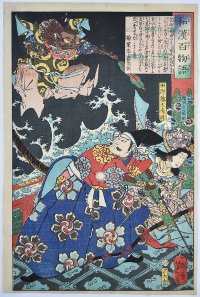
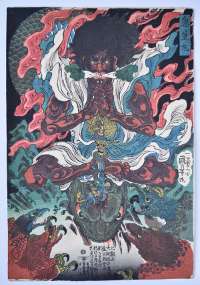
 Click here to view image full size. Shows the samurai Tawara Toda (“Lord of the Ricebag”) Hidesato slaying the monstrous centipede Mukade on the request of the Dragon King. Elated the king presents him with a bottomless bag of rice. Behind Hidesato is the centipede’s arch-enemy Otohime. One of a set of 26 prints with title: Wakan hyaku monogatari, “One Hundred Tales of China and Japan.” Published by Daikokuya Kinnosuke, 1865.   Fine impression with variegated cartouche and mica. Fine colour and condition. Signed Ikkaisai Yoshitoshi ga.   Status: Sold  

Taiso YOSHITOSHI (1839-1892)

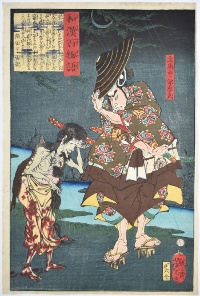
 Click here to view image full size. Shows Suma Urabe Suetake, one of the retainers of Minamoto Yorimitsu, meeting the apparition of the woman Ubume, who is to place a baby boy in his arms. One of a set of 26 prints with title: Wakan hyaku monogatari, “One Hundred Tales of China and Japan.” Published by Daikokuya Kinnosuke, 1865.   Very good impression, colour and condition. Signed Ikkaisai Yoshitoshi ga.   Status: Sold  

Utagawa YOSHIHARU (1828-1888)

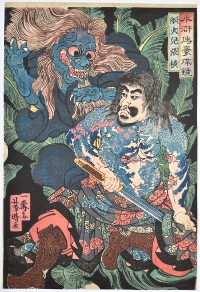
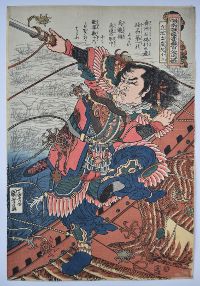
 Click here to view image full size. A fearsome beast looking over the shoulder of Senkaiji Chojun. One of a set Suikoden goketsu kagami, “Mirror of Heroes of the Suikoden.” The set published in conjuction with Yoshitaki and Yoshitsuya by Yamaguchiya Tobei, 1856.   Fine impression of the first edition with variegated cartouche. Fine colour. Trimmed at bottom, otherwise fine condition. Signed Ichibaisai Yoshiharu ga.   Status: Sold  

Taiso YOSHITOSHI (1839-1892)

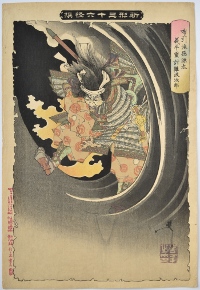
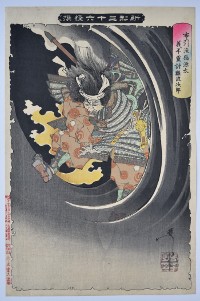
 Click here to view image full size. The ghost of the wicked Genta Yoshihira attacking his executioner Nanba Jiro at the Nunobiki waterfall from Shinkei sanjurokkaisen, “New Forms of Thirty-six Ghosts.”The set published by Sasaki Toyokichi, 1889-1892 (this being 1889). One of the two best designs from the set.   Very fine first edition. Fine colour and condition. Signed Yoshitoshi.   Status: Sold  

Utagawa KUNIYOSHI (1797-1861)

 Click here to view image full size. A triptych showing Ushiwakamaru (Minamoto no Yoshitsune, 1159-1189) and his manservant Onmaya Kisanta watching his loyal retainer, the warrior monk Benkei, dragging the giant Mii Temple bell up Mount Hiei. Benkei ga yuriki tawamure ni Miidera no tsurigane no Eizan e hikiaguru zu. Published by Ibaya Senzaburo, 1845-6. One of Kuniyoshi’s great designs. Rare.   Fine impression. Very good colour. Some edge strengthening on the back on centre sheet, otherwise very good condition. Full size: An extremely difficult design to find without trimming and illustrated examples often have the bell not aligning up because of this. Signed Ichiyusai Kuniyoshi ga.   Status: Sold  

Furuyama MOROMASA (C. 1712-1772)

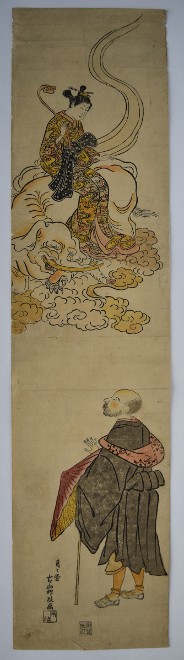
 Click here to view image full size. A rare artist, possibly the son and pupil of Furuyama Moroshige. Shows the famous poet Saigyo Hoshi (1118-1190) gazing up at the courtesan Eguchi as the Bodhisattva Fugen on a white elephant. The poet is famous for his long poetic journeys around Japan but especially to northern Honshu. Fugen is known for offering shelter to travelling monks. A large panel, 27.5 x 6.5 in; 70 x 16.5 cms. Coloured by hand in tan, yellow, beni, brown, and sumi. Published c. 1740s by Igaya. Provenance: Sold Christies, New York, 31/10/1995, lot 10.   Fine impression. Slight soil and creasing. Several small restored areas but generally very good condition for the date. Signed Getsugetsudo Furuyama Moromasa.   Status: Sold  

Kitao SHIGEMASA (1739-1820)

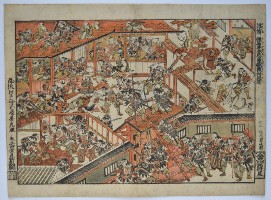
 Click here to view image full size. A large panel, 12.5 x 16.75 in; 31.5 x 42.5 cms in two shades of beni, yellow and blue (partially faded). Published by Eijudo c. 1768-72. Title in right panel: Uki-e Kanadehon Chushingura youchi no zu, “The Night Attack from the Storehouse of Loyalty, New Perspectives.” On the left border is written: Furyu Edo goshikizumi ganso, Eijudo Hibino, “ The original of elegant Edo pictures in five colours, Eijudo Hibino [Nishimuraya Yohachi]” This publisher considered himself the inventor of benizuri-e. Shows Act 11 of the Chushingura. This famous story revolves around the suicide of Enya Hangan in 1701. Forced to draw his sword in the Shogun’s palace by the goading of the courtier Moronao, he has no option but to commit seppuku. His retainers become Ronin and vow revenge. This Act shows the night attack by the 47 Ronin led by Yuranosuke on Moronao’s house. He is seen lower left confronted before his assassination. The Chushingura was an 11 act bunraku puppet play written in 1748. Shigemasa had a long career and was founder of the Kitao School. A prolific book illustrator including collaborations with Shunsho. Designed a number of these uki-e, western perspective prints. Extremely rare: One other impression is in the Achenbach Foundation, S.F., acc. no. 54755.84. An early rendition of this famous tale.   Very good impression and colour. Some careful restoration with slight soil and fold marks, but given the date and size in very good condition. Signed Kitao Shigemasa dzu.   Status: Sold  

Taiso YOSHITOSHI (1839-1892)

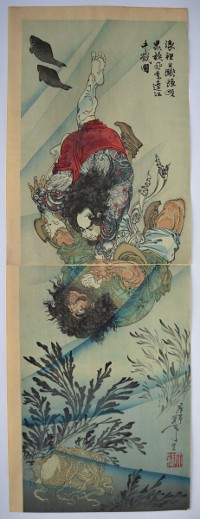
 Click here to view image full size. A vertical oban diptych showing the renowned swimmer and fishmonger Rorihakucho Chojun grappling underwater with the famous (but non-swimmer) warrior Kokusenpu (“Black Whirlwind”) Riki. The result of Chojun challenging Riki to a fight after his gang attempt to rob some fishermen. They eventually become friends. Rorihakucho Chojun Kokusenpu Riki ochude tatakau zu. Published by Matsui Eikichi early 1887. This is the first edition without publisher or date. It was then issued with this information and then re-published by Hasegawa Tsunejiro in September 1887. This is most likely a proof impression with extra large margin on the left. The finest impression I have seen of this design.   Superb impression, colour and condition. Signed Oju Yoshitoshi ga.   Status: Sold  

Taiso YOSHITOSHI (1839-1892)

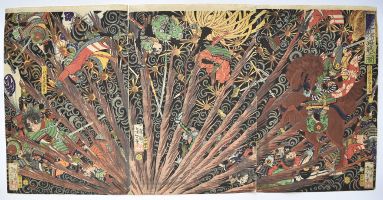
 Click here to view image full size. A triptych showing an exploding land-mine throwing bodies and horses into the ether. Taiheiki Masakiyo nansen no zu, “Masakiyo’s Difficult Battle from the Taiheiki.” Figures identified in the print are the 14th century warriors Sato Shukei no Kami Masakiyo and Shimura Masazo Katsutoyo, but by way of avoiding censorship, it is actually showing Kato Kiyomasa (1562-1611) and Kimura Matazo Shigekatsu. It may also be that the design alludes to the rogue samurai in Choshu Province during the summer of 1866. Published by Yamashiroya Jinbei, 1866. One of Yoshitoshi’s great designs. An unidentified collector’s seal at the bottom right of each sheet. In fact, this is a reworking of a similar composition in a book early in his career, Ehon jitsugokyo dojikyo yoshu of 1853.   Fine impression and colour. Lovely oxidation of the orange pigment. Fine condition. Signed Ikkaisai Yoshitoshi hitsu.   Status: Sold  

Katsukawa SHUNTEI (1770-1820)

 Click here to view image full size. A fabulous and extremely rare triptych showing the ama diver Tamatori-hime escaping from the Dragon King’s Palace with the priceless pearl. The story (with variations) relates how the Dragon King stole the jewel during a storm when it, and two other treasures, were being sent to Japan by the Tang dynasty emperor in memory of his consort’s father, Kamatari. Subsequently, Fujiwara no Fuhito, the son of Kamatari, searches for the pearl; meets the pearl diver Tamatori-hime, falls in love and marries her. She vows to retrieve the pearl which she eventually achieves but is pursued through the ocean by the dragon and a myriad grotesque sea creatures who were guarding it. Published by Kawaguchiya Uhei, c. 1810.   Fine impression, colour and condition. Full size. Signed Shuntei ga.   Status: Sold  
Utagawa KUNIYOSHI (1797-1861)

 Click here to view image full size. A triptych of the Ink Wars, Bokusen no zu. Evidently a court pastime during the Nara period (710-794) was to stage ink battles. Courtiers are involved in throwing ink and daubing each other with brushes. Published by San, 1843.   Fine impression, colour and condition. Signed Ichiyusai Kuniyoshi giga.   Status: Sold  

Utagawa SADAHIDE (1807-1873)

 Click here to view image full size. An exceptionally rare triptych showing the great battle between Takeda Shingen (left) and Uesugi Kenshin (right) during the fourth (of five) Kawanakajima battles. Kenshin lunges with his sword but is parried by Shingen using his iron war fan (gunbai). These skirmishes took place in the mid. 16th century. I can, at the moment, only locate one damaged impression of this fine design. Published 1846 by Tsujiokaya Bunsuke.   Very good impression, colour and condition. Full size. Signed Gyokuransai Sadahide ga.   Status: Sold  
Utagawa KUNIYOSHI (1797-1861)

Click here to view image full size. The warrior Ritchitaisai Genshoji in a boat attacked by grappling-hooks thrown by his adversaries. A design from the set Tsuzoku Suikoden goketsu hyaku-hachi-nin no hitori, “The Hundred and Eight Heroes of the Popular Suikoden, One by One.” Based on the Chinese novel Shui Hu Zhuan, attributed to Shi’Nai’an, which tells of a band of 108 brigands who operated from Liangshan Marsh. Published by Kagaya Kichiyemon, 1827-30. Robinson S2.53.     Fine impression, colour and condition. Full size (unusual as these prints are overlarge obans and often trimmed). Signed Ichiyusai Kuniyoshi ga.     Status: Sold    
Tsukioka YOSHITOSHI (1839-1892)

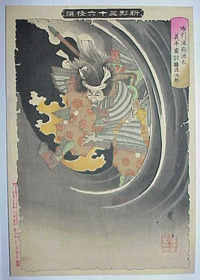
 Click here to view image full size. The ghost of Genta Yoshihira, having been executed by Taira no Kiyomori, springs into the air causing a thunderstorm and exacting revenge. The best design from Shingata sanjurokkaisen, “New Forms of Thirty-Six Ghosts.” Published 1889 by Sasaki.   Very fine impression, colour and condition. The first edition. Signed Yoshitoshi.   Status: Sold  
Ichiryusai HIROSHIGE (1797-1858)

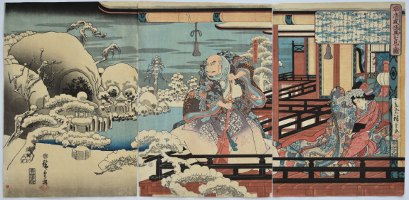
 Click here to view image full size. Taira no Kiyomori haunted by strange sights, Taira no Kiyomori kaii o miru zu. Hiroshige’s finest musha-e. A triptych showing the dying Taira no Kiyomori, head of the Taira clan, tormented by hallucinations and seeing, from the veranda of his palace, the garden covered in snow and transmogrified into the skeletons and skulls of the people he had slain. His lover cowers behind him. Published by Ibaya Kyubei, c. 1845. A wonderful design.   Fine impression, colour and condition. The first sheet doesn’t quite match because the publishers had to fit in the title cartouche which protrudes into the top margin. This is the same on every impression. Signed Hiroshige ga and Ichiryusai Hiroshige ga.   Status: Sold  
Utagawa KUNIYOSHI (1797-1861)

 Click here to view image full size. Kido Maru learning magic from the forest tengu. Possibly Kuniyoshi’s greatest design in this genre. He is shown, cross-legged,atop a giant python, two wrapped pine sprigs (aomatsuba) in his mouth. A long dagger is driven into the python’s head and snakes curl around its blade. Robinson SIF.1. Illustrated in colour , pl. 12, and also used on the front cover of B. W. Robinson, Kuniyoshi: The Warrior-Prints, Phaidon, 1982. This is the rare first edition published by Tsutaya Kichizo, c 1840 with the kiwame seal above publisher.   Very fine impression with fine gradation (missing later on). Fine colour. Imperceptible fold, otherwise fine condition. Full size. Signed Ichiyusai Kuniyoshi ga.   Status: Sold  

Ichiryusai HIROSHIGE (1797-1858)

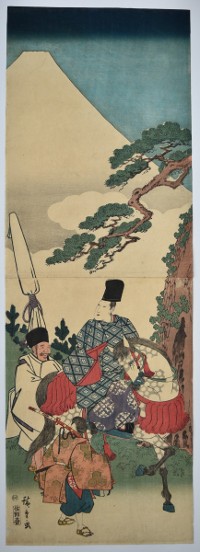
 Click here to view image full size. A vertical diptych showing the famous poet and court noble, Ariwara no Narihira (825-880), on horseback with his attendant before Mt. Fuji on their way to the east. The eastern journey was one of the main parts of the Ise Monogatari. Published by Marukyu, c 1845-6.   Fine impression, colour and condition. Full size with ample room for joining. This is the best copy of this design I have seen. Signed Hiroshige ga.   Status: Sold  

Utagawa KUNIYOSHI (1797-1861)

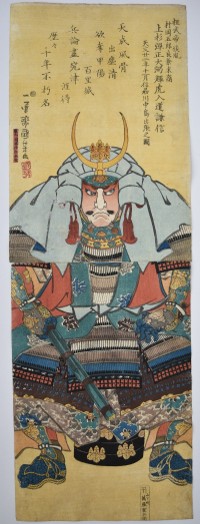
 Click here to view image full size. A rare vertical diptych showing the famous Daimyo Uesugi Kenshin (1530-1578). He ruled Echigo Province and was known as a skillful administrator as well as warlord; also for his rivalry with Takeda Shingen who he fought at the fourth battle of Kawanakajima. Published by Jubei Yorozuya, 1846.   Fine impression and colour. Extensive mica applied to the headgear. Yellow ground. Very slight trimmimg at bottom, otherwise full size with ample room for joining. Signed Ichiyusai Kuniyoshi ga.   Status: Sold  

Toyohara CHIKANOBU (1838-1912)

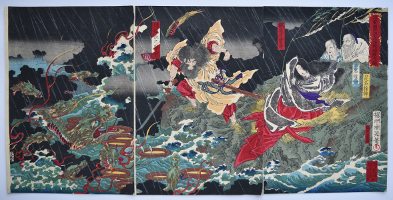
 Click here to view image full size. A triptych showing the Shinto Storm God Susanoo about to slay the eight-headed dragon, Yamata no Orochi, at the head of the Hi river in pouring rain. The dragon devoured virgins and had eaten the seven daughters of two earthly deities, seen top right. The eighth, Kushi-inada-hime, also on right, is saved by Susanoo who encourages the dragon to drink eight times brewed sake from eight vats which intoxicates it enough to be killed. Rare: Chikanobu is not known for this type of subject. Published c 1870s.   Very good impression, colour and condition. Mica applied to sky, rain printed in silver. Full size. Signed Yoshu Chikanobu hitsu.   Status: Sold  

Tsukioka YOSHITOSHI (1839-1892)

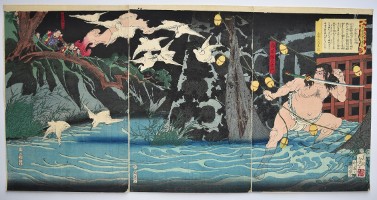
 Click here to view image full size. A triptych showing a scene during the siege of Nagashino Castle by Takeda Katsuyori. Torii Suneemon Katsutaka was sent to get help and managed to evade the guards. He insists on returning to his comrades but meanwhile Takeda has fastened bells to the cables on the castle’s exit which gave the alarm and frightens a flock of herons. Katsutaka was captured and died a samurai’s death shouting hold fast to his comrades. Takeda’s troops were subsequently massacred. Published by Kinseido, 1868. From a series Bidan musha hakkei, “Eight Views from Fine Tales of Warriors.”   Very fine impression, the rain beautifully burnished; blind-printing and mica applied. Fine colour and condition. Full size. A fine copy. Signed Tsukioka Yoshitoshi hitsu.   Status: Sold  

Ichiryusai HIROSHIGE (1797-1858)

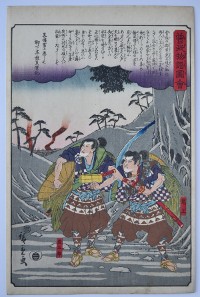
 Click here to view image full size. The brothers Goro and Juro battling Kikko Kojiro and Aiko Saburo in the pouring rain. From a set Soga monogatari zue, “The Revenge of the Soga Brothers.” A set of 30 prints published by Ibaya Senzaburo, 1848. This famous story has many versions but basically it tells how Kawazu Sukeyasu was murdered by his cousin Kudo Suketsune. Sukeyasu left two sons and his widow remarried a man called Soga. He adopted the two children and they waited patiently for an opportunity to kill Suketsune which came when he was hunting near Mt. Fuji. They killed him but were themselves slain in the ensuing battle. This is the first edition, it was republished in 1858 by Yamaguchiya Tobei.   Fine impression and colour. Light album backing, otherwise fine condition. Signed Hiroshige ga.   Status: Sold  

Ichiryusai HIROSHIGE (1797-1858)

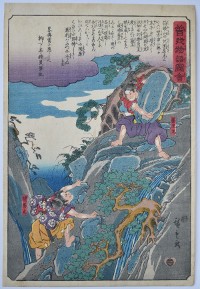
 Click here to view image full size. Hakomaru (Soga no Goro) stands on top of a steep cliff holding a huge boulder. From a set Soga monogatari zue, “The Revenge of the Soga Brothers.” A set of 30 prints published by Ibaya Senzaburo, 1848. This famous story has many versions but basically it tells how Kawazu Sukeyasu was murdered by his cousin Kudo Suketsune. Sukeyasu left two sons and his widow remarried a man called Soga. He adopted the two children and they waited patiently for an opportunity to kill Suketsune which came when he was hunting near Mt. Fuji. They killed him but were themselves slain in the ensuing battle. This is the first edition, it was republished in 1858 by Yamaguchiya Tobei.   Fine impression and colour. Light album backing, otherwise fine condition. Signed Hiroshige ga.   Status: Sold  

Ichiryusai HIROSHIGE (1797-1858)

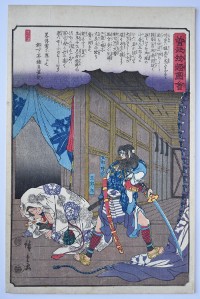
 Click here to view image full size. Asahina Saburo tugging on Goro Tokimune’s armour. From a set Soga monogatari zue, “The Revenge of the Soga Brothers.” A set of 30 prints published by Ibaya Senzaburo, 1848. This famous story has many versions but basically it tells how Kawazu Sukeyasu was murdered by his cousin Kudo Suketsune. Sukeyasu left two sons and his widow remarried a man called Soga. He adopted the two children and they waited patiently for an opportunity to kill Suketsune which came when he was hunting near Mt. Fuji. They killed him but were themselves slain in the ensuing battle. This is the first edition, it was republished in 1858 by Yamaguchiya Tobei.   Fine impression and colour. Light album backing, otherwise fine condition. Signed Hiroshige ga.   Status: Sold  

Ichiryusai HIROSHIGE (1797-1858)

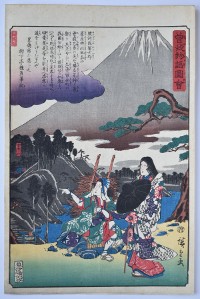
 Click here to view image full size. A noblewoman is directed to the Soga shrine by a wood-gatherer. From a set Soga monogatari zue, “The Revenge of the Soga Brothers.” A set of 30 prints published by Ibaya Senzaburo, 1848. This famous story has many versions but basically it tells how Kawazu Sukeyasu was murdered by his cousin Kudo Suketsune. Sukeyasu left two sons and his widow remarried a man called Soga. He adopted the two children and they waited patiently for an opportunity to kill Suketsune which came when he was hunting near Mt. Fuji. They killed him but were themselves slain in the ensuing battle. This is the first edition, it was republished in 1858 by Yamaguchiya Tobei.   Fine impression and colour. Light album backing, otherwise fine condition. Signed Hiroshige ga.   Status: Sold  

Ichiryusai HIROSHIGE (1797-1858)

 Click here to view image full size. Goro Tokimune comes across the wrestler Goromaru. From a set Soga monogatari zue, “The Revenge of the Soga Brothers.” A set of 30 prints published by Ibaya Senzaburo, 1848. This famous story has many versions but basically it tells how Kawazu Sukeyasu was murdered by his cousin Kudo Suketsune. Sukeyasu left two sons and his widow remarried a man called Soga. He adopted the two children and they waited patiently for an opportunity to kill Suketsune which came when he was hunting near Mt. Fuji. They killed him but were themselves slain in the ensuing battle. This is the first edition, it was republished in 1858 by Yamaguchiya Tobei.   Fine impression and colour. Light album backing, otherwise fine condition. Signed Hiroshige ga.   Status: Sold  

Ichiryusai HIROSHIGE (1797-1858)

 Click here to view image full size. Onio and Dozaburo, the retainers of the Soga Brothers. From a set Soga monogatari zue, “The Revenge of the Soga Brothers.” A set of 30 prints published by Ibaya Senzaburo, 1848. This famous story has many versions but basically it tells how Kawazu Sukeyasu was murdered by his cousin Kudo Suketsune. Sukeyasu left two sons and his widow remarried a man called Soga. He adopted the two children and they waited patiently for an opportunity to kill Suketsune which came when he was hunting near Mt. Fuji. They killed him but were themselves slain in the ensuing battle. This is the first edition, it was republished in 1858 by Yamaguchiya Tobei.   Fine impression and colour. Light album backing, otherwise fine condition. Signed Hiroshige ga.   Status: Sold  

Katsukawa SHUNTEI (1770-1820)

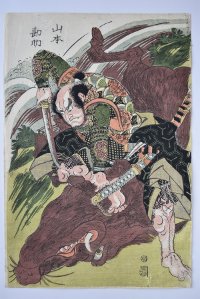
 Click here to view image full size. Yamamoto Kansuke (Haruyuki) (1501-1561) overpowering a gigantic boar. Takeda Shingen’s most valuable general and one of the Takeda nijushi-sho, “Takeda’s Twenty-four [most trusted] Generals.” Kansuke was involved in a lengthy feud with Kenshin Tora and is killed in one of their skirmishes at Kawanakajima on 12 Oct. 1561.   Very good impression, colour and condition. Signed Shuntei ga.   Status: Sold