Tsukioka YOSHITOSHI (1839-1892)

 Click here to view image full size. Yamauba and Kaidomaru from Ikkai zuihitsu, “Essays by Yoshitoshi.” A set of 13 prints published by Masadaya in 1872 ( this design being 1873 ). Shows the mother and son ( also known as Kintaro ). He of the enormous strength is often shown acting as umpire at a wrestling match between a hare and a monkey. The Madonna-like figure here is one of the few Yoshitoshi designs to borrow heavily from western art. There are numerous variations in seals in this fine set but, as yet, no research has been done into their significance. Very fine impression and colour. There is an alternate version of this print with Kintaro printed in a light brown. Trimmed close on the left but retaining black border. Retains original album backing. Signed Ikkaisai Yoshitoshi hitsu. Status: Sold

Tsukioka YOSHITOSHI (1839-1892)

 Click here to view image full size. The monkey of phenomenal powers Sun Wukong battles Kinkaku Daio on a sea cliff. From a fine, rare and early set of at least 21 designs: Tsuzoku saiyuki, “Journey to the West” published by Fukuta between 10/1864 and 8/1865, this being 12 The story covers the journey of Son Goku ( Chin. Sun Wukong ) a.k.a. The Monkey King to India, accompanying Xuanzang, to retrieve the Buddhist sutras. Sun Wukong, born from a stone, had supernatural powers; possessed enormous strength; could transform himself into other people and objects, and cover large distances in a single flip. The story covers 100 chapters and there are a multitude of characters and events. A fine design. Fine impression. Minimal soil and fading. Signed Ikkaisai Yoshitoshi hitsu. Status: Sold

Tsukioka YOSHITOSHI (1839-1892)

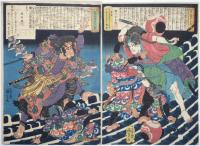
 Click here to view image full size. The monkey of phenomenal powers Sun Wukong battles a warrior ( Rakijo ? ) on a precipitous cliff over a choppy sea. From a fine, rare and early set of at least 21 designs: Tsuzoku saiyuki, “Journey to the West” published by Fukuta between 10/1864 and 8/1865, this being 12 The story covers the journey of Son Goku ( Chin. Sun Wukong ) a.k.a. The Monkey King to India, accompanying Xuanzang, to retrieve the Buddhist sutras. Sun Wukong, born from a stone, had supernatural powers; possessed enormous strength; could transform himself into other people and objects, and cover large distances in a single flip. The story covers 100 chapters and there are a multitude of characters and events. A fine design. Fine impression. Minimal soil and fading. Signed Ikkaisai Yoshitoshi hitsu. Status: Sold

Tsukioka YOSHITOSHI (1839-1892)

 Click here to view image full size. The monkey of phenomenal powers Sun Wukong battles Kofuo, the wind demon who had captured Genjosanzo. From a fine, rare and early set of at least 21 designs: Tsuzoku saiyuki, “Journey to the West” published by Fukuta between 10/1864 and 8/1865, this being 12 The story covers the journey of Son Goku ( Chin. Sun Wukong ) a.k.a. The Monkey King to India, accompanying Xuanzang, to retrieve the Buddhist sutras. Sun Wukong, born from a stone, had supernatural powers; possessed enormous strength; could transform himself into other people and objects, and cover large distances in a single flip. The story covers 100 chapters and there are a multitude of characters and events. A fine design. Fine impression. Minimal soil and fading. Signed Ikkaisai Yoshitoshi hitsu. Status: Sold
Tsukioka YOSHITOSHI (1839-1892)

 Click here to view image full size. The monkey of phenomenal powers Sun Wukong battles an enormous polka dot shishi lion. Shidado no roma. From a fine, rare and early set of at least 21 designs: Tsuzoku saiyuki, “Journey to the West” published by Fukuta between 10/1864 and 8/1865, this being 12 The story covers the journey of Son Goku ( Chin. Sun Wukong ) a.k.a. The Monkey King to India, accompanying Xuanzang, to retrieve the Buddhist sutras. Sun Wukong, born from a stone, had supernatural powers; possessed enormous strength; could transform himself into other people and objects, and cover large distances in a single flip. The story covers 100 chapters and there are a multitude of characters and events. A fine design. Fine impression. Minimal soil and fading. Signed Ikkaisai Yoshitoshi hitsu. Status: Sold
Kobayashi KIYOCHIKA (1847-1915)

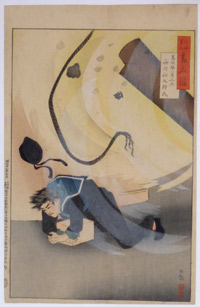
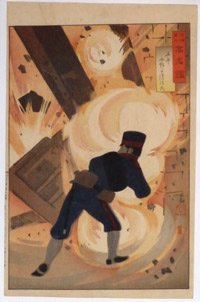
 Click here to view image full size. Shows ordinary seaman Nishikawa Hatsutaro of the corvette Katsuragi which saw action during the Sino-Japanese war ( 1/7/1894-17/4/1895 ). He appears to be saving something by covering it with his body. From a set Rikukaigunjin komei kagami, “Mirror of Army and Navy Heroes.” Published by Inoue Kichijiro, 2 For whatever reason, a rare set. Fine design. Fine impression and colour. Signs of mounting au verso, otherwise fine condition. Signed Kiyochika. Status: Sold

Kobayashi KIYOCHIKA (1847-1915)

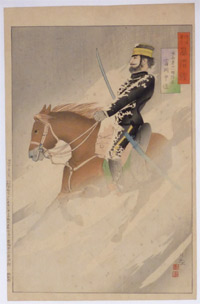
 Click here to view image full size. Shows Lieutenant Colonel Tomioka Sanzo charging on horseback. He was the commander of the 22nd infantry regiment during the Sino-Japanese war ( 1/7/1894-17/4/1895 ). From a set Rikukaigunjin komei kagami, “Mirror of Army and Navy Heroes.” Published by Inoue Kichijiro, 2 For whatever reason, a rare set. Fine design. Fine impression and colour. Signs of mounting au verso, otherwise fine condition. Signed Kiyochika. Status: Sold

Kobayashi KIYOCHIKA (1847-1915)

 Click here to view image full size. Shows the army engineer Onoguchi Tokuji who destroyed the castle gate at Jinzhoucheng during the Sino-Japanese war ( 1/7/1894-17/4/1895 ). From a set Rikukaigunjin komei kagami, “Mirror of Army and Navy Heroes.” Published by Inoue Kichijiro, 2 For whatever reason, a rare set. Fine design. Fine impression and colour. Signs of mounting au verso, otherwise fine condition. Signed Kiyochika. Status: Sold

Ichiyusai KUNIYOSHI (1797-1861)

 Click here to view image full size. The best design from Genji kumo ukiyoe awase, “Ukiyoe Comparisons of the Cloudy Chapters of Genji.” A set comparing famous warriors to the Chapters of the Genji Monogotari ( Tale of Genji ) written by Lady Murasaki Shikibu ( c 973 – 1025 ). This design is for Chapter 22, Tamakatzura. Shows the pearl diver, Tamatori-hime, who has reclaimed the precious pearl stolen by the Dragon King. She is pursued by a host of his aquatic retainers including a giant octopus before finally returning the jewel to her husband Fujiwara no Kamatari, albeit buried in her chest for safety and causing her death. A popular subject with Kuniyoshi who designed a number of other oban prints and triptychs on the subject. The Dragon King’s palace can be seen beneath the waves in the background. Published by Iseya Ichibei, 1843-5. Very good impression, colour and condition. Each sheet lightly attached. Signed Ichiyusai Kuniyoshi ga. Status: Sold

Ichiyusai KUNIYOSHI (1797-1861)

 Click here to view image full size. A vision of hell. In the centre sits Enma, King of Hell, dressed as a Chinese official flanked by minions. He sits in judgement deciding whether a deceased person had been good or bad. Those found wanting are subjected to horrendous tortures, miscreants being boiled, crushed, burnt or having their tongues pulled out. Mothers in Japan were known to threaten naughty children with a visit from Enma. Kuniyoshi is known to have owned a “hell” garment which he had painted and is often pictured wearing it. Published by Tsutaya Kichizo c. mid 1830’s. Rare. Another example illustrated in the new Nikkei/Mori Arts Center Kuniyoshi catalogue, no 111. Very good impression, colour and condition. Each sheet lightly attached. Signed Ichiyusai Kuniyoshi ga. Status: Sold

Tsukioka YOSHITOSHI (1839-1892)

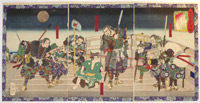
 Click here to view image full size. A rare triptych Toyotomi shoshinroku, “A Record of the Advancement of Toyotomi Hideyoshi.” Shows the young Hideyoshi ( 1537 – 1598 ) demanding an apology from Hachisuka Koroku on Yahagi Bridge. Published c. 1869 by Yorozumago. Fine impression and colour. Gauffrage and extensive burnishing. The paulownia border intact which is often trimmed. Signed Ikkaisai Yoshitoshi hitsu. Status: Sold
Tsukioka YOSHITOSHI (1839-1892)

 Click here to view image full size. Arguably Yoshitoshi’s masterpiece in the triptych format. Shows Mongaku ( Endo Morito, c.1120-1200 ) subjecting himself to three years penance as a Buddhist monk beneath the waterfall of Mount Nachi in Kii Province. Morito inflicted this punishment on himself because he had inadvertently cut off the head of Kesa Gozen, the wife of the palace guard Watanabe Wataru, with whom he was in love. Published 1859 ( centre sheet ) and 1860 ( outside panels ) by Kadokin. Extremely rare: Another impression in the Baur collection, Geneve, Switzerland. Fine impression, very good colour. Minor marks and small expertly restored wormage. Slight trimming. Extensive splashed gofun. Signed Ikkaisai Yoshitoshi hitsu. Status: Sold  Click here to view image full size.  Click here to view image full size.  Click here to view image full size.

Tsukioka YOSHITOSHI (1839-1892)

 Click here to view image full size. A fox priest from Tsuki hyakushi, “One Hundred Phases of the Moon.” Based on the Kyogen farce Konkai, “A Fox’s Cry” which tells of a hunter who is lectured on trapping foxes by his uncle, a priest. On his way home his uncle turns into his true form, a fox, and is snared in a trap. Yoshitoshi’s design shows the uncle transmogrifying into a fox. The set published by Akiyama Buemon between 1885 – 92, this design issued 1 One of the best designs from the set. Very good impression and colour. Retains original light album backing. Signed Yoshitoshi Status: Sold

Ichiyusai KUNIYOSHI (1797-1861)

 Click here to view image full size. Shows Inudzuka Shino Moritaka defending himself against Inukai Kempachi Nobumichi and his men on the Horyukaku roof. From a set of four diptychs ( often split ) published by Nishimuraya Yohachi, c 1835. Robinson S 5.6. Very good impression. Fine colour and condition. Completely untrimmed. Signed Ichiyusai Kuniyoshi ga. Status: Sold

Tsukioka YOSHITOSHI (1839-1892)

 Click here to view image full size. Mariko from the Fifty-Three Stations of the Tokaido Road. The set designed by several artists and various publishers to commemorate the journey of the Shogun from Edo to Kyoto in 2 The best Yoshitoshi design from this set. Shows a battle fleet outside Mariko. Published by Yamaguchi 5 Very good impression and colour. Small fibre loss at extreme left edge. Very good condition. Signed Yoshitoshi fude. Status: Sold

Ichiyusai KUNIYOSHI (1797-1861)

 Click here to view image full size. The pilot and nobleman Yoshibei leaps from his vessel to a rock in the Chopping Block Shoals and sacrifices himself to save his ship off the coast of Buzen Province. Meisho Kyushu yori joraku no toki. Published c 1850 by Santetsu. A wonderful and rare triptych which is seldom illustrated. Robinson T251. Extremely fine impression. Fine colour and condition. Totally untrimmed. Colours do not quite match across the three sheets – a common fault on 19th century triptychs. Signed Ichiyusai Kuniyoshi ga. Status: Sold

Tsukioka YOSHITOSHI (1839-1892)

 Click here to view image full size. Abe no Hirafu slaying a giant bear from Dai Nippon meisho kagami, “Mirror of Famous Generals of Japan.” A set of 51 prints published between 1876 and 1882 by Funazu Chujiro. ( This being 1880. ) Probably the best design from the set. Very good impression, colour and condition. Full size. Signed Oju Yoshitoshi ga. Status: Sold

Tsukioka YOSHITOSHI (1839-1892)

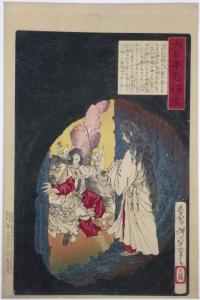
 Click here to view image full size. Amaterasu Omikami appearing from the cave from Dai Nippon meisho kagami, “Mirror of Famous Generals of Japan.” A set of 51 prints published between 1876 and 1882 by Funazu Chujiro. ( This being 1882. ) One of the best designs from the set showing the famous story of Amaterasu – the Sun Goddess who had enclosed herself in a grotto with a large rock blocking the entrance causing darkness in the universe. She was tempted to peep out from the cave by the raucous activities of the other gods and goddesses whereupon she glimpsed herself in a mirror and the stone door was quickly fastened back by Ame no Tajikara. Very good impression, colour and condition. Full size. Signed Oju Yoshitoshi ga. Status: Sold

Tsukioka YOSHITOSHI (1839-1892)

 Click here to view image full size. Kamitsukeno Yatsunada attacking Saohime’s castle from Dai Nippon meisho kagami, “Mirror of Famous Generals of Japan.” A set of 51 prints published between 1876 and 1882 by Funazu Chujiro. ( This being 1880. ) One of the best designs from the set showing Saohime perishing in the flames of her brother’s castle – Saohiko – who had conspired with his sister to seize the throne. Very good impression, colour and condition. Full size. Signed Oju Yoshitoshi ga. Status: Sold

Ichiryusai HIROSHIGE (1797-1858)

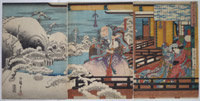
 Click here to view image full size. Taira no Kiyomori kaii o miru zue, “Taira no Kiyomori Haunted by Strange Sights.” Towards the end of his life, Kiyomori, the head of the Taira clan, was obsessed with and hallucinated that his vanquished enemies had come back for retribution. Shows Kiyomori and his lover on the engawa of the palace confronted by a multitude of snow covered sculls and skeletons in the garden. Published by Kinseido, c 1845. Hiroshige’s best musha-e triptych. A much sought after and rare design. Fine impression, colour and condition. Signed Hiroshige ga. Status: Sold

Ichiryusai HIROSHIGE (1797-1858)

 Click here to view image full size. Yoshitsune senbon zakura, “Yoshitsune and the Thousand Cherry Trees” from an extremely rare set: Kokon joruri tsukushi, “Ancient and Modern Dramas Illustrated.” The set published c 1846 by Sanoki. Basil Stewart listed 14 known designs in his Subjects Portrayed in Japanese Colour-Prints, Kegan Paul, 1922, p. 308 and this was updated to 15 by Strange in 1925 ( which still seems to be the known number extant for this set ). Shows the fox Tadanobu and Yoshitsune’s lover Shizuka-gozen. Very fine impression, colour and condition. Signed Hiroshige ga. Status: Sold

Ichiryusai HIROSHIGE (1797-1858)

 Click here to view image full size. Seishu Akogi no ura. Akogi no Heiji being arrested for fishing in forbidden waters from an extremely rare set: Kokon joruri tsukushi, “Ancient and Modern Dramas Illustrated.” The set published c 1846 by Sanoki. Basil Stewart listed 14 known designs in his Subjects Portrayed in Japanese Colour-Prints, Kegan Paul, 1922, p. 308 and this was updated to 15 by Strange in 1925 ( which still seems to be the known number extant for this set ). Very fine impression, colour and condition. Signed Hiroshige ga. Status: Sold

Ichiryusai HIROSHIGE (1797-1858)

 Click here to view image full size. Chushin koshaku yukifuri no dan, “Meeting of the Loyal Ones in Snow” from an extremely rare set: Kokon joruri tsukushi, “Ancient and Modern Dramas Illustrated.” The set published c 1846 by Sanoki. Basil Stewart listed 14 known designs in his Subjects Portrayed in Japanese Colour-Prints, Kegan Paul, 1922, p. 308 and this was updated to 15 by Strange in 1925 ( which still seems to be the known number extant for this set ). A snow scene showing Yazama Jiutaro, one of the 47 Ronin, meeting his wife Orin in Edo after a long separation. Very fine impression, colour and condition. Signed Hiroshige ga. Status: Sold

Utagawa KUNIYOSHI (1797-1861)

 Click here to view image full size. An unfinished otanzaku set Buyu nazorae Genji, “Selected Warriors for the Chapters of Genji.” This design illustrating Chapter 38 ( Suzumushi ) of the Genji monogatari ( the Genji crest in the middle upper right cartouche ). Shows Satsuma Taira Tadanori in court dress with open fan at the door of the house of Kiku-no-mae of the Miyabara family. Published by Ibaya Sensaburo, c 1846. Robinson S28.38. Fine impression, colour and condition. A slightly later and trimmed copy illustrated in Heroes & Ghosts, 1998, no. 44, p. 70. Signed Ichiyusai Kuniyoshi ga. Status: Sold

Yamazaki TOSHINOBU (1857-1886)

 Click here to view image full size. The best design from Nihon ryakushi zu, “ A Brief History of Japan in Pictures.” Mongaku ( Endo Morito, c. 1120 – 1200 ) subjecting himself to three years penance as a Buddhist monk beneath the waterfall of Mount Nachi in Kii Province. Morito inflicted this punishment on himself because he had inadvertently cut off the head of Kesa Gozen, the wife of the palace guard Watanabe Wataru, with whom he was in love. This subject lends itself to some wonderful designs: See this website for a rare horizontal triptych by Yoshitoshi and a vertical triptych by Kuniyoshi, and there are many single sheets by various artists. Toshinobu was a pupil of Kunisada and then Yoshitoshi. Published by Kanei Heizaburo, 1878. Very good impression color and condition. Signed Oju Toshinobu. Status: Sold

Ichiyusai KUNIYOSHI (1797-1861)

 Click here to view image full size. The fifteen year old Otani Furuinosuke killing a wild boar with his bare hands. From the set Honcho Suikoden goyu happyaku-nin no hitori, “ Eight Hundred Heroes of Our Country’s Suikoden, One by One.” A series of fine designs coming after the Tsuzoku Suikoden that was a turning point in Kuniyoshi’s career. Robinson S4a.14. Published by Kaga-ya Kichiyemon, c early 1830s. Many designs from this set reissued by Ibaya Sensaburo, c 1845. Very good impression. Fine colour and condition. Untrimmed ( a rarity on these designs ). Signed Ichiyusai Kuniyoshi ga. Status: Sold
Utagawa HIROSHIGE (1787-1858)

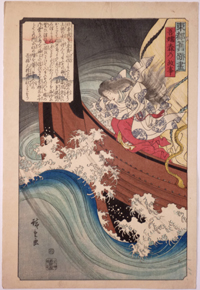
 Click here to view image full size. Azuma no Mori no koji “ The Old Story of Azuma” from a set Toto kyuseki tsukushi, “Old Edo Stories, Illustrated.” Exceptionally rare: Four other designs from the set came up at the Orange and Thornicraft sale, Sothebys, 25/3/1912, lot 440. And another impression of this design is illustrated in Hiroshige, The Albuquerque Museum, 1983, no. 722, pl. 74. Shows the concubine Tachibana Hime about to throw herself from the prow of the boat to appease the sea-gods and protect her lord Yamato Take. This she did despite him vowing to marry Miyazu Hime on his return. Published by Wakasa-ya, c 1845. A wonderful design. Fine impression, colour and condition. Almost mint. Signed Hiroshige ga. Status: Sold
Utagawa KUNIYOSHI (1797-1861)

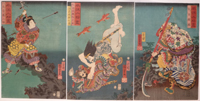
 Click here to view image full size. A triptych with title Furyu ningyo zu, “Pictures of Dolls in Contemporary Fashion.” There was a craze for these lifelike dolls in the 1850s ( this triptych being dated 2/1856 ). In fact Kuniyoshi designed another print in the same year of the centre subject Tammeijiro Genshogo being captured. This impression appears to be the only known copy: Not listed anywhere. Unidentified publisher. An original hanshita-e for the first sheet exists in the Victoria & Albert Museum, illustrated in Japanese Colour Prints, Edward F. Strange, 1913, pl. XLII. Very fine impression and colour. Possibly very slightly trimmed round. Signed Ichiyusai Kuniyoshi ga. Status: Sold

Tsukioka YOSHITOSHI (1839-1892)

 Click here to view image full size. An important original oban wood-block for printing the last sheet of a triptych Gishi youchi rannyu no zu, the night attack of the forty-seven Ronin. The block was cut by Hori Cho and published by Fujikei, 4 The only Yoshitoshi block I have seen. Sold together with the published print in indifferent condition. Block in good condition. Status: Sold  Click here to view image full size.

Utagawa KUNISADA (1786-1865)

 Click here to view image full size. A nagaban ( 20 x 9 in; 51 x 23 cms ) print showing a rear view of General Bacho ( Chinese Ma Chao ) on horseback carrying a huge axe. One of the Five Tiger Generals, heroes of the Chinese Ming Dynasty “Romance of the Three Kingdoms.” A set of five prints with title Goku saishiki go hon nobori no uchi, “Five Brightly Coloured Banners.” Published by Moriya Jihei, c 1835-7 and complements another nagaban set of the same date but showing female warriors. Extremely rare, partly due to their size. Fine impression and colour. Minor soil towards bottom and almost undiscernable centre fold. Signed Kochoro Kunisada ga. Status: Sold