Suzuki HARUNOBU (1725-1770)

Click here to view image full size. A chuban print from an untitled series showing a courtesan lying under a futon waiting for her kamuro to prepare her pipe in the adjoining room. A fusuma partially separates the two rooms and has a painting of a mountain pheasant on a craggy rock (alluded to in the poem above which is by Kakinomoto no Hitomaro, one of the famous Thirty-six Immortal Poets). This poem, which is also interpreted by Hokusai in his set One Hundred Poems Explained by the Nurse, is complex and speaks of long nights dragging by like a mountain trail or a pheasant’s tail. Published c 1768. A particularly rare Harunobu: Another impression is in the BM: A_1937-0710-0-18. Fine impression with beautiful blind-printing delineating her body. The material hanging behind her is also gauffraged. Very good colour. Minor soil and signs of mounting au verso, otherwise very good condition. Signed on the fusuma Suzuki Harunobu ga. Status: Sold

Torii KIYOMINE ( KIYOMITSU II ) (1787-1868)

 Click here to view image full size. Beauties on the beach at Kamakura with white cranes. This is an allusion or pastiche ( mitate ) of the story that Minamoto Yoritomo’s favourite amusement was flying cranes with labels attached to their legs requesting those who saw them to report the fact and fly them again. Kiyomine, a pupil of Kiyonaga, used – as here – the Kiyomine signature on his early work, c 1815. Published by Eijudo han ( Nishimura-ya ). Very good impression and colour. Small area repaired wormage, otherwise very good condition. Signed Kiyomine ga. Status: Sold

Suzuki HARUNOBU (1724-1770)

 Click here to view image full size. A chuban showing the courtesan Matsukaze of the Ogi-ya House from a set of prints: Ukiyo kika, “Strange Flowers of the Floating World.” Shows the courtesan parading outside a Yoshiwara house with her two kamuro. One of the most influential ukiyo-e artists taking full advantage of polychrome printing in 1765 and publishing a large number of exquisite prints, often with innovative pigments and on thick hosho. Published c late 1760s. Another impression in Yoshida, Harunobu zenshu, p. 128. Fine impression. Slight fading otherwise very good condition. Signed Harunobu ga. Status: Sold

Katsukawa SHUNCHO(Fl. c 1780-1801

Click here to view image full size. The first sheet of a triptych showing travellers on a mountain path – possibly the Tokaido Road. Published by Eijudo (Nishimuraya Yohachi), c 1790. Other impressions in the MFA Boston, acc. no. 21.5953 and the BM, 1910, 0212, 0.439. Little is known of Shuncho’s life. He was a pupil of Shunsho and heavily influenced by Kiyonaga. Probably the greatest exponent of the triptych format and a master of the pillar print format.   Fine impression. Extremely good colour. Fine condition. Signed Shuncho ga.   Status: Sold  

Utagawa KUNISADA (1786-1864)

Click here to view image full size. Natsu, “Summer” from a set f four prints Shii no ch “The Four Seasons.” A beauty holds a large umbrella against a summer storm with lightning flashing around her. Published by Kawaguchiya Uhei, c 1833-34. Very good impression, colour and condition. Signed Kochoro Kunisada ga with double Toshidama seal (which is lacking on some impressions). Status: Sold

Ikeda EISEN (1790-1848)

Click here to view image full size. Decorative paper from a series Tosei kobutsu hakkei, “Eight Favourite Things in the Modern World.” The set compares beauties with their favourite “things.” In this case paper, shown top left, while other designs from the set compare beauties to dolls, playing cards, the theatre, kimono, etc. Shows a Yoshiwara courtesan holding a bundle of folded tissue. She has sasabeni lips: the lower lip painted with sasa from the bamboo plant, and the upper lip using beni from the safflower. Published by Senichi (Izumiya Ichibei), c 1823. Fine impression. Slight fading and minor soil, otherwise very good condition. Signed Keisai Eisen ga. Status: Sold
Keisai EISEN (1790-1848)

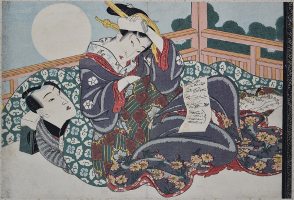
 Click here to view image full size. An amorous couple on a balcony with a large full moon. One of the three best designs from a set of twelve prints: Keisei higo, “Secret Words of a Courtesan” published c 1822-25. Although the set comes under the shunga heading, each print is an abuna-e design, without any graphic detail. Fine composition. Fine impression and colour. Laid onto board from the original album. Small wormage and slight centre fold ( as usual ), otherwise good condition. Status: Sold

Kitagawa UTAMARO (1753-1806)

Click here to view image full size. The lovers Hinadori and Kuganosuke from a series of half-length portraits of pairs of lovers featured in joruri love-suicide plays. (Joruri were bunraku puppet dramas). Jitsu kurabe iro no minakami, “True Feelings Compared: The Founts of Love.” At the height of their popularity the Japanese government cracked down on these joruri plays as they were inspiring copycat double suicides amongst the population. Published by Nishimuraya Yohachi, c 1798-9. Fine impression. Very good colour. Some paper chain lines visible, otherwise very good condition. Signed Utamaro hitsu. Status: Sold

Utagawa KUNIYOSHI (1797-1861)

Click here to view image full size. An aizuri-e print of the courtesan Hontsue of the Daimonjiya House in the Yoshiwara, Edo. Seated on a ledge, she holds an extremely long pipe and is compared to one of the sights of Edo: The Ryogoku Bridge. Published by Kawaguchiya Chozo, c 1830s. Fine impression, colour and condition. Signed Ichiyusai Kuniyoshi ga. Status: Sold

Keisai EISEN (1790-1848)

 Click here to view image full size. A winter scene with an amorous couple in a boat keeping warm beneath a huge duvet. One of the three best designs from a set of twelve prints: Keisei higo, “Secret Words of a Courtesan” published c 1822-25. Although the set comes under the shunga heading, each print is an abuna-e design, without any graphic detail. Fine impression and colour. Laid onto board from the original album. Small wormage and slight centre fold ( as usual ), otherwise good condition. Status: Sold

Kitagawa UTAMARO (1754-1806)

Click here to view image full size. A double-bust portrait of the famous courtesans Ariwara (bottom) and Usumizu of the Tsuruya House in the Yoshiwara, Edo. From a set Seiro yukun awase kagami, “Mirror of Courtesans of the Green Houses.” Published by Yamada, c 1797.   Fine impression. Very good colour. Very slight trimming, otherwise very good condition. Signed Utamaro hitsu.   Status: Sold    

Torii KIYOTSUNE (Fl. c 1757-1779)

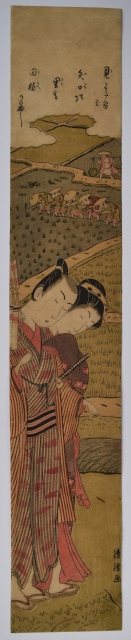
Click here to view image full size. A pillar print showing an amorous couple walking beside rice paddies. In the background a line of women plant rice. Kiyotsune was a pupil of Kiyomitsu and specialised in theatrical prints. Published c early 1770s. Rare.   Fine impression. Exceptionally well retained colour. Very good condition. Signed Kiyotsune ga.   Status: Sold  

Utagawa KUNIYOSHI (1797-1861)

 Click here to view image full size. Women washing cloth in the Chofu River from a set of six triptychs of the Six Tama (or Jewel, or Crystal) Rivers. Musashi no kuni Chofu Tamagawa, “Chofu Crystal River in Musashi Province.” Published by Sanoya Kihei, 1847-8.   Very good impression, colour and condition. Signed Ichiyusai Kuniyoshi ga.   Status: Sold  

Tsukioka YOSHITOSHI (1839-1892)

 Click here to view image full size. Spring from a set of triptychs Zensei shiki, “The Four Seasons at their Height.” (Actually, only three designs known.) Shows beauties enjoying an outing at the Risshun Plum Garden on the first day of spring at Hara village in the Ebara District. Published by Akiyama Buemon, 3   Superb impression of the first edition with de-luxe pigments; the red double-printed (lacking on later editions), blind-printing, burnishing, and beautiful bokashi. Fine colour and condition. Signed Oju Yoshitoshi hitsu.   Status: Sold  

Tsukioka YOSHITOSHI (1839-1892)

Click here to view image full size. Niai-so: Koka nenkan kuruwa no geisha fuzoku, “Looking suitable: the appearance of a brothel geisha of the Koka era” (1844-1848). From the set Thirty-two Aspects of Women published by Tsunashima Kamekichi, 1888. Shows the beauty dressed as a fashionable young man.     Very fine impression of the first edition. Very fine colour with blind-printing and burnishing. Gold (brass powder) applied to the peacock design on the costume. This particular design from the set is notorious for having the brass degrade the paper and these areas fall out as well as offsetting onto the opposite print in album sets. Very fine condition. Signed Yoshitoshi ga.     Status: Sold    

Ichiryusai HIROSHIGE (1797-1858)

 Click here to view image full size. Shows a beauty composing a letter from a set of ten prints Fukutoku gane no narikei, “Virtuous Women and the Money Tree.” Published by Aritaya Kiyoemon, c. 1847-50. The money tree branches make up the kanji characters of the sub-title, in this case Shuseki, the tree of good writing.   Very good impression, colour and condition. Signed Hiroshige ga.   Status: Sold  

Katsukawa SHUN’EI (1762-1819)

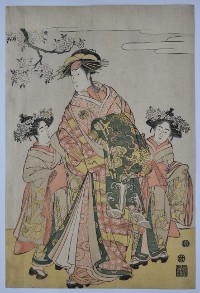
 Click here to view image full size. A parading courtesan with her two kamuro. Published c. late 1790s by Murataya Jirobei (Eiyudo). Unsigned, but the manner of drawing the courtesan’s face is typical of Shun’ei. Interestingly, another unsigned print (with spurious Shunsho signature) but by Shun’ei is illustrated in The Actor’s Image, Clark & Ueda, A.I.C., 1994, no. 130, p. 346, and has the same publisher.   Very good impression and colour. Some small expertly restored wormage at left edge, otherwise very good condition.   Status: Sold  

Keisai EISEN (1790-1848)

 Click here to view image full size. The courtesan Shiratama of the Sanomatsuya House in the Shin Yoshiwara seated looking into a mirror. Episode Sekidera from a Seven Komachi set: Shin Yoshiwara yugimi nana Komachi. The set based on the seven episodes in the life of the famous 9th century poetess Ono no Komachi. Published by Tsuta-ya, c 1830. Very good impression of the first state. Superb, unfaded colour. Fine condition; full size. Signed Kei Status: Sold

Keisai EISEN (1790-1848)

 Click here to view image full size. The courtesan Efuku of the Owariya House in the Shin Yoshiwara seated at a low desk and holding a toothpick. Episode Kiyomidzu from a Seven Komachi set: Shin Yoshiwara yugimi nana Komachi. The set based on the seven episodes in the life of the famous 9th century poetess Ono no Komachi. Published by Tsuta-ya, c 1830. Very good impression of the first state. Superb, unfaded colour. Fine condition; full size. Signed Keisai Eisen ga. Status: Sold

Tsukioka YOSHITOSHI (1839-1892)

 Click here to view image full size. Mita-so: Tempo nenkan o-kosho fuzoku, “Looking Inquisitive: The Appearance of a Maid in the Tempo Era” ( 1830 – 1844 ). From the set: Thirty-two Aspects of Women published by Tsunashima Kamekichi, 1888. Shows a maid peering through a summer bamboo screen.   Superb impression of the first edition. Very fine colour and condition with the extra paper at left edge and the full handling area showing bottom right. Beautiful blind-printing and a polished pattern applied to the black obi. Signed Yoshitoshi ga.   Status: Sold  

Okumura MASANOBU (1686-1764)

Click here to view image full size. Kanzake momiji-gari, “Heating Sake with Maple Leaves.” No. 9 from a set of 12 prints, the orihon being signed on the last design. The set parodies famous plays. A samurai, wearing a basket hat, approaches a group of three women seated below a maple tree while a young girl tends to a kettle being heated by maple leaves. Momiji-gari was an autumn fixture that involved visiting scenic spots to brew sake and enjoy and appreciate the autumn foliage. Published c early 1730s. Another impression is illustrated in The Clarence Buckingham Collection of Japanese Prints, AIC, 1955, no. 48, p. 133.   Fine impression. Light touches of hand-applied beni. Fine condition. (One can seldom catalogue such prints in this way as they are usually toned, wormed or damaged in other ways.)   Status: Sold

Hanekawa CHINCHO (1679-1754)

Click here to view image full size. An oversized hosoban showing a parading courtesan with her kamuro and an attendant holding an umbrella. A rare arist who made few prints: Clarence Buckingham states that he was of samurai stock and only worked when in the mood. (Where he got this information I am not sure but it is repeated by Dr Richard Lane and Laurence Roberts.) He was a pupil of Torii Kiyonobu. Sometimes used the name Motonobu. Excessively rare: This may be the only impression extant. Published by Komatsuya who published c 1709-34.   Very good impression. Hand-applied colour in two shades of beni, mustard, and gold powder on the umbrella. Some small restored wormage and slight soil, but generally very good condition. Signed Hanekawa Chincho zu.   Status: Sold

Suzuki HARUNOBU (1724-1770)

Click here to view image full size. Shows the great beauty Ofuji at her shop, the Moto-Yanagiya, near the Kannon-do, Asakusa. She is shown grinding a powder with a mortar. A customer is seated near her smoking a pipe. In the foreground is a rooster. (The Tori no ichi, “Days of the Rooster” festival was held nearby.) Ofuji was the daughter of the owner of the tooth-brush store and their products are displayed on the left: toothbrushes, picks and packets of powder. Two boards behind her advertise Nioi-fushi, “Perfumed tooth-blacking” and [Shuchu]-ka, “Sake flowers,” evidently a side-line for her which were scented flowers and other shapes, crumpled, and which opened out in cups of sake. Ofuji was frequently depicted by Harunobu and Buncho, and later by Utamaro.   Fine impression. Very good colour and condition. Unsigned: Normally an unsigned Harunobu would indicate a calendar print in its first state, and the rooster point to the Rooster year 1765. However, it’s difficult to see where the months could have been hidden, so we surmise that it was published c 1769.   Status: Sold    

Utagawa KUNIYOSHI (1797-1861)

 Click here to view image full size. Etchu Namerikawa otako, “Giant Octopuses in Namerikawa in Etchu” and sub-title Oo itai, “Ouch.” Obviously the cat’s claw being compared to the menacing tentacles of the octopus. A series of seventy prints Sankai medetai zue, “Affectionate Feelings for Mountains and Seas.” The set compares half-length beauties with famous products of the locality. Published by Tsurakichi, 1852. Kuniyoshi was particularly fond of cats and his studio was known to be home to a number of them. This may be his best evocation of a cat.   Superb impression with the cat’s coat blind-printed. Very fine colour and condition. Signed Ichiyusai Kuniyoshi ga.   Status: Sold  

Utagawa TOYOKUNI I (1769-1825)

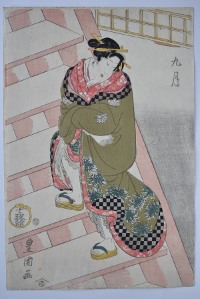
Click here to view image full size. A beauty climbing stairs, the ninth month from a set of twelve. Published c 1813 by Nishimuraya Yohachi. Beauties ascending stairs was a stock subject for ukiyo-e artists. I’m not sure why.     Fine impression, colour and condition. Signed Toyokuni ga.     Status: Sold    

Chobunsai EISHI (1756-1829)

 Click here to view image full size. An aiban from a set of four prints: Shiki warabe asobi, a series of prints comparing young children to the four seasons. Another from the set is illustrated in Estampes Japonaises. Collection des Musees royeaux d’Art et d’Histoire, Bruxelles, 1989, cat. 319, p. XXXIX ( incorrectly attributed to Eisho ). Published by Izumiya Ichibei 1795-6. Very good impression, colour and condition. Full size. Signed Eishi. Status: Sold

Utagawa TOYOKUNI I (1769-1825)

Click here to view image full size. A beauty from a set Furyu hakkei, “Fashionable Eight Views.” Each beauty represents one of the famous Eight Views of Omi, here being Evening Glow at Seta.This theme, which originates from China, is often encountered in Japanese art. Shows a young woman unrolling a scroll with a view (presumably) of Seta Bridge. An extremely rare set with the designs standing alone but also forming diptychs. Three other single prints from the set are illustrated in Ukiyoe-e Taikei, vol. 9, no. 6, Night Rain, in colour, and nos. 101, Evening Snow and 102, Returning Sail, in b A complete (faded) diptych is in the MFA Boston, Returning Sail and Returning Geese, 21.7473-4. I cannot, at the moment, locate another impression of this design. Published by Izumiya Ichibei (Kansendo) c 1794 – Toyokuni’s best period. Provenance: Ex collection Hayashi (seal bottom left) and Louis Gonse. A beautiful print.     Fine impression. Slight loss of gold in cloud at top but otherwise fine colour. Fine condition. Signed Toyokuni ga.     Status: Sold    

Kitagawa UTAMARO (1753-1806)

Click here to view image full size. Shows Shinanoya Ohan (left) and Obiya Choemon from a series of half-length portraits of pairs of lovers featured in joruri love-suicide plays. Jisu kurabe iro no minakami, “True Feelings Compared: The Founts of Love.” Choemon was the adopted heir of Obiya, an obi business in Kyoto. Ohan was a young girl from the Shinanoya store next door. In fact, the drama is based on an actual event in Kyoto during the Kyoho era. Two dead bodies were discovered in the Katsuragawa; one of a 50 year old man, the other of a 14 or 15 year old girl. Published by Nishimuraya “Sei” c 1798-9. Another impression is in the MFA Boston, 11.14296. Provenance: Ex Louis Gonse collection. Rare.     Fine impression. Exceptionally good colour. Fine condition. Signed Utamaro hitsu.     Status: Sold    

Chobunsai EISHI (1756-1829)

Click here to view image full size. A parading oiran, Senzan of the Choji-ya, with her two kamuro Isoji and Hanaji. From a set Seiro moyo awase “Comparisons of Brothel Patterns.” Published by Nishimuraya Yohachi (Eijudo), c 1796-7. See Brandt, Hosoda Eishi, Eike Moog, 1977, 100. No. 263. Provenance: Ex Louis Gonse collection.     Fine impression. Exceptional colour. Fine condition.     Status: Sold    

Kitagawa UTAMARO II (?-1831?)

Click here to view image full size. A mother holding her child dressed as Kintaro (later Sakata no Kintoki) holding a small hatchet (ono). From a series Shichi henge kodakara asobi, “Dance of Seven Changes Played by Precious Children.” Published by Iwatoya Kisaburo, 1812. Fine impression. Very good colour. Very minor soil, otherwise very good condition. Signed Utamaro hitsu. Status: Sold