Utagawa KUNIYOSHI (1797-1861)

Click here to view image full size. The general Morozumi Masakiyo, Lord of Bungo and a retainer of the Takeda Clan (Shingen of Kai Province) in a battle with the Uesugi Clan (Kenshin of Echigo Province), The wars taking place between 1553 and 1563. From a set Koetsu yusho den, “Stories of Courageous Generals of the Provinces of Echigo and Kai.” Masakiyo is shown committing suicide by inserting his sword into his mouth while being blown up by a land-mine. As with so much in Japan, the land-mine originated in China from early times. Published by Sumiyoshiya Masagoro, c 1848-9. One of the “three great deaths” of these wars.   Very good impression with extensive sprayed pigment around the exploding mine. Slight fading, otherwise very good condition. Signed Ichiyusai Kuniyoshi ga.   Status: Available Price:  £2,800  

Shunbaisai HOKUEI (Active 1824-1837)

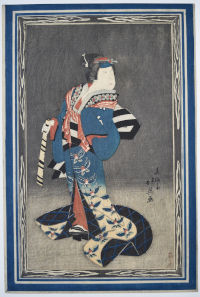
Click here to view image full size. Shows the actor Arashi Rikan II as the yako Koman holding a shakuhachi and posed within a wooden frame in the play Sugata kurabe deiri no minato, “Comparison of Fighting Figures at the Harbour.” Performed in 1834 at the Naka Theatre, Osaka. A yako was a chivalrous servant, usually of a samurai. Rare: Another impression is in the MIA, acc. no P.75.51.188.   Fine impression with the woodgrain enhanced on the background. Fine colour and condition. Signed Shunbaisai Hokuei ga with the carver’s seal bottom right Kasuke.   Status: Available Price: £1,500  

Kitagawa UTAMARO II (Fl. c 1807-1830s)

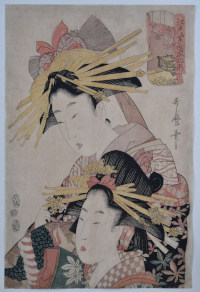
Click here to view image full size. A courtesan and her Shinzo from a set Edo murasaki edoru hinagata, “Models Designed in the Purple of Edo.” A bluish purple as opposed to the more reddish purple from Kyoto. A pigment that had been extremely expensive and reserved for the elite few, but became cheaper and more accessible during the Edo period, fuelled by leading actors – such as Danjuro – wearing an Edo murasaki headband. Published 11 Publisher unread.   Very good impression, colour and condition. Signed Utamaro hitsu.   Status: Available Price:  £2,800  

Utagawa KUNISADA (1786-1865)

Click here to view image full size. A courtesan biting on a tissue about to write a love letter from the set Ukiyoe jinsei tengankyo, “Types of the Floating World Seen Through a Physiognomist’s Glass.” The glass top right. These professionals who purported to look at people’s features and give counsel based on their countenance were called Ninsomi or simply Somi. This set of ten prints showing different female personalities have their characteristics written up above. Utamaro produced two fine sets based on this theme in 1792-4 and c 1802: Fuji ninso jupon and Bijin gomenso. The clenching of the tissue is always an indication of arousal. Published c 1830 by Moriya Jihei (Kinshindo).   Fine impression with blind-printing. Fine colour. Small repaired binding holes and very slight trimming, otherwise very good condition. Signed Gototei Kunisada ga.   Status: Available Price:  £1,800  

Utagawa KUNIYOSHI (1797-1861)

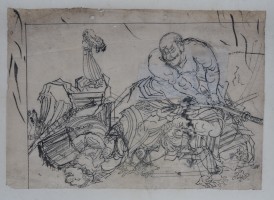
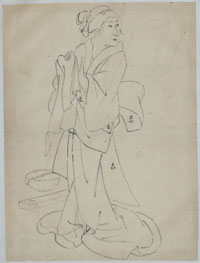
Click here to view image full size. An original drawing, sumi on thin paper laid onto Japanese paper, 6.5 x 9.25 in; 15.9 x 23.5 cms. A heavily muscled individual (Benkei ?) dispatching two adversaries. Sold “as is” with all imperfections common to surviving drawings. Two areas of pentimenti.   Status: Available Price:  £1,800  

Utagawa KUNISADA (1786-1864)

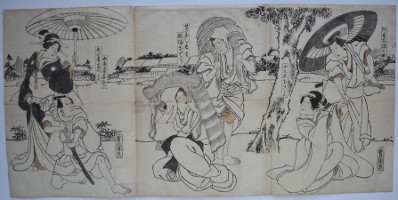
Click here to view image full size. An original hanshita-e (preparatory drawing) for a triptych showing, from the left, Nakamura Kamenojo I as the geisha Azuma standing above Kawarasaki Gonjuro I as Yamazakiya Yogoro, Bando Kamezo I as Settanaoshi Chogoro standing above Onoe Kikugoro IV as Kumasaka Ocho, and Onoe Kikugoro IV as Akogi Gennojo standing above Onoe Kikujiro II as Onnadayu Okoyo. The play was Yume musubu cho ni torioi performed at the Ichimura-za theatre 3 These first drafts by the artist themselves survive because a more detailed drawing was needed by the blockcutter, and this was normally given to an assistant to execute. Or the drawing was never taken up by the publisher, for whatever reason. Sumi and touches of red with some pentimenti. (This was also most likely a published print by Sanoki as it is from the same group as others offered here.) Signed on two sheets Toyoukuni ga.     Status: Available Price:  £1,500    

Utagawa KUNIYOSHI (1797-1861)

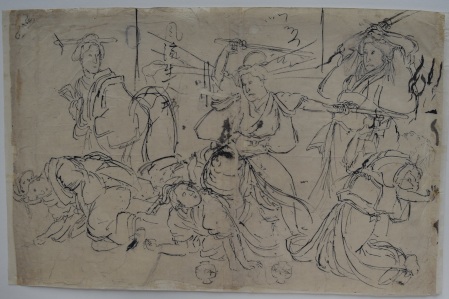
Click here to view image full size. A fine large original drawing, sumi on thin paper, 12 x 18.5 in; 30.4 x 47 cms. Shows battling women holding what appear to be wooden swords. Two seals at the bottom which appear to be the publisher Honmo who published 1855-56. Provenance: Ex collection Dr. Julius Kurth (1870-1949), an eminent scholar who wrote extensively on Japanese and Chinese art.   Sold “as is” but in good condition.   Status: Available Price:  £1,500  

Torii KIYOHIRO (Active 1737-1776)

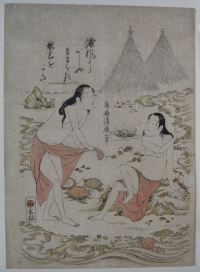
Torii KIYOHIRO Click here to view image full size. A large oban, 17.25 x 12.25 in; 44 x 35.2 cms, sumizuri-e with hand-applied colour. Shows two ama, abalone divers, on the seashore with nets in the background , abalone shells at their feet and an octopus in the waves below them. The poem above speaks of the salty sea breeze wafting across the shore. Published by Maruya Kuzaemon (Gyokeido) c late 1730s. Extremely rare: Another impression is in the Ritsumeikan University,   Very good impression. Light soil, and lightly laid down. Faint fold marks, but generally good condition for its size and date. Signed Torii Kiyohiro hitsu.   Status: Available Price: £12,800  

Tsukioka YOSHITOSHI (1839-1892)

Click here to view image full size. Okigatsuki-so: Meiji nenken saikyo nakai no fuzoku, “Looking Capable: The Appearance of a Kyoto Waitress in the Meiji Era [1867-1912].” Shows the waitress of a Kyoto geisha house whose job was to act as a go-between for customer and geisha. From a set Thirty-two Aspects of Women published by Tsunashima Kamekichi, 1888. The set depicts women of different backgrounds and occupations from the Kansei era through to the Meiji era with punning allusions to their situation or mood.   Very fine impression of the true first edition. Fine colour and condition. Signed Yoshitoshi ga.   Status: Available Price:  £1,650  

Tsukioka YOSHITOSHI (1839-1892)

Omota-so: Tempo nenkan Fukagawa karuko no fuzoku, “Looking Weighed-Down: The Appearance of a Waitress at Fukagawa in the Tempo Era [1830-1844].” Shows the waitress carrying a portable wooden table with food to a geisha party from a set Thirty-two Aspects of Women published by Tsunashima Kamekichi, 1888. The set depicts women of different backgrounds and occupations from the Kansei era through to the Meiji era with punning allusions to their situation or mood. Very fine impression of the true first edition. Fine colour and condition. Signed Yoshitoshi ga.   Status: Available Price:  £2,200    

Utagawa HIROSHIGE (1797-1858)

Click here to view image full size. One of a set: Edo Murasaki meisho Genji, “Murasaki’s Genji in Famous Places of Edo.” Mitate Ukifune Sumidagawa no watashi, “A Parody of Ukifune Crossing the Sumida River.” Shows a beauty on a ferry crossing the Sumida River in heavy snow, representing Ukifune, one of the court ladies of the Genji Monogatari. Stylised clouds above and below copying the traditional kiri-gane gold found on Yamato-e scrolls. These Genji pictures were popular at this time to circumvent the reforms of 1842. Published by Kinseido (his seal also appearing on the umbrella bottom right). Rare. Fine impression. Very good colour. Lower margin trimmed close, otherwise very good condition. Signed Hiroshige ga.     Status: Available Price:  £3,200    

Shibata ZESHIN (1807-1891)

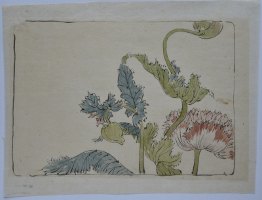
Click here to view image full size. A fine original drawing in sumi and colour for the series Hana kurabe, “A Comparison of Flowers” published by Shugyokudo between c 1875 – 1890. The set of 120 prints was issued in groups of 12 enclosed in paper wrappers. This design shows a group of Japanese poppies. On thin paper laid onto Japanese paper, 7.5 x 10 in; 19 x 25.5 cms.   Status: Available Price:  £580

Shibata ZESHIN (1807-1891)

Click here to view image full size. A fine original drawing in sumi and colour for the series Hana kurabe, “A Comparison of Flowers” published by Shugyokudo between c 1875 – 1890. The set of 120 prints was issued in groups of 12 enclosed in paper wrappers. This design shows a group of daffodills. On thin paper laid onto Japanese paper, 7.5 x 10.5 in; 19 x 26.5 cms.   Status: Available Price:  £580

Shibata ZESHIN (1807-1891)

Click here to view image full size. A fine original drawing in sumi and colour for the series Hana kurabe, “A Comparison of Flowers” published by Shugyokudo between c 1875 – 1890. The set of 120 prints was issued in groups of 12 enclosed in paper wrappers. This design shows the entrance to a shrine with numerous ema hanging under cover and two figures entering. On thin paper laid onto Japanese paper, 7.25 x 9.75 in; 18.5 x 24.5 cms.   Status: Available Price: £580

Shibata ZESHIN (1807-1891)

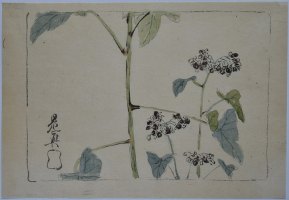
Click here to view image full size. A fine original drawing in sumi and colour for the series Hana kurabe, “A Comparison of Flowers” published by Shugyokudo between c 1875 – 1890. The set of 120 prints was issued in groups of 12 enclosed in paper wrappers. This design shows an unidentified plant with purple-black berries – possibly a variety of elderberry. On thin paper 7.25 x 10.5 in; 18.5 x 26.5 cms. Signed Zeshin and an indication for where the Shin seal should go. Sold together with the published print. Backed and with centre fold. Signed Zeshin and Shin seal.   Status: Available Price:  £580 Click here to view image full size.

Toyohara KUNICHIKA (1835-1900)

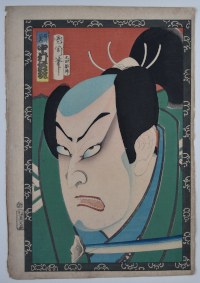
Click here to view image full size. The actor Nakamura Sagisuke in the role of the samurai attendant Kanji (Chugen Kanji) in the play Kichisama mairu yukari no otozure which was premiered at the Nakamura-za Theatre 15 From a set of at least 22 prints published by Gusokuya Kahei, 1869. Kunichika was a hack artist who nevertheless produced some fine triptychs (horizontal and vertical) and this fine set of actor bust portaits.   Fine impression and colour. Slight trimming, otherwise very good condition. Signed Kunichika hitsu.   Status: Available Price:  £1,280  

Utagawa KUNISADA (1797-1861)

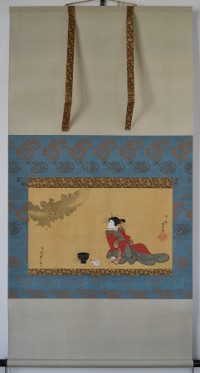
Click here to view image full size. A fine and interesting original painting, full colour on silk, 11.25 x 20.25 in; 28.5 x 51.5 cms. Shows a reclining beauty looking up at a cuckoo (hototogisu) flying in clouds. The cuckoo is the harbinger of the summer months. This painting, made c 1830, reflects Kunisada’s study, together with Ikkei, of the work of Hanabusa Itcho (1652-1724). Indeed, Ikkei gave Kunisada the name Hanabusa Ittai and this painting is signed Hanabusa Itcho Kunisada ga with seal Hanabusa Ittai Kunisada no in. To the bottom left is an inscription reading “A disciple of Utagawa Kunisada drawn on request [the cuckoo].” There is a small seal but it is undecipherable.     Minor marks but in generally very good condition. Touches of gold and the gofun on the face well retained. Newly mounted with new box.     Status: Available Price:  £2,300     Click here to view image full size. Click here to view image full size. Click here to view image full size.

Katsushika HOKUSAI (1760-1849)

Click here to view image full size. Volume 11 from the Manga. Front cover with original pink title slip: (Denshin kaishu) Hokusai manga juichihen, (“Transmitted from the Gods.”) “Hokusai’s Sketches, Vol. 11.” Original grey covers with burnished wave and diamond pattern. Inside front cover catalogue of newly published books; 2 pages preface and 29 numbered pages comprising 56 illustrations , 36 single page and 10 double page. 2 pages block-holders catalogue and inside back cover catalogue of newly published books. The extremely rare first edition published by Eirakuya Toshiro, Nagoya, c. 1834. The Manga was eventually completed in 15 volumes (the last two posthumously). The first 10 volumes published by Kadomaruya Jinsuke, Edo and Eirakuya Toshiro, Nagoya, 1814-1819; vols. 11 and 12 by Eirakuya only, c. 1834; vol. 13 by Eirakuya only, c. 1849; vol. 14 by Eirakuya only, c. 1850s; vol. 15 by Eirakuya only, 1878. Initially based on sketches produced on a visit to his friend and pupil Maki Bokusen in Nagoya in 1812. These sketches were collated by Bokusen and Katsushika Hoku’un and published in 1814. Other pupils collected sketches and so the set expanded. The books were enormously influential and popular, not just in Japan, but in the West and were endlessly reprinted giving rise to a plethora of late editions. In 1831, the German Phillip Franz von Siebold, reproduced images from the Manga in lithograph in his Archiv zur Beschreibung von Japon. They were also highly admired by the Impressionists, especially Manet and Bracquemond. Fine impressions of the first edition. Some minor defects but otherwise in very good condition. Status: Available Price:  £3,800 Click here to view image full size. Click here to view image full size. Click here to view image full size. Click here to view image full size. Click here to view…

Tsukioka YOSHITOSHI (1839-1892)

Click here to view image full size. Samu-so: Tempo nenkan Fukagawa Nakamachi geisha fuzoku, “Looking Frozen: The Appearance of a Fukagawa Nakamachi Geisha in the Tempo Era [1830-1844].” Shows a beauty caught in a snowstorm, her umbrella laden with snow from a set Thirty-two Aspects of Women published by Tsunashima Kamekichi, 1888. The set depicts women of different backgrounds and occupations from the Kansei era through to the Meiji era with punning allusions to their situation or mood.   Very fine impression of the true first edition. Fine colour and condition. Signed Yoshitoshi ga.   Status: Available Price:  £2,200  

Nagasawa ROSETSU ( 1754-1799 )

Click here to view image full size. An original painting showing a white mouse and a spiny lobster on a tray. Rosetsu is considered one of the most important artists of the late Edo period but little is known of his short life ( he died at forty-five ) apart from the fact that he studied, and was one of the top disciples, of Maruyama Okyo. He is labelled an “eccentric” painter as he defies easy classification. His brushwork is a tour de force and he is known for his expressive depictions of animals. The Chinese-style inscription above is by Rosetsu’s friend Minagawa Kien who was a painter and scholar of Confucianism. It implies that the lobster and mouse are both signs of good fortune. Ink and light colour on paper. Image size 44.75 x 11.25 in; 113.75 x 28.5 cms.   Signed Rosetsu with seal Gyo. Painted 1790s. Inscription signed and sealed Kyosai. Slight foxing, otherwise in very good condition. One of the most copied painters. See Kono, Exhibition of Nagasawa Rosetsu, Chiba City Art Museum, 2000, pl. 42 for identical seals. Tsuji Nobu, Nagasawa Rosetsu: the Fanciful Painter, Miho Museum, 2011, pls. 19, 58-60, 67,87, 90, 91, 93 and 94.   Status: Available Price:  £4,200   Click here to view image full size. Click here to view image full size. Click here to view image full size.

Utagawa KUNIYOSHI (1797-1861)

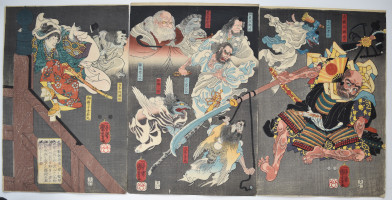
Click here to view image full size. A triptych showing the famous battle on Gojo Bridge. The story relates how Benkei only needs one more blade to add to the 999 he has wrenched from samurai attempting to cross the bridge in order to fashion an invincible weapon. He meets Ushiwaka Maru (Minamoto no Yoshitsune’s childhood name) and challenges him to a fight on the bridge. Yoshitsune is aided by Sojobo, King of the Tengu (white-bearded in the centre) and other yamabushi tengu. Benkei loses the fight and becomes Yoshitsune’s loyal retainer. Published by Enshuya Hikobei, 1847-50. Robinson T194.   Fine impression, colour and condition. A lovely copy of this triptych. Signed Ichiyusai Kuniyoshi ga.   Status: Available Price:  £3,800  

Mori SOSEN (1747-1821)

Click here to view image full size. A fine surimono-sized painting, light colour on silk, 7.75 x 7 in; 19.5 x 17.8 cms. Shows a female sika deer. His life is not well documented but he is known to have studied under the Kano artist Yamamoto Joshunsai (?-1781) before being drawn into Maruyama Okyo’s (1735-1795) artistic circle and his style is more Shijo than anything else. His animal paintings were evidently highly valued by Okyo. He was an immediate favourite with eastern collectors because of his monkey paintings at which he excelled, although he was more versatile than literature implies and highly accomplished at painting other animals. But his images of monkeys take precedence and he is considered the pre-eminent painter, east or west, on this subject. It is alleged that he lived in the woods for three years eating fruit and nuts to study the monkeys and other animals, and is also supposed to have had a cage of monkeys at the back of his house to better observe them. Very good condition, unmounted. Signed Sosen hitsu with seals So, Sen.    Status: Available Price:  £1,500

Attributed to Sugimura JIHEI (Active c. 1681-1703)

Click here to view image full size. A large-size hand-coloured print showing a couple in flagrante delicto from an untitled set of twelve prints published by Hangiya Chojiro, c. 1685. (There were in fact two alternative designs added making a total of fourteen sheets.) Most reference works give this set to Moronobu. However, Timothy Clark, in the British Museum exhibition catalogue: Shunga, sex and pleasure in Japanese art, 2013, pp. 128-131 attributes the set to Jihei stating that “…this group of prints is one of the most glorious to have survived from the early period of ukiyo-e.”   Very good impression. Fine hand-colouring. Minor imperfections and signs of mounting au verso, but all compatible with the age of the print.     Status: Available Price:  £5,800    

Attributed to Sugimura JIHEI (Active c. 1681-1703)

Click here to view image full size. A large-size hand-coloured print showing a couple in flagrante delicto from an untitled set of twelve prints published by Hangiya Chojiro, c. 1685. (There were in fact two alternative designs added making a total of fourteen sheets.) Most reference works give this set to Moronobu. However, Timothy Clark, in the British Museum exhibition catalogue: Shunga, sex and pleasure in Japanese art, 2013, pp. 128-131 attributes the set to Jihei stating that “…this group of prints is one of the most glorious to have survived from the early period of ukiyo-e.”   Very good impression. Fine hand-colouring. Minor imperfections and signs of mounting au verso, but all compatible with the age of the print.   Status: Available Price:  £5,800  

Hishikawa MORONOBU (?-1694)

Click here to view image full size. A large sumizuri-e print from a shunga set of twelve published c. 1680s. In each case the couples are enclosed in a Chinese-style fan border. A couple in flagrante delicto beside a tiger and bamboo screen. Moronobu was possibly the single most influential artist and pioneered the ukiyo-e school. A painter, printmaker and illustrator.   Good impression. Minor marks, otherwise good condition.   Status: Available Price:  £1,800  

Hishikawa MORONOBU (?-1694

Click here to view image full size. A large sumizuri-e print from a shunga set of twelve published c. 1680s. In each case the couples are enclosed in a Chinese-style fan border. A couple in flagrante delicto, the women disturbed while threading a needle. Moronobu was possibly the single most influential artist and pioneered the ukiyo-e school. A painter, printmaker and illustrator.   Very good impression. Slight stains at top, otherwise very good condition.   Status: Available Price:  £1,800  

Hishikawa MORONOBU (?-1694)

Click here to view image full size. A large sumizuri-e print from a shunga set of twelve published c. 1680s. In each case the couples are enclosed in a Chinese-style fan border. A couple in flagrante delicto. Moronobu was possibly the single most influential artist and pioneered the ukiyo-e school. A painter, printmaker and illustrator.   Very good impression. A small wormhole and slight stain, otherwise very good condition.   Status: Available Price:  £1,800  

Hishikawa MORONOBU (?-1694)

Click here to view image full size. A large sumizuri-e print from a shunga set of twelve published c. 1680s. In each case the couples are enclosed in a Chinese-style fan border. A couple in flagrante delicto. Moronobu was possibly the single most influential artist and pioneered the ukiyo-e school. A painter, printmaker and illustrator.   Very good impression. A small wormhole and slight stain, otherwise very good condition.   Status: Available Price:  £1,800  

Tsukioka YOSHITOSHI (1839-1892)

Click here to view image full size. A fascinating print showing Kintoki (aka Kintaro and Sakata Kaidomaru) and yama-uba beneath a flowering cherry tree. Strong western elements are obvious in this design indicating a knowledge of (probably) Flemish Madonna and Child paintings or icons, Kintoki standing in for the child Jesus. Yama-uba is depicted as a bare-breasted benign mother figure, rather than the wizened witch which is how she is usually shown, having raised Kintoki on Mount Ashigara. From the set Ikkai zuihitsu, “Essays by Yoshitoshi.” (Ikkai was an early name of Yoshitoshi’s.) A set of thirteen prints published by Masadaya Heikichi 1872 A fine set.   Extremely fine impression and colour from the first edition with a brown Kintoki (rather than bright red) and the red seals in the margin and over signature. The white hare’s coat is blind-printed. Margins trimmed a little, otherwise fine condition. Signed Ikkaisai Yoshitoshi hitsu.   Status: Available Price:  £2,200