Utagawa TOYOKUNI I (1769-1825)

Click here to view image full size. The actor Nakamura Utaemon II playing two roles (out of seven), Nana yaku no uchi, which are: the Manzai street entertainer Tsuchiemon (seated) and Kudayu’s daughter Okumi, in the play Chushin koshaku performed at the Nakamura-za Theatre, 7     Very good impression and colour. Minor creasing, otherwise very good condition. Signed Toyokuni ga.     Status: Sold

Utagawa TOYOKUNI I (1769-1825)

Click here to view image full size. The actors Matsumoto Koshiro V (right) as the barber Nagata Taro; in reality Kamada Masakiyo, and Segawa Michinosuke I as Genkichi’s wife, Osoro; in reality Nagata’s younger sister, in the play Wakazakari Heike Monogatari, performed at the Ichimura-za Theatre, 11 Published by Hachi.     Very good impression and colour. Minor creasing, otherwise very good condition. Signed Toyokuni ga.     Status: Sold

Utagawa TOYOKUNI I (1769-1825)

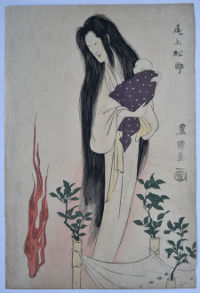
Click here to view image full size. The actor Onoe Matsusuke I as the ghost of the wife of Kohada Koheiji in the play Eiri otogi zoshi performed at the Ichimura-za Theatre, 7 In fact, Matsusuke played both the wife and Kohada Koheiji. One of the best plots in Kabuki: Kohada Koheiji was a third-rate kabuki actor who couldn’t find work. His drama teacher, taking pity on him, bribed a director to give him work. On seeing him, the director immediately saw his potential as a yurei (ghost) because of his appearance – white skin, dark, sunken eyes and long hair. And at this he became extremely successful. However, his wife Osoka, was embarrassed by him and took a lover. Together, they planned to kill him which they did by drowning him in a swamp. This gave him his greatest yurei role and he came back to haunt them to death. Published by Tsuruya Kinsuke, 1808.     Very good impression and colour. Minor creasing, otherwise very good condition. Signed Toyokuni ga.     Status: Sold

Toyohara KUNICHIKA (1835-1900)

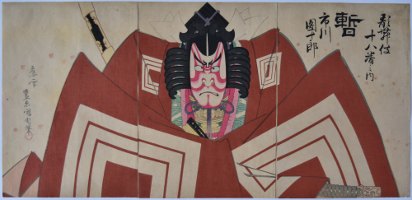
Click here to view image full size. A fine triptych showing the actor Ichikawa Danjuro IX in Shibaraku role. Kabuki juhachiban no uchi: shibaraku, “The Eighteen Famous Kabuki Plays: Shibaraku.” Published by Fukuda Kumajiro, 8 Illustrated on the front cover of Time Present and Time Past: Images of a Forgotten Master: Toyohara Kunichika (1835-1900). Amy Reigle Newland. Hotei publishing, 1999.     Fine impression and colour. Album backing, otherwise fine condition. Signed Oju Kunichika hitsu.     Status: Sold

Utagawa KUNISADA (1786-1864)

Click here to view image full size. A vertical diptych showing the actor Onoe Baiko III in the role of the vengeful and disfigured spirit of Kasane above Sawamura Tossho I as her husband Kinoshitagawa Yoemon. From the play Kuruwa kruwa date no ooyose performed at the Ichimura-za theatre 1836. Published by Kawaguchiya Chozo, 1836. Extremely rare.     Fine impression and colour. Very good condition. Signed Gototei Kunisada ga.     Status: Sold    

Toyohara KUNICHIKA (1835-1900)

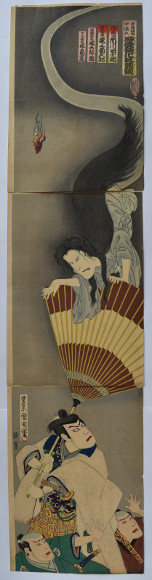
Click here to view image full size. A vertical triptych showing Onoe Kikugoro as Okiku’s ghost; Ichikawa Danjuro IX as the daimyo Aoyama Tessan, and Onoe Kikujiro V and Onoe Matsusuke V as his retainers in the play Sarayashi kesho no sugatami, “Mirror of the House of Blue Dishes.” Performed at the Kabuki-za Theatre, 10 There are two versions of the story: In one, the mistress of the house breaks a valuable blue and white Dutch plate, hiding it in a well and blaming the maid-servant Okiku, who then commits suicide in the well. In the other, Okiku refuses to become Aoyama’s mistress who hides the plate and threatens to accuse her of theft. She throws herself into the well. But in both cases Okiku’s ghost comes back to haunt Aoyama. Published by Fukuda Kumajiro, 1892.     Very fine impression and colour. Very small nicks out of top margin, otherwise fine condition. Full, untrimmed size. Signed Toyohara Kunichika hitsu.     Status: Sold

Utagawa KUNISADA (1786-1864)

Click here to view image full size. The actor Danjuro VIII as the ghost of Seigen from a set of prints Mitate sanjurokkasen no uchi, “An Imaginary Thirty-six Poets” published by Iseya Kanekichi in 1852. The relevant poet in this case is Ariwara no Narihira. The corrupt priest Seigen broke his vows of chastity when he fell in love with Sakurahime. Danjuro played this role in the play Yami no ume yume no tamakura, in the New Year’s programme at the Kawarazaki theatre, Edo, in 1     Very fine early impression with glue applied to the eyes. Fine colour and condition. Signed Toyokuni ga.     Status: Sold    

Utagawa KUNISADA (1786-1864)

Click here to view image full size. The actor Ichikawa Kodanji IV in the role of the vengeful and disfigured spirit of Kasane (Kasane no Bokon) from a set of prints Mitate sanjurokkasen no uchi, “An Imaginary Thirty-six Poets” published by Iseya Kanekichi in 1852. The relevant poet in this case is Fujiwara Toshiyuki no Ason.     Very fine early impression with glue applied to the eyes. Fine colour and condition. Signed Toyokuni ga.     Status: Sold    

Utagawa KUNIYOSHI (1797-1861)

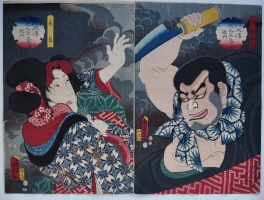
 Click here to view image full size. A diptych showing the actors Bando Shuka (left) as O-kaji, wife of Danshichi, with sword drawn attacking Seki Sanjuro III as the old hag, wife of Giheiji of Mikawa-cho in pouring rain. From the play Shinzo Tsurifune kidan performed at the Ichimura theatre, 5 Published by Kakumotoya Kinjiro. Kuniyoshi designed another version of this play in the same year for another publisher.   Fine impression and colour. Very good condition. Signed Ichiyusai Kuniyoshi ga.   Status: Sold  

Utagawa KUNICHIKA (1835-1900)

 Click here to view image full size. A triptych showing the actor Ichikawa Sandanji I as Akiyama Kiimori amidst an intense conflagration started in an attempt to capture him, Yakuchi no ba. From the series Meiijiza shinkyogen, “New Plays from the Meiji Theatre.” Published by Akiyama Buemon , 1894.   Fine impression, colour and condition. The sheets joined. Signed Toyohara Kunichika hitsu.   Status: Sold  

Tsukioka YOSHITOSHI (1839-1892)

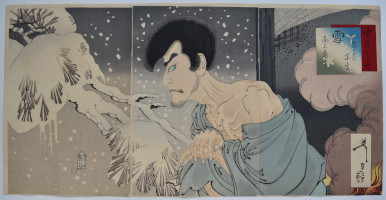
Click here to view image full size. A triptych showing the priest Iwakura Sogen in a snowy garden. “Snow” from a set of three half-length portraits of actors with title: Setsugekka no uchi, “Snow, Moon, and Flowers.” Sogen was infatuated with the beautiful courtesan Irokotohime. He broke his vow of chastity and was expelled from his temple. Unfortunately, Irokotohime dies and Sogen is left with just his memories. There are other versions of this story and a play with the actor Onoe Baiko V. Published by Akiyama Buemon, 1890.   Fine impression of the first edition with variegated and unaltered sub-cartouche. Fine colour and condition. Signed Yoshitoshi ga.   Status: Sold

Taiso YOSHITOSHI (1839-1892)

 Click here to view image full size. The actor Onoe Kikugoro V as Aoyagi Harunosuke from a fine and rare set of 14 actor prints: Seiu kandankei, “A Barometer of Emotions.” This being Full Tide. The set published by Okura Magobei, 1877. Presumably showing Kikugoro in the play Shianui Monogatari written by Ryukatei Tanekazu; Ryutei Tanehiko II; and Ryusuitei Tanekiyo. The actor was a great friend of Yoshitoshi.   Very good impression and colour. Slight soil and creasing, otherwise good condition. Signed Oju Yoshitoshi hitsu.   Status: Sold  

Toyohara KUNICHIKA (1835-1900)

 Click here to view image full size. A full-on image of the actor Ichikawa Danjuro IX as Kamakura Gongoro Kagemasa in the Shibaraku play with the voluminous costume associated with the role. Title: Kabuki juhachiban no uchi/Shibaraku, “The Eighteen Famous Kabuki Plays:Shibaraku.” Kunichika made a number of prints, single, diptych and triptych, of this subject but this particular design is rare. Published by Mizuno Asajiro, c. 1895.   Very good impression and colour. Background partly blind-printed. Slight trimming losing publishing information on left edge of last sheet and slight soil. Otherwise good condition. Signed Oju Toyohara Kunichika hitsu.   Status: Sold  

Toyohara KUNICHIKA (1835-1900)

Click here to view image full size. The actor Otani Tomoemon V playing the role of Ono no Michikaze (also read as Ono no Tofu) in the play Ono no Tofu Aoyagi Suzuri performed at the Ichimura-za Theatre, 5 From a set of at least 22 prints published by Gusokuya Kahei, 1869. Kunichika produced some fine triptychs (horizontal and vertical) as well as this fine set.   Fine impression and colour. Very good condition. Signed Kunichika ga.   Status: Sold  

Katsukawa SHUN’EI (1762-1819)

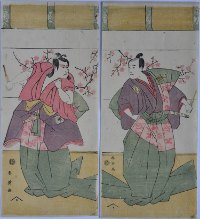
 Click here to view image full size. A hosoban diptych complete showing Ichikawa Monnosuke II ( left sheet ) as Soga no Goro and Sawamura Sojuro III ( right sheet ) as Soga no Juro in the play Shunshoku Edo-e Soga performed at the Ichimura-ya in the first month of 1791. Published by Harimaya Shinshichi. Most hosoban multiples have become separated over time. Very good impression, colour and condition. Completely untrimmed. Signed Shun’ei ga. Status: Sold

Tsukioka YOSHITOSHI (1839-1892)

Click here to view image full size. Hana, “Flowers” from the set Setsugekka no uchi, “Snow, Moon, and Flowers.” Shows the actor Ichikawa Sadanji as Gosho no Gorozo. The main character in the play Soga moyo tateshi no goshozome, “The Story of Gorozo, the Chivalrous Commoner.” A convoluted plot (as usual) with the samurai Gorozu becoming an otokodate upon being expelled by his family because of an undesirable love affair. Gorozu ends up killing his old master’s lover, Oshu. Published by Akiyama Buemon, 1890. A fine set of bust portraits.   Fine impression, colour and condition. Signed Yoshitoshi.   Status: Sold  

Utagawa TOYOKUNI I (1769-1821)

Click here to view image full size. The actor Ichikawa Omezo I in the role of Hannya no Goro in a Shibaraku scene. Part of the play Monomiguruma yuki no takadono performed at the Morita-za Theatre, 11 Published by Kawachiya Genshichi. A striking design.     Fine impression and colour. Small expertly repaired binding holes at top, otherwise fine condition. Full size. Signed Toyokuni ga.     Status: Sold

Shunchosai HOKUSHU (Active 1822-32)

Click here to view image full size. Onoe Kikugoro III as the ghost of Oiwa in Irohagana yotsuya kaidan, “Ghost Story of Yotsuya.” Performed at the Kado Theatre, 1 Probably the best known Japanese ghost story and has been made into a number of films. Tamiya Iemon, a masterless samurai, murders the wife he has disfigured who comes back to haunt him until he is driven mad and subsequently killed by Oiwa’s brother. Evidently, Kikugoro’s performance was something of a sensation at the time as he gave a bravura performance playing both the ghost of Oiwa and Koheiji who were nailed on opposite sides of a panel dropped into the river. There are at least five states of this print. The first appears to be that illustrated in Roger Keyes, The Theatrical World Of Osaka Prints, Philadelphia Museum Of Art, 1973, no. 34, p. 108 with the engraver and two printers and the writing printed in silver. The example offered here appears to be a second state without the engraver and printers’ seal but with the writing still printed in silver. Other impressions with different seals and lacking the first three lines of writing and the silver are known. See The Tsubouchi Memorial Theatre Museum of Waseda University catalogue, Kamigata Prints in the former period: part 1, nos. 279 and 280. Also BM impression 1962,0210,0.2 which may be the last state. Fine impression and colour with calligraphy in silver. Very good condition; full size. Signed Shunchosai Hokushu ga. Status: Sold

Utagawa KUNIYOSHI (1797-1861)

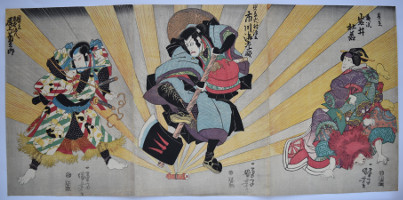
Click here to view image full size. A mitate (imaginary) triptych showing, from left to right: Onoe Kikugoro III as Takehara Genpachi; Ichikawa Ebizo V as Omura Gengo; Iwai Tojaku as Fujinami. The actors surrounding a handscroll that is emitting strong bands of light. Published by Edoya Matsugoro, c. late 1830s.     Fine impression and colour. Album backing and joined sheets, otherwise fine condition. Signed Ichiyusai Kuniyoshi ga.     Status: Sold

Katsukawa SHUNKO (1743-1812)

Click here to view image full size. An hosoban showing the actor Sakata Hangoro II as the sumo wrestler Kujaku Saburo Narihira in pouring rain in the kaomise drama Sugata no hana yuki no kuronushi performed at the Ichimuraza Theatre, 11 Shunko was a pupil of Katsukawa Shunsho and is thought to have originated the okubi-e format. Another impression is in AIC, 1939.881 (ex Frederick W. Gookin collection). Fine impression, colour and condition. Signed Shunko ga. Status: Sold

Kitao SHIGEMASA (1739-1820)

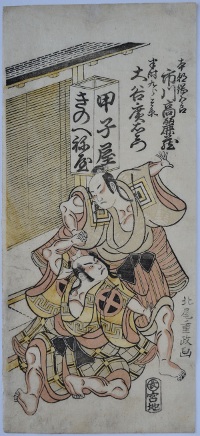
 Click here to view image full size. A hosoban showing the actors Ichikawa Komazo II (above right) in the role of Honcho Tsunagoro and Otani Hiroemon II (below) as Hantoki Kuroemon. The play was the second item (nibanme) on the programme which came after the first play Hatsuakinai omise Soga performed at the Nakamura-za Theatre, Spring 1767. The shop sign behind the actors reads Kinoeneya. Published by Miyaji, 1767.   Fine impression. Slight fading, otherwise very good colour and condition. Signed Kitao Shigemasa ga.   Status: Sold  

Utagawa KUNISADA (1786-1865)

Click here to view image full size. The actor Ichikawa Kodanji IV as the ghost of Kasane from a set Mitate sanjurokkasen no uchi, “An Imaginary Thirty-six Poets.” A famous early compilation; in this case the image is inspired by a poem of Fujiwara no Toshiyuki Ason. Shows Kasane’s vengeful ghost appearing to her husband who had murdered her. Published by Iseya Kanekichi, 1852.   Very fine early impression showing overall strong woodgrain and glue applied to the ghost’s right eye. Fine colour. Very small binding holes, otherwise very good condition. Signed Toyokuni ga.   Status: Sold  

Utagawa KUNISADA (1786-1865)

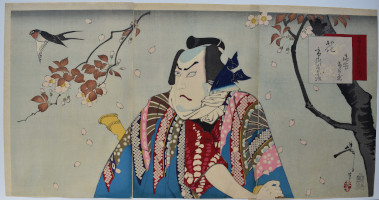
Click here to view image full size. The actor Ichikawa Danjuro VIII as the ghost of Seigen from a set Mitate sanjurokkasen no uchi, “An Imaginary Thirty-six Poets.” A famous early compilation; in this case the image is inspired by a poem of Ariwara no Narihira.The ghost is of the depraved priest Seigen who broke his vows of chastity by falling in love with Sakurahime (Princess Cherry Blossom), hence the cherry trees behind Seigen. He is expelled from the monastery and starves to death. Published by Iseya Kanekichi, 1852. Very fine early impression with glue applied to the ghost’s eyes. Fine colour. Very small binding holes, otherwise very good condition. Signed Toyokuni ga. Status: Sold

Utagawa KUNISADA II (1823-1880)

Click here to view image full size. The actor Segawa Kikunojo V as the Cat Witch Ama Myochin from the set Hakkenden inu no soshi no uchi , “Stories of the Eight Dog Heroes.” Published by Tsutaya Kichizo, 1852. The extremely lengthy novel by Kyokutei Bakin took 30 years to complete and was turned into a very successful play which was premiered at the Ichimura-za Theatre, 1 The convoluted story tells of the supernatural offspring from the coupling of Princess Fuse and her father’s dog Yatsufusa. They are later reborn to normal mothers and the plot revolves around their gradual discovery of each other. Shows the cat’s human form appearing through a bamboo curtain while her true self, with claws and hairy arms, can be seen silhouetted behind the curtain. She murders the father of the dog hero Inamura Kakutaro and then assumes his likeness. The best design from a fine set. Very fine impression with burnishing and blind-printing. (The finest impression I have seen.) Fine colour. Small binding holes, otherwise fine condition. Full size. Signed Ichiyosai Kunisada ga. Status: Sold

Utagawa KUNISADA II (1823-1880)

Click here to view image full size. The Actor Bando Mitsuemon I as Akaiwa Gajiro from the set Hakkenden inu no soshi no uchi , “Stories of the Eight Dog Heroes.” Published by Tsutaya Kichizo, 1852. The extremely lengthy novel by Kyokutei Bakin took 30 years to complete and was turned into a very successful play which was premiered at the Ichimura-za Theatre, 1 The convoluted story tells of the supernatural offspring from the coupling of Princess Fuse and her father’s dog Yatsufusa. They are later reborn to normal mothers and the plot revolves around their gradual discovery of each other. A fine set. Very fine impression with extensive burnishing. Later printings omit the burnishing on the costume and replace it with bokashi. Fine colour. Small binding holes, otherwise fine condition. Full size. Signed Kunisada ga. Status: Sold

Utagawa KUNISADA II (1823-1880)

Click here to view image full size. The complete diptych showing on the right the actor Arashi Otohachi III as the evil priest Bungyu attacking Asuka played by Fujikawa Kayu III from the set Hakkenden inu no soshi no uchi , “Stories of the Eight Dog Heroes.” Published by Tsutaya Kichizo, 1852. The extremely lengthy novel by Kyokutei Bakin took 30 years to complete and was turned into a very successful play which was premiered at the Ichimura-za Theatre, 1 The convoluted story tells of the supernatural offspring from the coupling of Princess Fuse and her father’s dog Yatsufusa. They are later reborn to normal mothers and the plot revolves around their gradual discovery of each other. A fine set. Extremely fine impressions. Fine colour. Small binding holes, otherwise fine condition. Full size. Signed Kunisada ga and Ichiyosai Kunisada ga. Status: Sold

Ryusai SHIGEHARU (1803-1853)

Click here to view image full size. The actor Nakamura Utaemon III as the ghost of Taira no Tomomori in the play Yoshitsune senbon zakura, “Yoshitsune and the Thousand Cherry Trees.” Famous for tying himself to an anchor and jumping into the sea at the battle of Dan-no-Ura (1185). Performed at the Kado Theatre, 5 An Osaka print published by Wataya Kihei.   Fine impression and colour. Very good condition. Signed Gyokuryutei Shigeharu ga.   Status: Sold  
Utagawa NOBUKATSU (Active 1824-1841)

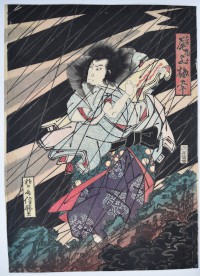
Click here to view image full size. An Osaka print showing the actor Onoe Baiko III as Kan Shojo (Sugawara Michizane) in the play Sugawara denju tenarai kagami, “Sugawara and the Secrets of Calligraphy.” Performed at the Takeda Theatre, 3 This is the famous Mt. Tempai scene from the play. Published by Tenmaya Kihei. Shows Kan Shojo transformed into the Thunder God wreaking revenge on his enemies.   Fine impression and colour. Crease near right edge, otherwise very good condition. Signed Tessai Nobukatsu ga.   Status: Sold  

Utagawa TOYOKUNI (1769-1825)

 Click here to view image full size. An actor portrait showing Matsumoto Koshiro V (standing) in the role of Banzui Chobei and Bando Mitsugoro III as Shira Gonpachi next to a kago in Sakurada Jisuke I’s play Banzuin Chobei shojin manaita. Performed at the Nakamura-za 7 Published by Nishimuraya Yohachi.   Very good impression and condition. Grey ground. Almost perfect colour. Signed Toyokuni ga.   Status: Sold  

Torii KIYOMITSU (1735-1785)

Click here to view image full size. An hosoban showing the actor Ichimura Uzaemon IX in the role of Hanako performing the famous dance in Musume Dojoji, “The Maiden at Dojoji Temple.” Hanako is allowed to dance before the new bell at the temple only to reveal herself as the spirit of Kiyohime who killed the priest Anchin hidden beneath the first bell. Published by Nishimuraya Yohachi c 1765.     Fine impression. Very good colour and condition. Signed Torii Kiyomitsu ga.     Status: Sold