Ichiyusai HIROSHIGE II (1829-1869)

 Click here to view image full size. Heavy snow, Yushima Tenjin, “Yushima Tenjin Shrine.” From Toto sanjurokkei, “Thirty-six Views of the Eastern [ Edo ] Capital.” The set published by Ai-To between 1861 and 1862 ( this being 9/1862 ). The shrine is famous for its ume, Japanese apricot trees, and the Ume Matsuri festival held in February and March. One of the six best designs from the set. Fine impression of the first edition. Fine colour. Trimmed close at bottom, otherwise fine condition. Signed Hiroshige ga. Status: Sold

Utagawa KUNISADA (1786-1865)

 Click here to view image full size. An extremely rare and unusual surimono: I have only seen two impressions – both of which have passed through my hands, and one of which was gifted to the Rijksmuseum, Amsterdam. Shows the most famous playwright of his age – Tsuruya Nanboku IV (1755-1829). His crest is clearly visible on his shoulder. He died on the 27th of the 11th month, 1829 and this surimono must date from shortly after that: A sort of shini-e – very unusual in surimono form. He wrote the most famous Kabuki ghost story: Yotsuya kaidan, “Yotsuya Ghost Story” (1825) as well as the quick-change play Osome no nanayuki (1813).   Fine impression and colour. The poems above printed in gold. Slight soil. Very small restored binding holes at left edge, and slight trimming at bottom. Signed Gototei Kunisada ga.   Status: Sold  

Utagawa KUNISADA (1786-1865)

 Click here to view image full size. A rare diptych, Kansho Tempaizan mangan. This famous tale (with different versions) is the basis for the play Sugawara denju tenarai kagami, “Sugawara and the Secrets of Calligraphy” which was performed at the Kawarazaki Theatre, Edo, 9 This Mt. Tempai scene shows Kan Shojo (Sugawara no Michizane), a Heian politician and poet, transforming himself into a demon and invoking a storm. Umeomaru , a former retainer of Kan Shojo is seen climbing the mountain on the left sheet. There is also a fine vertical surimono diptych of this subject issued by Kunisada in 1832. Published by Yamaguchi Tobei. A fine design I have not catalogued before.   Fine impression and colour. Imperceptible centre fold, otherwise fine condition. Signed Gototei Kunisada ga.   Status: Sold  

Ichiyusai HIROSHIGE II (1829-1869)

 Click here to view image full size. Kasumigaseki setchu, “Kasumigaseki in Snow” from Toto sanjurokkei, “Thirty-six Views of the Eastern [ Edo ] Capital.” The set published by Ai-To between 1861 and 1862 ( this being 6/1862 ). Shows a steep incline in what is now the administrative district of Tokyo. One of the six best designs from the set. Fine impression of the first edition. Fine colour. Trimmed close at bottom, otherwise fine condition. Signed Hiroshige ga. Status: Sold

Utagawa KUNISADA (1786-1865)

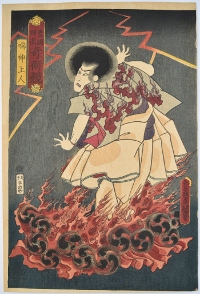
 Click here to view image full size. Narukami Shonin, a wicked priest, from the play Narukami. One of a set Toyokuni kigo kijutsu kurabe, “A Contest of Magic Scenes by Toyokuni.” The series published by Hiranoya Shinzo, 1862. The set is known for its deluxe printing.   Superb impression and colour. Fine condition. Signed Kio Toyokuni hitsu (77 year’s old).   Status: Sold  

Ichiyusai HIROSHIGE II (1829-1869)

 Click here to view image full size. Nakazu Mitsumata, “Mitsumata Middle Strand.” Shows the charring of a boat to preserve it on the eight-acre Nakazu Island. In the background Tsukudajima and Eitaibashi. From Toto sanjurokkei, “Thirty-six Views of the Eastern [ Edo ] Capital.” The set published by Ai-To between 1861 and 1862 ( this being 3/1862 ). Compare with the Kuniyoshi landscape of the same subject published by Yamaguchiya Tobei, 1834. One of the six best designs from the set. Fine impression of the first edition. Fine colour. Trimmed close at bottom, otherwise fine condition. Signed Hiroshige ga. Status: Sold
Utagawa KUNIYOSHI (1797-1861)

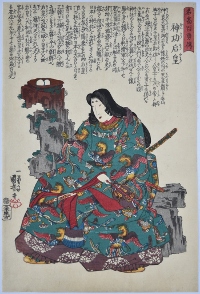
 Click here to view image full size. The Empress Jingo Kogo, sumptuously attired, sitting on a rock with two Imperial Jewels above her. She is supposed to have invaded Korea although there is some debate about this. From a set Meiko hyaku yu den, “Stories of a Hundred Heroes of High Renown.” The series published by Idzumi-ya Ichibei, 1843-44.   Very fine impression, colour and condition. Signed Ichiyusai Kuniyoshi ga.   Status: Sold  

Utagawa KUNIYOSHI (1797-1861)

 Click here to view image full size. Kaidomaru felling a tengu during practise with wooden swords from a set Honcho kendo ryaku den, “Abridged Stories of our Country’s Swordsmanship.” The series published by Kadzusa-ya Iwazo, c. 1845-6.   Very fine impression, colour and condition. Signed Ichiyusai Kuniyoshi ga.   Status: Sold  

Utagawa KUNIYOSHI (1797-1861)

 Click here to view image full size. An early triptych showing Shutendoji’s palace on Mount Oyeyama, Oyeyama Shotendoji shuzui no zu. Raiko (Minamoto no Yorimitsu) is charged by the Emperor Murakami with killing the evil Shutendoji who terrorizes the neighbourhood. He and his retainers infiltrate the castle and ply Shutendoji and his ogrish band with sake and dance for them. Eventually Shutendoji is so intoxicated he has to be carried to bed, whereupon Raiko and his followers attack and decapitate Shutendoji. This is the episode most depicted with the head flying through the air. Published by Daikokuya Heikichi, c. 1832. Robinson T21. Rare.   Fine impression, colour and condition. Signed Ichiyusai Kuniyoshi ga.   Status: Sold  

Ichiryusai HIROSHIGE (1797-1858)

 Click here to view image full size. Nihonbashi yukibare, “The Nihon Bridge, Clear Weather after Snow.” From Meisho Edo hyakkei, the “One Hundred Views of Edo.” The set published between 1856 and 1858 (this being 1856) by Uoya Eikichi. The bridge was completed in 1603 and was originally called Edo Bridge. All points are measured from this bridge (similar to our Charing Cross).   Fine impression of the first edition. There are slight variants of the first with some having red bokashi on the lower clouds but lacking the subtle gradation on Fuji and lower roofs. And also some have mica on the lower roofs. Fine colour and condition. Signed Hiroshige ga.   Status: Sold  

Ichiryusai HIROSHIGE (1797-1858)

 Click here to view image full size. Shomyoji-no bansho, “Vesper Bells at the Shomyoji Temple” from the rare early set Kanazawa hakkei, “Eight Views of Kanazawa.” The temple was built in 1258 by Hojo Sanetoki; the environs are seen on the right with boats in the foreground. The distant hills are printed without key-block outlines giving a painterly quality. These Eight View sets were inspired by the Eight Views of Xiaoxiang in China, first painted in the 11th century and then brought to Japan in the 14 – 15th centuries. Kanazawa is across Japan from Tokyo on the north coast on the Japan Sea. Published by Koshimuraya Heisuke, 1835-6.   Very good impression and colour. Slight margin soil and small expert repair to bottom left corner. Signed Hiroshige ga.   Status: Sold  
Toyohara CHIKANOBU (1838-1912)

 Click here to view image full size. Princess Toyotama, the daughter of the Dragon King of the sea, gives birth to Ugayafuki Aezu by turning herself into a dragon. From a set of 50 prints Azuma nishiki chuya kurabe, “Edo Embroidery Pictures.” The series published by Kobayashi Tetsujiro, 1886.   Fine impression with extensive mica. Fine colour and condition. Signed Yoshu Chikanobu hitsu.   Status: Sold  

Toyohara CHIKANOBU (1838-1912)

Click here to view image full size. O’ai-no-kata of Okazaki dispatches a man who spied on her while taking a bath. From a set of 50 prints Azuma nishiki chuya kurabe, “Edo Embroidery Pictures.” The series published by Kobayashi Tetsujiro, 1886.     Fine impression, colour and condition. Signed Yoshu Chikanobu hitsu.     Status: Sold    

Taiso YOSHITOSHI (1839-1892)

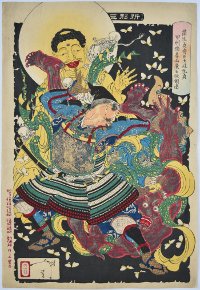
 Click here to view image full size. Toki Motosada, the retainer of Gamo Sadahide, throwing a red temple guardian to the ground and vanquishing the ghosts on Mount Inohana. From the set Shinkei sanjurokkaisen, “New Forms of Thirty-Six Ghosts.” The set published by Sasaki Toyokichi, 1889 – 1892 (this being 1890). This seems to be the same subject Yoshitoshi used for his set Wakan hyaku monogatari but the names are altered.   Very fine first edition, fine colour and condition. Signed Yoshitoshi.   Status: Sold  

Tsukioka YOSHITOSHI (1839-1892)

Click here to view image full size. The battle of Fujikawa from a set of triptychs Toyotomi Shoshinroku published by Yorozumago, c 1869. The set relates Hideyoshi’s (1537-1598) exploits. From humble origins he became the second unifier of Japan who, after 100 years of war, brought stability and peace.     Fine impression, colour and condition. Full size with extra paper all around. Signed Ikkaisai Yoshitoshi hitsu.     Status: Sold    

Taiso YOSHITOSHI (1839-1892)

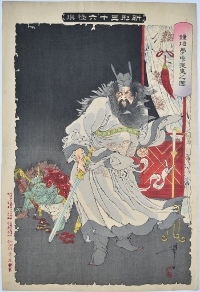
Click here to view image full size. Shoki appearing in the Chinese emperor Ming Huang’s dream and cleansing him of a fever demon. From the set Shinkei sanjurokkaisen, “New Forms of Thirty-Six Ghosts.” The set published by Sasaki Toyokichi, 1889 – 1892 (this being 1890).     Very fine first edition, fine colour and condition. Signed Yoshitoshi.     Status: Sold    

Taiso YOSHITOSHI (1839-1892)

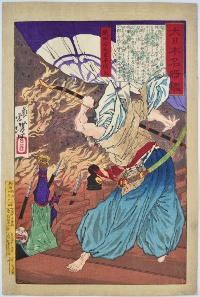
 Click here to view image full size. The famous daimyo Oda Nobunaga throwing an assailant over a terrace while the Honnoji Temple burns behind him. Nobunaga’s branch of the Oda clan held control of central Japan but he was eventually killed by his treacherous vassal Akechi Mitsuhide at this temple in 1582. From a set Dai Nippon meisho kagami, “Mirror of Famous Commanders of Great Japan.” The series of 51 prints published by Kumagai and Funazu Chujiro, c. 1876 – 82. The design here by the latter in 1878.   Fine impression, colour and condition. Signed Oju Yoshitoshi hitsu.   Status: Sold  

Taiso YOSHITOSHI (1839-1892)

Click here to view image full size. Shows Kiyohime changing into a serpent on the edge of the Hidaka River. The monk Anchin fell in love with Kiyohime only to change his mind. He escapes across the river followed by Kiyohime who becomes a serpent and traps him in the bell of the Dojo-ji Temple and kills him. From a set Shingata sanjurokkaisen, “New Forms of Thirty-six Ghosts,” sub-title: Kiyohime Hidakagawa ni jatai to naru zu. The set published by Sasaki between 1889 -1892 (this being 1890). This is the first edition.     Very fine impression, colour and condition. Signed Yoshitoshi.     Status: Sold    

Taiso YOSHITOSHI (1839-1892)

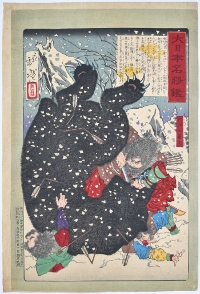
 Click here to view image full size. Abe no Hirafu (c. 575 – 674), a governor of Koshi Province, is famous for quelling the indigenous people of northern Japan – the Ainu. He is shown here killing a giant bear in the snow (of either northern Japan or Korea). From a set Dai Nippon meisho kagami, “Mirror of Famous Commanders of Great Japan.” The series of 51 prints published by Kumagai and Funazu Chujiro, c. 1876 – 82. The design here by the latter in 1880.   Fine impression, colour and condition. Signed Oju Yoshitoshi hitsu.   Status: Sold  

Taiso YOSHITOSHI (1839-1892)

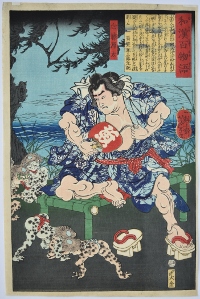
 Click here to view image full size. The famous wrestler Shirafuji Genta watching kappa (amphibious half humanoid, half turtle creatures). One of a set of 26 prints with title Wakan hyaku monogatari, “One Hundred Tales of China and Japan.” Published by Daikokuya Kinnosuke, 1865.   Fine impression, colour and condition. Signed Ikkaisai Yoshitoshi ga.   Status: Sold  

Taiso YOSHITOSHI (1839-1892)

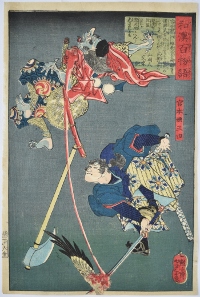
 Click here to view image full size. The famous swordsman Miyamoto Musashi cutting the arm off a tengu. He was taught the short sword technique from his father but then became expert with the long sword, eventually inventing the two-sword style, with the long sword in the right hand, the short in the left. One of a set of 26 prints with title Wakan hyaku monogatari, “One Hundred Tales of China and Japan.” Published by Daikokuya Kinnosuke, 1865.   Fine impression. Fine colour and condition. Signed Ikkaisai Yoshitoshi ga.   Status: Sold  

Taiso YOSHITOSHI (1839-1892)

 Click here to view image full size. Lord Mashiba Tairyo Hisayoshi defying the thunderstorm on Mount Kobo conjured up by Kobo Daishi. A retribution for ignoring the vow of silence on the mountain. One of a set of 26 prints with title Wakan hyaku monogatari, “One Hundred Tales of China and Japan.” Published by Daikokuya Kinnosuke, 1865.   Fine impression with burnishing and mica. Fine colour. Trimmed close on the right, otherwise very good condition. Signed Ikkaisai Yoshitoshi ga.   Status: Sold  

Taiso YOSHITOSHI (1839-1892)

 Click here to view image full size. Toki Daishiro, the retainer of Gamo Ujisato, vanquishing the demons in the temple on Mt. Inohana by grappling with the temple guardian. One of a set of 26 prints with title Wakan hyaku monogatari, “One Hundred Tales of China and Japan.” Published by Daikokuya Kinnosuke, 1865. This appears to be the same subject Yoshitoshi used in his set Shinkei sanjurokkaisen but with altered names.   Fine impression, colour and condition. Signed Ikkaisai Yoshitoshi ga.   Status: Sold  

Tsukioka YOSHITOSHI (1839-1892)

 Click here to view image full size. A triptych from a set of three designs: Buyu setsugekka no uchi, “Snow, Moon and Flowers with Valiant Warriors,” this being “Flower”: Ikutamori ume, “Plum at Ikuta Forest.” The battle of Ichi-no-Tan took place in the forest between the Taira and Minamoto clans. Published by Kiya Sojiro, 2   Very good impression, colour and condition. Signed Ikkaisai Yoshitoshi hitsu   Status: Sold  

Ichieisai YOSHITSUYA (1822-1866)

Click here to view image full size. The young Kintaro, aka, Kintoki, Sakata Kaidomaru. He is shown fighting a giant carp in a waterfall from a series: Honcho musha kagami, Kintaro, “ Mirror of Warriors of Our Country, Kintaro.” This child of superhuman strength is often depicted with the animals living on Ashigara mountain where he honed his fighting skills and was spotted by Minamoto Yorimitsu (944-1021), under whom he went on to serve.Yoshitsuya was a pupil of Kuniyoshi and this print can be compared to a famous design by Kuniyoshi of the same subject published in 1836. Published by Tsujiokaya Bunsuke, 7     Very good impression and colour. Slight creasing, otherwise good condition. Signed Ichieisai Yoshitsuya ga.     Status: Sold    

Ichieisai YOSHITSUYA (1822-1866)

 Click here to view image full size. An extremely rare print by this pupil of Kuniyoshi: Nobori ryu; kudari ryu, “Dragon going up [in the sky]; dragon going down [to the earth].” The most popular of Japanese subjects, printed in sumi and red. Published by Shimizuya Tsunejiro, 1849-50. This is the first time I have I catalogued this design.   Very good impression and colour. Minor creasing and slight adhesive mark at right edge. Signed Ichieisai Yoshitsuya ga.   Status: Sold  

Utagawa KUNIYOSHI (1797-1861)

 Click here to view image full size. A bust portrait of Teranishi Kanshin holding a fan from the series Kuniyoshi moyo shofuda tsuketari genkin otoko, “ Men of Ready Money with True Labels Attached, Kuniyoshi Fashion.” The title derived from a contemporary kabuki play Shofuda tsuki kongen kusazuri. Poem above by Gosonoya of Ise. Robinson S40.7. Published by Ibaya Kyubei, 1845. Fine impression and colour. Slight trimming and retains original album backing, otherwise fine condition. Signed Ichiyusai Kuniyoshi ga. Status: Sold

Utagawa YOSHIHARU (1828-1888)

 Click here to view image full size. The brigand Rori Hakucho Chojun from the set Suikoden goketsu kagami, “Mirror of the Heroes of the Suikoden.” A set mirrored on Kuniyoshi’s earlier Suikoden set. Shows him, with heavily tattooed torso and wielding a sword, defending himself against a dragon. Published by Yamaguchiya Tobei, 1856.   Fine impression and colour. Slight trimming top and bottom, otherwise very good condition. Signed Ichibaisai Yoshiharu ga.   Status: Sold  

Ichiyusai HIROSHIGE II (1829-1869)

 Click here to view image full size. Zojo-ji asagiri, “Morning Mist at Zojo Temple” from Toto sanjurokkei, “Thirty-six Views of the Eastern [ Edo ] Capital.” A couple watch a fish porter passing in the precincts of the Buddhist shrine . Situated in Shiba it was the Tokugawa family temple. The set published by Ai-To between 1861 and 1862 ( this being 6/1862 ). One of the six best designs from the set. Fine impression of the first edition. Fine colour and condition. Signed Hiroshige ga. Status: Sold

Yashima GAKUTEI (1786?-1868)

Click here to view image full size. A surimono, Komatsu Shigemori, from the Heike Monogatari. One of a set with series title: Honchoren honcho nijushiko, “Twenty-four Japanese Paragons of Filial Piety for the Honcho Circle.” Issued by the Honchoren poetry club, c. 1821. Shows Taira no Kiyomori (1118-81) seated in an alcove being admonished by his son Shigemori (1138-79) for not being as loyal to the emperor as he had been. Kiyomori was a famous military leader and head of the Taira Clan. Poem by Kanenoya Arikado.   Fine impression, colour and condition with silver and gold. Signed Gakutei with Sadaoka seal.   Status: Sold