Utagawa KUNIYOSHI (1798-1861)

 Click here to view image full size. Nitta Tadatsune encountering the goddess of Mount Fuji and her dragon in a cavern with numerous stalactites and a fast flowing river and waterfall. She complimented Tadatsune on his courage while his compatriots were stricken with terror. Statues of the goddess Kwannon ( Chin: Guanyin ) are often found in caves. Published by Tsuji-ya Yasubei, c. 1844. Robinson T143. A fine design. Very good impression, colour and condition. Signed Ichiyusai Kuniyoshi ga. Status: Sold

Totoya HOKKEI (1780-1850)

 Click here to view image full size. A surimono showing two beauties by the pond at Tsunowazu Kumano Shrine in Yotsuya. The title is: Yotsuya Juniso, referring to the twelve shrines at Tsunowazu in Yotsuya. The poem on the large stone is by Shibanoya and refers to the peacefulness of the place with the willows and water. The other writing directs visitors to the cool of the nearby waterfall and the Unju forrest.   Fine impression with silver and gold. Fine colour and condition. Signed on request, Motome ni ojite Hokkei fude.   Status: Sold  

Utagawa KUNISADA (1785-1865)

 Click here to view image full size. A surimono showing the actors Ichikawa Monnosuke III (right) and Ichikawa Danjuro VII walking in the emado of Asakusa Temple in Edo. This was a pavilion at the Shinto shrine used for displaying votive tablets. This seems to be part of a three or five sheet set showing a continuous procession of Ichikawa actors at the shrine. Provenance: From my Catalogue 15, 1975, no. 67.   Fine impression with extensive gold and silver. Fine colour and condition. Signed Gototei Kunisada ga.   Status: Sold  

Kubo SHUMMAN (1757-1820)

 Click here to view image full size. A surimono showing court figures dancing from a series: Shofudai Hisakataya Bunbunsha Tosa Nikki, “The Tosa Diary for the Shofudai, Hisakataya and Bunbunsha Poetry Groups.” Issued late 1810s. For another from this series see: Jewels Of Japanese Printmaking: Surimono Of The Bunka-Bunsei Era 1804-1830, Joan B. Mirviss, Ota Memorial Museum of Art, 2000, no. 85, p. 131. Rare: Possibly the only known impression.   Fine impression. Very good colour. Lightly backed, otherwise very good condition. Artist’s seal Sho Shumman.   Status: Sold  

Utagawa KUNISADA (1785-1865)

 Click here to view image full size. A surimono showing Ichikawa Danjuro VII and Bando Mitsugoro III as Soga no Goro and Asahina no Saburo in the armour-pulling (kusazuri-biki) scene from the play Tsukisenzu haru gohiki Soga. Issued 1827. The story relates how Soga no Goro was feasting at a banquet when he learns of a plot to assassinate his brother, Juro. He rushes off to don his armour. Asahina, the liege of his enemy, tries to prevent him by pulling at his armour. Poems by Yukinoya Takane and Hoshitei Masunari. Rare.   Fine impression with extensive silver and gold. A gold ground. Fine colour. Some loss of the gold ground as is the case with other known impressions of this surimono. This appears to be the best preserved copy. Very good condition. Signed Oju Gototei Kunisada ga.   Status: Sold  

Katsushika HOKUSAI (1760-1849)

 Click here to view image full size. A surimono, Umazakushi, showing a saddle and cotton-gin from Watakuri uma, “A Series of Horses.” Issued for the Yomogawa club, 1822. Shows a horse’s saddle, a cotton-gin, basket of cotton floss and a branch of plum. A smoking set in the foreground. This set followed on from the success of the Shell surimono series issued in 1821. Twenty eight designs are known. The title (in a red gourd) top right is hand-stamped. Rare.   Fine impression with silver, gold and blind-printing. Fine colour. Minor soil, otherwise very good condition. Signed Fusenkyo Iitsu hitsu.   Status: Sold  

Ichiryusai HIROSHIGE (1797-1858)

 Click here to view image full size. The compound of the Tenman Shrine at Kameido, Kameido Tenmangu keidai no yuki. The best design from a Toto meisho set of 21 prints published by Kikakudo (Sanoki) c 1832-5 and then extended to 55 in c. 1839-42. Also one of the best known places in Edo with the Drum Bridge, koi ponds and wisteria which flowered in the Fifth Month. The main shrine is dedicated to the memory of Sugawara no Michizane (Tenjin), the father of Japanese learning and built in 1662. Hiroshige shows the shrine in winter under falling snow.   Fine early impression with the red publisher’s seal in right margin (later editions having the black seal of Sanoki). These later editions have a black sky and a block defect appears at the edge of the pond centre left. Fine colour. Signed Hiroshige ga.   Status: Sold  

Ichiryusai HIROSHIGE (1797-1858)

 Click here to view image full size. Soshu Enoshima Benzaiten kaicho mode Hongu Iwaya no zu, “Pilgrimage to the Cave Shrine of Benzaiten on Enoshima.” A triptych showing the back view of the island (the causeway being on the other side) with the Iwaya cave on the right. Groups of women from Edo schools of narrative chanting are seen with umbrellas (Benzaiten was a deity associated with music). The statue was displayed once every six years. Published by Sumiyoshi Masagoro, 1851.   Fine impression. Very good colour. Fine condition. Signed Hiroshige ga.   Status: Sold  

Ichiryusai HIROSHIGE (1797-1858)

 Click here to view image full size. Midono from Kisokaido rokujukyutsugi no uchi , “Sixty-Nine Stations of the Kisokaido.” The set of seventy prints was published by Hoeido in 1835, but in 1837 Hiroshige took over and completed the series with the publisher Iseya Rihei (Kinjudo). The conjecture is that Hiroshige was the better known and more commercial artist, reinforced by the fact that Eisen’s name was removed from the designs already published. Hence only the first editions have his signature on those prints. Shows travellers in a field of pampas grass and a farm worker with a hoe to the left. On the hill above are torii gates leading to a Shinto shrine. The area here opens out after the narrow Kiso valley and is popular with walkers today. Provenance: Ex Grabhorn collection.   Fine impression of the earliest state with bokashi on the brow of the hill. Fine colour. Slight centre fold, otherwise very good condition. Signed Hiroshige ga.   Status: Sold  

Utagawa KUNIYOSHI (1797-1861)

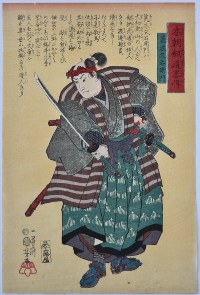
 Click here to view image full size. Araki Matayemon standing, examining his sword from Honcho kendo ryaku den, “Abridged Stories of Our Country’s Swordsmanship.” The set published by Kadzusaya Iwazo in c 1845-6.   Extremely fine impression, colour and condition. Solid yellow ground. Signed Ichiyusai Kuniyoshi ga.   Status: Sold  

Utagawa KUNIYOSHI (1797-1861)

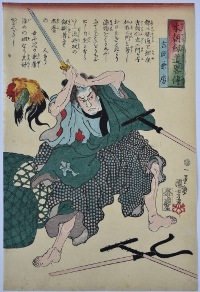
 Click here to view image full size. Yoshioka Kanefusa defending himself in an attack by police from Honcho kendo ryaku den, “Abridged Stories of Our Country’s Swordsmanship.” The set published by Kadzusaya Iwazo in c 1845-6.   Extremely fine impression, colour and condition. Solid yellow ground. Signed Ichiyusai Kuniyoshi ga.   Status: Sold  

Utagawa KUNIYOSHI (1797-1861)

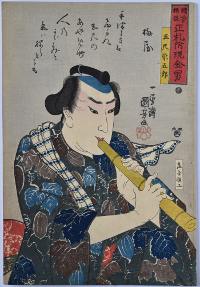
 Click here to view image full size. A bust portrait of Goshaku Somegoro playing a shakuhachi from the series Kuniyoshi moyo shofuda tsuketari genkin otoko, “ Men of Ready Money with True Labels Attached, Kuniyoshi Fashion.” The title derived from a contemporary kabuki play Shofuda tsuki kongen kusazuri. Poem above by Umeya. Robinson S40.3. Published by Ibaya Kyubei, 1845. Fine impression and colour. Slight trimming and retains original album backing, otherwise fine condition. Signed Ichiyusai Kuniyoshi ga. Status: Sold

Ichieisai YOSHITSUYA (1822-1866)

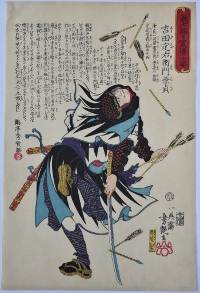
 Click here to view image full size. Yoshida Sadaemon Kanesada slicing arrows in half with his sword from a set Gishi Meimei jitsu den, “Biographies of Loyal Followers [aka The 47 Ronin].” The series published by Tsujiokaya Bunsuke, 1860.   Extremely fine impression, colour and condition. Signed Ichieisai Yoshitsuya ga.   Status: Sold  

Utagawa KUNIYOSHI (1797-1861)

 Click here to view image full size. Sasaki Ganryu standing, in profile, with clenched fist, from Honcho kendo ryaku den, “Abridged Stories of Our Country’s Swordsmanship.” The set published by Kadzusaya Iwazo in c 1845-6.   Extremely fine impression, colour and condition. Solid yellow ground. Signed Ichiyusai Kuniyoshi ga.   Status: Sold  

Taiso YOSHITOSHI (1839-1892)

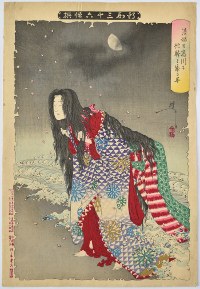
 Click here to view image full size. Kiyohime assumes a serpent form at Hidaka river as she continues her pursuit of the monk Anchin. From the set Shinkei sanjurokkaisen, “New Forms of Thirty-Six Ghosts.” The set published by Sasaki Toyokichi, 1889 and 1890.   Extremely fine impression of the first edition with three-colour cartouche. Fine colour and condition. Signed Yoshitoshi.   Status: Sold  

Taiso YOSHITOSHI (1839-1892)

 Click here to view image full size. A design showing Hojo Tokiyori in a snowy landscape from the set Dai Nippon meisho kagami, “Mirror of Famous Commanders of Great Japan.” He was Regent during the Kamakura period (1185-1333) but withdrew to the temple of Saimyoji and subsequently travelled around the country incognito to familiarize himself with the conditions of the populace. Published by Funazu Chujiro, 1878.   Fine impression with extensive burnishing. Fine colour. Light backing, otherwise very good condition. Signed Oju Yoshitoshi hitsu.   Status: Sold  

Taiso YOSHITOSHI (1839-1892)

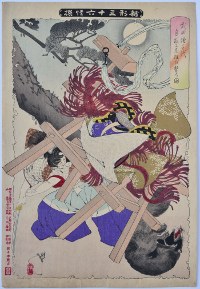
 Click here to view image full size. Takeda Katsuchiyo in his boyhood killing an old badger which had transformed itself into a wooden saddle-horse. From the set Shinkei sanjurokkaisen, “New Forms of Thirty-Six Ghosts.” The set published by Sasaki Toyokichi, 1889 and 1890.   Very fine impression of the first edition with three-colour cartouche. Fine colour. Very good condition. Signed Yoshitoshi.   Status: Sold  

Utagawa KUNIYOSHI (1797-1861)

 Click here to view image full size. India from Sangoku yoko zue, “The Magic Fox of the Three Countries [China, India, Japan].” A set with strong western elements. Here showing Kwayo-fujin (the fox) having shot a St. Sebastian-like figure in the eye watched by King Hansoku. Both attired in exotic and archaic western garments and head pieces. Also western influences in the sky, trees and architecture. The set published by Iseya Chusuke and Echizenya Hachiyemon, c 1849-50. Unidentified collector’s seal bottom left. Rare.   Fine impression with strong woodgrain. Very good colour and condition. Signed Ichiyusai Kuniyoshi ga.   Status: Sold  

Utagawa KUNIYOSHI (1797-1861)

 Click here to view image full size. The warrior Hakumenrokun Teitenju in full armour levering a mass of rock with an iron bar. A design from the set Tsuzoku Suikoden goketsu hyaku-hachi-nin no hitori, “The Hundred and Eight Heroes of the Popular Suikoden, One by One.” Based on the Chinese novel Shui Hu Zhuan, attributed to Shi Nai’an, which tells of a band of 108 brigands who operated from Liangshan Marsh. Published by Kagaya Kichiyemon, 1827-30. Robinson S2.20. There is another version of this design with yellow rocks and the sky a solid blue.   Fine impression, colour and condition. Full size (unusual as these prints are overlarge obans and often trimmed). Signed Ichiyusai Kuniyoshi ga.   Status: Sold  

Utagawa KUNIYOSHI (1797-1861)

 Click here to view image full size. The warrior Chusenko Teitokuson driving his sword into a huge snake. A design from the set Tsuzoku Suikoden goketsu hyaku-hachi-nin no hitori, “The Hundred and Eight Heroes of the Popular Suikoden, One by One.” Based on the Chinese novel Shui Hu Zhuan, attributed to Shi Nai’an, which tells of a band of 108 brigands who operated from Liangshan Marsh. Published by Kagaya Kichiyemon, 1827-30. Robinson S2.13. One of the best designs from this impressive set.   Fine impression, colour and condition. Full size (unusual as these prints are overlarge obans and often trimmed). Signed Ichiyusai Kuniyoshi ga.   Status: Sold  
Toyohara CHIKANOBU (1838-1912)

 Click here to view image full size. An apparition of a nine-tailed fox. These foxes could turn themselves into beautiful women when a hundred years old. From a set of 50 prints: Azuma nishiki chuya karabe, “Eastern Brocades, Day and Night, Compared.” Published by Kobayashi Tetsujiro, 1886.   Very fine impression. Fine colour and condition. Signed Yoshu Chikanobu hitsu.   Status: Sold  

Utagawa KUNIYOSHI (1798-1861)

 Click here to view image full size. An early design without series title showing Nikki Gennosuke in pouring rain fending off wild wolves while suddenly observing the apparition of a dead man behind him. Published by Tsuta-ya Kichizo, c 1840. Robinson S1e.2. A fine and rare design. Very good impression and colour. Slight trimming, otherwise very good condition. Signed Ch-o-ro Kuniyoshi ga. Status: Sold

Utagawa YOSHIIKU ( 1833-1904 )

 Click here to view image full size. No. 30, Sakai Kuzo Hisatsune surviving gunshot from a large chuban series Taiheiki eiyuden “ Biographies of the Heroes of the Taiheiki.” A fictional history written in the late 14th century. The set published by Hirooka Kosuke, 1 One of the four best designs from the set. Fine impression, colour and condition. Signed Chokaro Yoshiiku ga. Status: Sold

Utagawa YOSHIIKU ( 1833-1904 )

 Click here to view image full size. No. 61, Saito Izu-no-kami Toshimitsu fighting an adversary under water from a large chuban series Taiheiki eiyuden “Biographies of the Heroes of the Taiheiki. “ A fictional history written in the late 14th century. The set published by Hirooka Kosuke, 1 One of the four best designs from the set. Fine impression, colour and condition. Signed Ikkeisai Yoshiiku hitsu. Status: Sold

Utagawa YOSHIIKU ( 1833-1904 )

 Click here to view image full size. No. 32, Horio Mosuke Yoshiharu fighting a large boar from a large chuban series Taiheiki eiyuden “ Biographies of the Heroes of the Taiheiki. “ A fictional history written in the late 14th century. The set published by Hirooka Kosuke, 1 One of the four best designs from the set. Fine impression, colour and condition. Signed Chokaro Yoshiiku ga. Status: Sold

Takahashi CHIHARU (1777-1859)

Sold Click here to view image full size. A surimono in Yamato-e style showing Otohime and Tawara Toda on the long bridge at Seta. There are different versions of this popular legend. One has it that Otohime, the Dragon Princess, had an enemy in the form of a giant centipede that lived and poisoned Lake Biwa. It had also killed two of her sons. She begs Tawara Toda Hidesato, a famed archer, to kill it. This he does and she rewards him in the Dragon Palace with silk, a sword and armour, a temple bell, and a bag of rice. The silk and rice are to last forever, however much is used. Hence his name Tawara Toda, “Rice-bag Toda.” Probably issued for Dragon year 1832.     Fine impression, very good colour and condition. Signed Chiharu.     Status: Sold

Ichiryusai HIROSHIGE ( 1797-1858 )

 Click here to view image full size. Noji Tama River in Omi Province with a poem by Minamoto no Toshiyori from the series of six prints Shokoku Mutamagawa , “Six Jewel Rivers in the Provinces.” Shows a nobleman and attendants admiring the moon’s reflection. The set published by Maruya Kyushiro 11 Very fine impression. Fine colour. Trimmed on black border at bottom, otherwise fine condition. Signed Hiroshige ga. Status: Sold

Ryuryukyo SHINSAI (Active c 1799-1823)

Click here to view image full size. A surimono showing a scroll with a painting of a Takarabune ship and an enameled Persian clock (with Arabic numerals). Norizome, “Maiden Voyage [of the New Year].” The Takarabune, “Treasure Ship” is associated with the new year and carries the Seven Lucky Gods (Shichifukujin) with their treasures. Shinsai was a pupil of Hokusai and is best known for his surimono prints. Issued in 1822 by the Taiko-gawa, “Drum Poetry Group” with their emblem top right. Three poems by Shikishishima Michikusa; Ume no Sugatame; Fugentai. Another (trimmed) impression is in the MET, JP2116. Fine impression. Very good colour. Minor soil, otherwise very good condition. Signed Shinsai. Status: Sold

Katsushika HOKUSAI (1760-1849)

Click here to view image full size. A surimono, Hara, from an untitled Tokaido set, generally called the Surimono Tokaido. Published in 1804 for a kyoka club. There are 59 prints in the set; 8 being in this horizontal tanzaku format, the rest being koban size. This is the very rare first edition with the kyoka poems. In the second edition, also in 1804, the poems are left out. There is also a third edition in 1805 and a fourth in the 1840s where these tanzaku designs were replaced by koban prints designed by Hokusai’s pupil Yanagawa Shigenobu. Shows travellers admiring Fuji.     Very fine impression. Fine colour and condition. Signed Gakyojin Hokusai ga.     Status: Sold