Utagawa SADAHIDE (1807-1873)

 Click here to view image full size. An exceptionally rare triptych showing the great battle between Takeda Shingen (left) and Uesugi Kenshin (right) during the fourth (of five) Kawanakajima battles. Kenshin lunges with his sword but is parried by Shingen using his iron war fan (gunbai). These skirmishes took place in the mid. 16th century. I can, at the moment, only locate one damaged impression of this fine design. Published 1846 by Tsujiokaya Bunsuke.   Very good impression, colour and condition. Full size. Signed Gyokuransai Sadahide ga.   Status: Sold  

Utagawa KUNISADA II (1823-1880)

 Click here to view image full size. A snow scene showing Prince Genji and attendants on Sugatami Bridge from a set of twelve months: Junikagetsu Genji no Sugatami. This being the eleventh month. Published by Yamashiroya Jinbei, 1867.   Fine impression, colour and condition with extensive splashed gofun. Signed Kochoro Kunisada hitsu   Status: Sold  

Ichiryusai HIROSHIGE II (1829-1869)

 Click here to view image full size. Soshu Shichirigahama, the “Seven Ri Beach” near Kamakura, Kanagawa Prefecture. From the set Shokoku meisho hyakkei, “The One Hundred Views of Famous Places in the Provinces.” From the beach one gets a clear view of Fuji and Enoshima Island – both framed by a giant wave. The set (of which only 80 are known) was published by Uoya Eikichi, 1859-61 (this being 1859). Hiroshige’s foremost pupil. He was called Shigenobu until assuming the name Hiroshige II on Hiroshige’s death. Married his daughter.   Very good impression and colour. Very slight stain in cartouche, otherwise very good condition. Sugned Hiroshige ga.   Status: Sold  

Ichiryusai HIROSHIGE (1797-1858)

 Click here to view image full size. Kameido Tenmangu keidai no yuki, “The Compound of the Tenman Shrine at Kameido in Snow.” From a set of twenty-one prints Toto meisho, “Famous Views in the Eastern Capital” published by Sanoya Kihei, c. 1834-5. The series was extended to fifty-five in c.1839-42. One of the most famous places in Edo. Known for its pergola, two drum bridges, koi ponds and the wisteria which flowered in the fifth month. The main shrine is dedicated to the memory of Sugawara no Michizane (Tenjin), the father of Japanese learning and built in 1662. The design comes in various states: Late editions have a black sky and the red publisher’s seal on right margin, is replaced with an abbreviated Sanoki seal in black. Even later editions show a slipping plug becoming evident on the edge of the water, centre left.   Very good impression, colour and condition. Signed Hiroshige ga.   Status: Sold  

Ichiryusai HIROSHIGE (1797-1858)

 Click here to view image full size. Numazu, Hikure, “Yellow Dusk” from Tokaido gojusan tsugi, “The Fifty-three Stations of the Tokaido.” The set of fifty-five prints was published jointly by Hoeido and Senkakudo in 1834. Shows travellers about to enter the village of Numazu beneath the huge orb of the moon. On each side are dark pines, and this station is famous for its forest which stretches along the seashore. One of the travellers is carrying a red tengu mask on his back, the mark of a pilgrim to the Shinto shrine of Kompira.   Very good impression and colour. Imperceptible centre fold and minor repaired wormage on bottom margin, otherwise very good condition. Signed Hiroshige ga.   Status: Sold  

Ichiryusai HIROSHIGE (1797-1858)

 Click here to view image full size. Kozuke, Harunasan setchu, “Kozuke [Province], Mount Haruna Under Snow.” From the set of sixty-nine prints, Rokuju-yoshu meisho zue, “Views of Famous Places in the Sixty-odd Provinces.” Published 1856 by Koshihei, although sealed between 1853-56 (this being 1853). A red bridge spans a gorge with precipitous cliffs and a fast flowing river. Fantastic crags point upwards into the sky. In the distance is Mount Haruna, a sleeping volcano.   Fine, early impression. Fine colour and condition. Signed Hiroshige ga.   Status: Sold  

Utagawa KUNIYOSHI (1797-1861)

Click here to view image full size. The warrior Ritchitaisai Genshoji in a boat attacked by grappling-hooks thrown by his adversaries. A design from the set Tsuzoku Suikoden goketsu hyaku-hachi-nin no hitori, “The Hundred and Eight Heroes of the Popular Suikoden, One by One.” Based on the Chinese novel Shui Hu Zhuan, attributed to Shi’Nai’an, which tells of a band of 108 brigands who operated from Liangshan Marsh. Published by Kagaya Kichiyemon, 1827-30. Robinson S2.53.     Fine impression, colour and condition. Full size (unusual as these prints are overlarge obans and often trimmed). Signed Ichiyusai Kuniyoshi ga.     Status: Sold    

Tsukioka YOSHITOSHI (1839-1892)

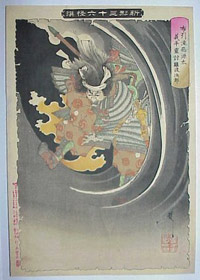
 Click here to view image full size. The ghost of Genta Yoshihira, having been executed by Taira no Kiyomori, springs into the air causing a thunderstorm and exacting revenge. The best design from Shingata sanjurokkaisen, “New Forms of Thirty-Six Ghosts.” Published 1889 by Sasaki.   Very fine impression, colour and condition. The first edition. Signed Yoshitoshi.   Status: Sold  

MADOYA (Active c. 1830s)

 Click here to view image full size. A surimono by an Osaka artist from a series with title Hasoku shunsho juhachi-ban no uchi,”Eighteen Pieces Praising Spring Near the Water.” Sub-title: Tenpozan (the name of the new port in Osaka Bay). Shows a girl in a boat beside the prow of a larger vessel. The Osaka port sign is seen in the background. Three poems above. Rare.   Fine impression and colour with touches of gold and silver. Very slightly trimmed left, otherwise fine condition. Signed Oju Madoya hitsu.   Status: Sold  

Totoya HOKKEI (1780-1850)

 Click here to view image full size. Hokkei, a pupil of Hokusai, is best known for his fine surimono. This rather enigmatic example shows an ox being led by a farmer and his son. There appears to be a festival element in the headgear. Presumably issued for the Ox year (1829). The poetry club logo, top left, is in the form of an ox. Another impression is in Harvard, 1933.4.1981, and another example is in the MFA, Boston, 11.20608. Interestingly, this example lacks the aforementioned ox seal: Possibly there was a commercial printing of the surimono.Two poems above. Rare.   Fine impression. Fine colour with extensive silver. Fine condition. Signed Hokkei.   Status: Sold  

Ichiryusai HIROSHIGE (1797-1858)

 Click here to view image full size. Sukiya embankment in snow, Toto Sukiya-gashi, from Fuji sanjurokkei, the “Thirty-six Views of Fuji.” The set published by Tsutaya Kichizo, 1858. The rampart on the inner side of the moat of Edo Castle on the right. Figures cross a bridge leading to Sukiya Gate. In the distance the long outer walls of the main residence of the Nabeshima Clan of Saga. Fuji on the horizon.   Fine impression and colour. Imperceptible centre fold, otherwise very good condition. Signed Hiroshige ga.   Status: Sold  

Totoya HOKKEI (1780-1850) (Attrib. to.)

 Click here to view image full size. A surimono showing a new year’s throng of musicians, a monkey trainer, a samurai and children with a large kite. Possibly one sheet of a diptych or triptych. A beautiful example of the art of the surimono. Rare.   Superb impression. Fine colour with extensive silver, gold and blind-printing.   Status: Sold  

Utagawa TOYOHIRO (1773-1829)

 Click here to view image full size. A surimono showing a mechanical doll with movable eyes and mouth. It holds two puppets of Chinese boys, karako, playing cymbols. These automata, karakuri ningyo, were popular in Edo-period Japan and those made by Takeda Omi were the most famous. The doll stands on a small table with a flowering cherry tree. Issued c 1810s. Rare.   Fine impression and colour with extensive gold, silver and burnishing. Fine condition.   Status: Sold  

Ichiryusai HIROSHIGE (1797-1858)

 Click here to view image full size. Taira no Kiyomori haunted by strange sights, Taira no Kiyomori kaii o miru zu. Hiroshige’s finest musha-e. A triptych showing the dying Taira no Kiyomori, head of the Taira clan, tormented by hallucinations and seeing, from the veranda of his palace, the garden covered in snow and transmogrified into the skeletons and skulls of the people he had slain. His lover cowers behind him. Published by Ibaya Kyubei, c. 1845. A wonderful design.   Fine impression, colour and condition. The first sheet doesn’t quite match because the publishers had to fit in the title cartouche which protrudes into the top margin. This is the same on every impression. Signed Hiroshige ga and Ichiryusai Hiroshige ga.   Status: Sold  

Yashima GAKUTEI (1786-1868)

 Click here to view image full size. A surimono showing two dancers performing the Sparrow dance, Suzume odori. From a set of six prints forming a hexaptych (this being the top left sheet) for the Katsushika Poetry Club, Katsushika rokubantsuzuki, c 1827-8. The vertical gold bands suggest a birdcage.Illustrated in Surimono, in the Rijksmuseum, Amsterdam, Matthi Forrer, 2013, no. 455.   Fine impression and colour. Minor soil, otherwise good condition.   Status: Sold  

Katsushika HOKUSAI (1760-1849)

 Click here to view image full size. A surimono, Watakuri uma, from a series Uma tsukushi, “Horse Series.” The set of at least thirty surimono was issued by the Yomo-gawa Poetry Club for the Horse Year, 1822. The title alludes to the appearance of the watakuri, “cotton gin” usually seen atop a wooden sawhorse-like stand. Also shown is a wooden saddle on a leather base, a smoking set and branches of white plum. Poems by Matsuchi, Kagetsudo and Matsunoya Sononari. Rare.   Fine impression and colour with silver, gold and blind-printing. Very good condition. Signed Fusenkyo Iitsu hitsu.   Status: Sold  

Ichiryusai HIROSHIGE (1797-1858)

 Click here to view image full size. Fulling cloth beneath a full moon. Toi Tama-qawa in Settsu Province from the set Six Tama Rivers. One of the two best designs from the set. Published circa early 1830s. Fine impression and colour. Minor repair extreme top edge, otherwise fine condition. Signed Hiroshige ga. A beautiful print. Status: Sold

Utagawa KUNISADA (1786 – 1865)

 Click here to view image full size. The actor Ichikawa Danjuro VII as the medicine peddler in the play Uiro-uri and Ichikawa Danjuro IV in the votive panel above as Kagekiyo in the play of the same name. Both these plays are included in the Kabuki Juhachiban ” Eighteen Favourite Plays” chosen to illustrate the special art of the Danjuro line of actors. The lower half of Kagekiyo’s costume includes the characters “Dragon King” “Ryu-o” suggesting the date 1820. The upper half has the Gogawa hour-glass poetry club symbol. Very fine impression. Fine colour with gold and silver. Fine condition. Signed Kunisada ga. Status: Sold

Totoya HOKKEI (1780-1850)

Click here to view image full size. A surimono showing the god Sarutahiko with a rooster and hen. The second sheet from a 5-sheet set: Haru no iwato, “The Boulder of Spring” referring to the rock placed by the sun goddess over the entrance to the cave she hid in thereby depriving the world of light. Sarutahiko accompanied Uzume in her dancing to try to lure Amaterasu from the cave. He is shown with his extra high geta (wooden shoes) which enabled him to look taller at crossroads (being the god of travel and pathways). Issued by the Drum Club, Taiko-ren, their symbol above title top right. Poems by Saiseitei Nanao and Sekigentei Namio. Issued for Rooster year 1825. Provenance: Ex collection Kunsthalle Bremen.   Fine impression, colour and condition. Extensive gold and silver with blind-printing on the rooster and hen. Signed Hokkei.   Status: Sold  

Tomikichiro TOKURIKI (1902-2000)

 Click here to view image full size. The original keyblock woodblock for print 20, Distant View of Fuji from Ise Asama Mountain from The Thirty-six Views of Fuji, published by Uchida Bijutsu Shoten, 1939-40. Sold together with the annotated finished print. The reverse of the block has another unidentified image. Block size 11.5 x 16.75 in; 29 x 42.8 cms. Block sold “as is” and the print has some minor damage. Status: Sold  Click here to view image full size.

Tomikichiro TOKURIKI (1902-2000)

 Click here to view image full size. A complete set of 5 double-sided original woodblocks comprising the keyblock and 9 colour blocks. Sold together with the finished print. Although late, it’s very rare to find complete sets of blocks and shows clearly how the prints were produced. Some of the blocks retain the keyblock proofs glued to them. For print 11, Kameyama Shrine in Kishu from a set of 50 prints of scenes of sacred places and historic landmarks. Published by Uchida Bijutsu Shoten, 1941. The average size of blocks is 11.75 x 17 in; 30 x 43 cms. All blocks sold “as is.” The print is in good condition. Status: Sold  Click here to view image full size.  Click here to view image full size.  Click here to view image full size.  Click here to view image full size.  Click here to view image full size.  Click here to view image full size.  Click here to view image full size.  Click here to view image full size.  Click here to view image full size.  Click here to view image full size.

Yashima GAKUTEI (1786?-1868)

Click here to view image full size. A sailing junk caught in stormy seas, driving rain, and under a threatening sky. The masterpiece from a set of six prints issued in album form with title Naniwa meisho, Tempozan shokei ichiran, “A Famous Place in Osaka, Selected Views of Mount Tempo.” Published in Osaka, 1834, by Shioya Kisuke. In the circular cartouche: Osaka Tempozan yudachi no kei, “View of a Storm at Tempozan, Osaka.”Gakutei is best known for his many surimono. He was also a kyoka poet and painter. Unfortunately he produced few landscapes. Other impressions illustrated in Michener, Japanese Prints, no. 198; Mellor sale catalogue, Sotheby, July 1963, pl. XXXI; and Grabhorn, Landscape Prints of Old Japan, pl. 30. SC I One of the great 19th century landscapes.     Fine impression. Very good colour. Slight trimming at bottom and backed centre fold (as usual as it was published in folding album form), otherwise good condition. Signed Gogaku with seal Go.     Status: Sold    

Katsushika HOKUSAI (1760-1849)

 Click here to view image full size. A koban surimono from a kyoka set ( of one hundred ? ) published c. 1805. Shows a kyoka poet with poem by Mikumi Himemari. Seemingly the only large group illustrated is in the Katsushika Hokusai Exhibition from The Peter Morse Collection, Ukiyo-e Ota Memorial Museum of Art, 1988, no . 167 ( this design on page 106 ). Rare. Ex collection Tony Strauss-Negbaur ( seal au verso ). Fine impression, colour and condition. Signed Hokusai ga. Status: Sold

Utagawa KUNIYOSHI (1797-1861)

 Click here to view image full size. Kido Maru learning magic from the forest tengu. Possibly Kuniyoshi’s greatest design in this genre. He is shown, cross-legged,atop a giant python, two wrapped pine sprigs (aomatsuba) in his mouth. A long dagger is driven into the python’s head and snakes curl around its blade. Robinson SIF.1. Illustrated in colour , pl. 12, and also used on the front cover of B. W. Robinson, Kuniyoshi: The Warrior-Prints, Phaidon, 1982. This is the rare first edition published by Tsutaya Kichizo, c 1840 with the kiwame seal above publisher.   Very fine impression with fine gradation (missing later on). Fine colour. Imperceptible fold, otherwise fine condition. Full size. Signed Ichiyusai Kuniyoshi ga.   Status: Sold  

Ichiryusai HIROSHIGE (1797-1858)

 Click here to view image full size. A vertical diptych showing the famous poet and court noble, Ariwara no Narihira (825-880), on horseback with his attendant before Mt. Fuji on their way to the east. The eastern journey was one of the main parts of the Ise Monogatari. Published by Marukyu, c 1845-6.   Fine impression, colour and condition. Full size with ample room for joining. This is the best copy of this design I have seen. Signed Hiroshige ga.   Status: Sold  

Utagawa KUNIYOSHI (1797-1861)

 Click here to view image full size. A rare vertical diptych showing the famous Daimyo Uesugi Kenshin (1530-1578). He ruled Echigo Province and was known as a skillful administrator as well as warlord; also for his rivalry with Takeda Shingen who he fought at the fourth battle of Kawanakajima. Published by Jubei Yorozuya, 1846.   Fine impression and colour. Extensive mica applied to the headgear. Yellow ground. Very slight trimmimg at bottom, otherwise full size with ample room for joining. Signed Ichiyusai Kuniyoshi ga.   Status: Sold  

Tsukioka YOSHITOSHI (1839-1892)

 Click here to view image full size. A triptych showing a scene during the siege of Nagashino Castle by Takeda Katsuyori. Torii Suneemon Katsutaka was sent to get help and managed to evade the guards. He insists on returning to his comrades but meanwhile Takeda has fastened bells to the cables on the castle’s exit which gave the alarm and frightens a flock of herons. Katsutaka was captured and died a samurai’s death shouting hold fast to his comrades. Takeda’s troops were subsequently massacred. Published by Kinseido, 1868. From a series Bidan musha hakkei, “Eight Views from Fine Tales of Warriors.”   Very fine impression, the rain beautifully burnished; blind-printing and mica applied. Fine colour and condition. Full size. A fine copy. Signed Tsukioka Yoshitoshi hitsu.   Status: Sold  

Ichiryusai HIROSHIGE (1797-1858)

 Click here to view image full size. The brothers Goro and Juro battling Kikko Kojiro and Aiko Saburo in the pouring rain. From a set Soga monogatari zue, “The Revenge of the Soga Brothers.” A set of 30 prints published by Ibaya Senzaburo, 1848. This famous story has many versions but basically it tells how Kawazu Sukeyasu was murdered by his cousin Kudo Suketsune. Sukeyasu left two sons and his widow remarried a man called Soga. He adopted the two children and they waited patiently for an opportunity to kill Suketsune which came when he was hunting near Mt. Fuji. They killed him but were themselves slain in the ensuing battle. This is the first edition, it was republished in 1858 by Yamaguchiya Tobei.   Fine impression and colour. Light album backing, otherwise fine condition. Signed Hiroshige ga.   Status: Sold