Utagawa HIROSHIGE II (1826-1869)

Click here to view image full size. Akasaka kiribatake uchi yukei, “Evening View of the Paulownia Plantation at Akasaka under rain.” From the set Meisho Edo hyakkei, “One Hundred Views of Edo.” The set published by Uoya Eikichi 1856-58 (this being 1859: a replacement print for Hiroshige’s for which the blocks were probably damaged).   Very good impression with mica sprinkled across the top. Very good colour. Trimmed close at bottom, otherwise very good condition. Signed Nisei “second” Hiroshige ga.   Status: Sold  

Utagawa HIROSHIGE II (1826-1869)

Click here to view image full size. The Dragon’s Maw Mountain, Bizen Province, Bizen tatsu-no-kuchiyama from an unfinished set Shokoku meisho hyakkei, “One Hundred Views of Famous Places in the Provinces” published by Uoya Eikichi between 1859 and 1861 (this being 1861). Shows a lone figure battling a heavy rainstorm in a steep-sided canyon.   Superb impression of the first edition. Fine colour and condition. Signed Hiroshige ga.   Status: Sold  

Utagawa HIROSHIGE (1797-1858)

Click here to view image full size. Tango Province, Amanohashidate (“Bridge to Heaven”). One of Japan’s three scenic views. The sandbar, located in Miyazu Bay, is said to resemble a pathway connecting heaven and earth. Also known for its fine pine trees. From a set of 69 prints [Dai Nihon] Rokujuyoshi meisho zue, “Famous Places in the Sixty-odd Provinces [of Japan]” published by b Koshimuraya Heisuke between 1853 and 1856, this being 1853. Very fine impression and colour. Light album backing, otherwise fine condition. Signed Hiroshige ga. Status: Sold

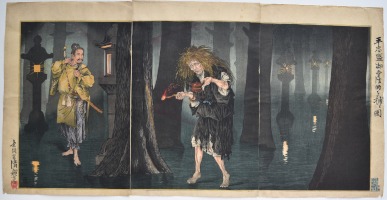
Kobayashi KIYOCHIKA (1847-1915)

Click here to view image full size. Taira no Tadamori Mido hoshi o toraen zu. The story relates how the Emperor Shirakawa was perturbed by a monster in the precincts of the Mido Temple at night. He commands the samurai Taira no Tadamori to kill it. The triptych shows Tadamori discovering that the monster is, in fact, the bedraggled old priest of Mido Temple who steals oil from the stone lanterns. Published by Hara Taneaki, c 1883. Very fine impression with particularly fine gradation and printing. Fine colour. Minor edge damage, otherwise fine condition. Full margins: This design often comes with the title and or publisher’s seal trimmed. Signed Hoensha Kiyochika hitsu. Status: Sold

Shotei HOKUJU (1763-1825)

Click here to view image full size. Shimosa Choshi no ura katsuo tsuribune, “Fishing for Bonito in Choshi Bay in Shimosa Province.” Hokuju, a pupil of Hokusai, produced a number of these fine “westernized” landscapes designed with stylised clouds, cubistic mountains and shadows cast by figures. This is one of the best. Bonito is a favourite fish in Japan where it is in the markets from around May each year. Choshin Bay has always produced the largest seafood catch in Japan. Hokuju produced a substantial body of work in this vein. However, he was not the only one. Okyo, Toyoharu, Hokusai, Kunitora, Kuninao and Shinsai also designed prints in this genre, as well as other artists producing examples. Interestingly, Hiroshige, the pre-eminent landscape artist, designed nothing like this. Indeed, the influences flowed the other way before too long, Hiroshige being a favourite of the Impressionists. This is the rare first edition published by Eijudo, c. 1820. His landscapes were republished by Yamamoto. Rare.     Fine impression and colour. Very good condition. Full size. Signed Shotei Hokuju ga.     Status: Sold

Utagawa HIROSHIGE (1797-1858)

Click here to view image full size. Kisoji no Yamagawa, “Mountain River on the Kiso Road.” One of Hiroshige’s most iconic images: Snow from an untitled set of three Setsugekka (“Snow, Moon, Flowers”) triptychs. The other two being Moon at Kanazawa and Whirlpools at Awa. The Setsugekka theme was taken from a poem by Tang dynasty poet Bai Juyi (Haku Rakuten). It’s a metonym for beautiful views, etc. This part of the Kiso Road was particularly treacherous but it’s not possible to identify the exact location and Hiroshige most likely used a certain amount of artist’s license. Published by Okasawaya Taheiji, 1857, a year before his death. Fine impression and colour. Centre sheet lightly backed and slightly trimmed, otherwise very good condition. Signed Hiroshige hitsu with Bokurin Shokoku seal. Status: Sold

Utagawa KUNIYOSHI (1797-1861)

 Click here to view image full size. Aigo Gozayemon Hisamitsu (Haigo Gozaemon Hisamitsu) mounted and armoured (less helmet) in battle levelling his long spear. He was a retainer of the Oda family and served under Shibata Katsuiye. From the set Taiheiki yeiyuden, “Heroic Stories of the Taiheiki. A history of the wars of the loyalist Nitta and Kusunoki families against the Ashikaga war-lords during the second quarter of the fourteenth century. But in fact the subject of this set of fifty prints (this design numbered 43) is the civil war of the late 16th century. Censorship restrictions imposed in the 1840s prevented publishers from illustrating historical subjects from the Tensho era 1573-92 onwards, so the publishers circumvented this by slightly altering the names of the historical figures. Published 1848-9 by Yamamoto-ya Heikichi. Robinson S62.1. One of the best designs from the set. Very fine impression. Fine colour and condition. Signed Ichiyusai Kuniyoshi ga.   Status: Sold  

Utagawa KUNIYOSHI (1797-1861)

 Click here to view image full size. Negoro- no Komizucha (Negoro-no Komizucha) dressed as a warrior-monk fighting with a long nail-studded club (a tetsubo) and a broken naginata. Swords and arrows fly about him.. From the set Taiheiki yeiyuden, “Heroic Stories of the Taiheiki. A history of the wars of the loyalist Nitta and Kusunoki families against the Ashikaga war-lords during the second quarter of the fourteenth century. But in fact the subject of this set of fifty prints (this design numbered 26) is the civil war of the late 16th century. Censorship restrictions imposed in the 1840s prevented publishers from illustrating historical subjects from the Tensho era 1573-92 onwards, so the publishers circumvented this by slightly altering the names of the historical figures. Published 1848-9 by Yamamoto-ya Heikichi. Robinson S62.26. One of the best designs from the set. Fine impression and colour. Very good condition. Signed Ichiyusai Kuniyoshi ga.   Status: Sold  

Kobayashi KIYOCHIKA (1847-1915)

 Click here to view image full size. Shows Captain Kani Ichita who, because he was suffering from dysentery, broke down 100 yards from the assault on Two Dragon Hill at the siege of Port Arthur in the Russo-Japanese war ( 1/8/1904-2/1/1905 ). Not able to forgive his weakness, he went back to the same spot a week later and commited seppuku. From a set Rikukaigunjin komei kagami, “Mirror of Army and Navy Heroes.” Published by Inoue Kichijiro, 2 For whatever reason, a rare set. Fine design. Fine impression and colour. Signs of mounting au verso, otherwise fine condition. Signed Kiyochika. Status: Sold

Utagawa KUNIYOSHI (1797-1861)

 Click here to view image full size. Fukishima Masamori (Fukushima Masanori) in armour struggling with three assailants. He was the son of a cooper in the province of Owari. From the set Taiheiki yeiyuden, “Heroic Stories of the Taiheiki. A history of the wars of the loyalist Nitta and Kusunoki families against the Ashikaga war-lords during the second quarter of the fourteenth century. But in fact the subject of this set of fifty prints (this design numbered 15) is the civil war of the late 16th century. Censorship restrictions imposed in the 1840s prevented publishers from illustrating historical subjects from the Tensho era 1573-92 onwards, so the publishers circumvented this by slightly altering the names of the historical figures. Published 1848-9 by Yamamoto-ya Heikichi. Robinson S62.9. One of the best designs from the set. Fine impression and colour. Small binding holes, otherwise very good condition. Signed Ichiyusai Kuniyoshi ga.Published 1848-9 by Yamamoto-ya Heikichi. Robinson S62.2. One of the best designs from the set.   Status: Sold  

Kobayashi KIYOCHIKA (1847-1915)

 Click here to view image full size. Lieutenant Mitsutani on horseback in swirling smoke. From a set Rikukaigunjin komei kagami, “Mirror of Army and Navy Heroes.” Published by Inoue Kichijiro 1895. I have been unable to get any information on this hero. For whatever reason, a rare set. Fine design. Fine impression and colour. Signs of mounting au verso, otherwise fine condition. Signed Kiyochika. Status: Sold

Utagawa KUNIYOSHI (1797-1861)

 Click here to view image full size. Akashi Ridayu Hidemoto (Akashi Gidayu Tadamasu) with a peasants’ straw raincoat over his armour and armed with a hoe. On one occasion, together with Shioren Sajima, he commanded a force of men dressed as farmerts. From the set Taiheiki yeiyuden, “Heroic Stories of the Taiheiki. A history of the wars of the loyalist Nitta and Kusunoki families against the Ashikaga war-lords during the second quarter of the fourteenth century. But in fact the subject of this set of fifty prints (this design numbered 34) is the civil war of the late 16th century. Censorship restrictions imposed in the 1840s prevented publishers from illustrating historical subjects from the Tensho era 1573-92 onwards, so the publishers circumvented this by slightly altering the names of the historical figures. Published 1848-9 by Yamamoto-ya Heikichi. Robinson S62.2. One of the best designs from the set. Very fine impression, colour, and condition. Signed Ichiyusai Kuniyoshi ga.   Status: Sold  

Tsukioka YOSHITOSHI (1839-1892)

 Click here to view image full size. The demon Ibaraki of Rashomon ( a gate south of the Imperial Palace in Kyoto ) visits Watanabe no Tsuna disguised as an old woman to retrieve its severed arm. This famous story relates how Watanabe cut off the arm after camping out at the gate to rid the neighbourhood of the beast. ( See below on this website for Yoshitoshi’s vertical diptych of the same subject. ) From Yoshitoshi manga, “Sketches by Yoshitoshi” from a fine set of seven diptychs. Published by Kobayashi 1885-86 ( this being 1885 ).   Very fine impression of the first edition. Fine colour. Fine condition apart from one minor mark. As originally published with no backing paper, with the margins completely untrimmed ( often cut in this set ), and plenty of space for joining. Signed Yoshitoshi ga.   Status: Sold  

Keisai EISEN (1790-1848)

 Click here to view image full size. Edo Ryogokubashi noryo no yakei, “View of an Evening Cooling Off at the Ryogoku Bridge, Edo.” Shows a multitude of boats beneath the bridge, fireworks above. Published c 1829.   Fine, early impression. Fine colour and condition. Signed Eisen ga.   Status: Sold  

Utagawa KUNIYOSHI (1797-1861)

 Click here to view image full size. Inuzaka Keno Tanetomo struggling with four adversaries from Kyokutei-o seicho Hakkenshi zui-ichi, “The One and Only Eight Dog History of Old Kyokutei [Bakin], Best of Refined Authors.” The set of eight prints form diptychs and are based on Bakin’s (1767-1848) famous novel Satomi Hakkenden, “Eight Dogs of the Satomi Clan.” Robinson S5.7.   Very good impression, colour and condition. Signed Ichiyusai Kuniyoshi ga.   Status: Sold  

Tsukioka YOSHITOSHI (1839-1892)

 Click here to view image full size. Hohodemi Mikoto battling a giant bream to regain the magic fish hook. The best design from a fine chuban set Biyu Suikoden published by Omiya Kyujiro, 1866/7 (this being 1867). He eventually marries the Sea God’s daughter Princess Toyotama. There is a later edition with the publisher’s name removed.   Very good impression, colour and condition. Signed Kaisai Yoshitoshi hitsu.   Status: Sold  

Ichieisai YOSHITSUYA (1822-1866)

 Click here to view image full size. Raiko and his four retainers: from left to right, Sakata no Kintoki, Usui no Sadamitsu, Watanabe no Tsuna and Urabe no Suyetake on Oyeyama, “Devil’s Mountain.” Shows Raiko having just decapitated the giant head of the demon Shuten-doji which then descended upon his helmet. Unidentified publisher, 1858.   Fine impression. Very good colour and condition. Signed Ichieisai Yoshitsuya ga   Status: Sold  

Tsukioka YOSHITOSHI (1839-1892)

 Click here to view image full size. Fushimi ojishin Momoyama goten no zu. Shows Kato Kiyomasa protecting Toyotomi Hideyoshi during the earthquake which destroyed the Fushimi castle two years after it was completed in 1594. Published by Fukase, 1885.   Very fine impression, colour and condition with extra paper around. Signed Oju Taiso Yoshitoshi ga.   Status: Sold  

Utagawa KUNIYOSHI (1797-1861)

 Click here to view image full size. Ina-uye Daikuro Masatada (Inoue Daikuro Nagayoshi) in armour but without helmet, his sashimono adorned with a skull, about to discharge a huge gun. From the set Taiheiki yeiyuden, “Heroic Stories of the Taiheiki. A history of the wars of the loyalist Nitta and Kusunoki families against the Ashikaga war-lords during the second quarter of the fourteenth century. But in fact the subject of this set of fifty prints (this design numberSurimono 033ed 47) is the civil war of the late 16th century. Censorship restrictions imposed in the 1840s prevented publishers from illustrating historical subjects from the Tensho era 1573-92 onwards, so the publishers circumvented this by slightly altering the names of the historical figures. Published 1848-9 by Yamamoto-ya Heikichi. Robinson S62.16. One of the best designs from the set. Fine impression, colour, and condition. Signed Ichiyusai Kuniyoshi ga.   Status: Sold  

Utagawa KUNIYOSHI (1797-1861)

 Click here to view image full size. Kido Takuzayemon Nagachika (Kido Sakuzaemon Norishige) on stone steps above a river attempting to prise open a metal grill. He was lord of the castle of Uda in Higo Province. From the set Taiheiki yeiyuden, “Heroic Stories of the Taiheiki. A history of the wars of the loyalist Nitta and Kusunoki families against the Ashikaga war-lords during the second quarter of the fourteenth century. But in fact the subject of this set of fifty prints (this design not numbered) is the civil war of the late 16th century. Censorship restrictions imposed in the 1840s prevented publishers from illustrating historical subjects from the Tensho era 1573-92 onwards, so the publishers circumvented this by slightly altering the names of the historical figures. Published 1848-9 by Yamamoto-ya Heikichi. Robinson S62.19. One of the best designs from the set. Fine impression and colour. Small binding holes, otherwise very good condition. Signed Ichiyusai Kuniyoshi ga.   Status: Sold  

Utagawa KUNIYOSHI (1797-1861)

 Click here to view image full size. Orio Mosuke Yasuharu (Horio Mosuke Yoshiharu) in early youth overcoming a huge wild boar. A feat which caused Hideyoshi to take him into his service. From the set Taiheiki yeiyuden, “Heroic Stories of the Taiheiki. A history of the wars of the loyalist Nitta and Kusunoki families against the Ashikaga war-lords during the second quarter of the fourteenth century. But in fact the subject of this set of fifty prints (this design not numbered) is the civil war of the late 16th century. Censorship restrictions imposed in the 1840s prevented publishers from illustrating historical subjects from the Tensho era 1573-92 onwards, so the publishers circumvented this by slightly altering the names of the historical figures. Published 1848-9 by Yamamoto-ya Heikichi. Robinson S62.27. One of the best designs from the set. Fine impression, colour, and condition. Signed Ichiyusai Kuniyoshi ga.   Status: Sold  

Utagawa KUNIYOSHI (1797-1861)

 Click here to view image full size. Saito Toshimoto nyudo Ryuhon (Saito Toshimitsu nyudo Ryuhon) in armour struggling with a Chinese brigand underwater. From the set Taiheiki yeiyuden, “Heroic Stories of the Taiheiki. A history of the wars of the loyalist Nitta and Kusunoki families against the Ashikaga war-lords during the second quarter of the fourteenth century. But in fact the subject of this set of fifty prints (this numbered 48) is the civil war of the late 16th century. Censorship restrictions imposed in the 1840s prevented publishers from illustrating historical subjects from the Tensho era 1573-92 onwards, so the publishers circumvented this by slightly altering the names of the historical figures. Published 1848-9 by Yamamoto-ya Heikichi. Robinson S62.31. One of the best designs from the set. Fine early impression. Fine colour. Slight nibbling to left edge, otherwise very good condition. Signed Ichiyusai Kuniyoshi ga.   Status: Sold  

Totoya HOKKEI (1780-1850)

 Click here to view image full size. A still life surimono showing a right-eye flounder or flatfish, Karei, and a red bream, kaneme-tai. And small unidentified vegetables. Provenance: A slip from a catalogue on the back indicates that it comes from a Paris sale, probably early 20th century describing it as Limande et dorade. Hokkei is best known for his surimono. He was originally a fishmonger, hence his name Totoya, and also accounts for the number of surimono he designed with fish and shells. Extremely rare.   Fine impression and colour with mica on the bream. Minor soil, otherwise very good condition. Signed Hokkei.   Status: Sold  

Tsukioka YOSHITOSHI (1839-1892)

 Click here to view image full size. The most gruesome of Yoshitoshi’s designs showing the old hag of the Lonely House about to eviscerate the pregnant woman hanging from the roof. Published by Matsui Eikichi, 1885.   Fine impression of the first edition. Little work has been done on the various states in this set other than that most were reprinted by Hasegawa Tsunejiro. Fine colour. Very full size with large margins left, top and where the sheets join. (The left border is often trimmed thereby losing the publication details.) Minor soil, otherwise fine condition. On thick hosho. Signed Oju Yoshitoshi.   Status: Sold  

Utagawa KUNIYOSHI (1797-1861)

 Click here to view image full size. The stern of a large sailing-junk and a smaller vessel infront. A poem by Sangi Takamura (Ono no Takamura) from Hyaku-nin isshu, “The Hundred Poets” published by Ebine c 1838. Depending which story one reads, either Takamura, who was a customs official for ships trading to and from China, went missing on a mission or was reported for being an extortioner and banished to the Oki Islands. Either way, he was subsequently pardoned. One of the best designs from this fine set. Robinson S19.11 and illustrated in Robinson (1961), no. 59.   Fine impression, colour and condition. Signed Ichiyusai Kuniyoshi ga.   Status: Sold  

Utagawa KUNIYOSHI (1797-1861)

 Click here to view image full size. A triptych showing the famous battle on Gojo Bridge between Ushiwaka Maru (Minamoto no Yoshitsune’s childhood name) and Benkei. Yoshitsune is aided by Sojobo, King of the Tengu (white-bearded in the centre), and other yamabushi tengu. Published by Enshuya Hikobei, 1847-50. Robinson T194.   Very fine impression and colour. Fine condition. This is the best example I have seen of this design. Signed Ichiyusai Kuniyoshi ga.   Status: Sold  

Ichiryusai HIROSHIGE (1797-1858)

 Click here to view image full size. An extremely rare uncut fan print: Kominato in Awa Province from Boso meisho, Famous Places in Awa, Kazusa and Shimosa Provinces. Shows beauties viewing the bay. Another impression illustrated in Hiroshige no uchiwae, Hiroshige Fan Prints, Okuda, Atsuko, Unsodo, 2010, no 91, p 68 (plus two others from the set). Five other designs presently known: Hoda Coast; Mount Kiyosumi; Mount Fuji from Kisarazu; Mount Kano, and Kisarazu in Kazusa Province. Published by Tsujiya Yasubei, 12 Certainly one of the few impressions extant.   Very fine impression, colour and condition. Signed Hiroshige ga.   Status: Sold  

Utagawa KUNISADA (1786-1864)

 Click here to view image full size. A long surimono showing a fan with an image of Ichikawa Danjuro VII as Soga no Goro in the play Yanone, “The Arrow Head.” To the left a fan shape with a poem by Sansho VII (Ichikawa Danjuro VII) and irises. Extremely rare. This impression sold by me in 1997. Issued c 1814. These long surimono were published with the poems attached but were invariably removed by collectors as being a distraction from the image.   Very good impression and colour. Minor soil, otherwise good condition. Signed Gototei Kunisada ga. A name bottom left corner reads Onishi Tokuzo II.   Status: Sold  

Ichiryusai HIROSHIGE (1797-1858)

 Click here to view image full size. Mount Haruna in snow, Kozuke Province.One of the best designs from Rokuju yoshu meisho zue, “Famous Places in the Sixty-odd Provinces.” The series published by Koshimuraya Heisuke between 7/1853 and 3/1856 (this being 8/1853).   Very good impression and colour. Margins trimmed a little, otherwise very good condition. Signed Hiroshige ga.   Status: Sold  

Totoya HOKKEI (1780-1850)

 Click here to view image full size. A surimono showing the Japanese Buddhist goddess Benten, as always with her lute, and a monkey and rat holding a scroll showing the short months (2,4,7,9,12) for the Rat year, 1828. Benten (Hindu: Saraswati) originates from India via China. She is also one of the Seven Gods of Good Fortune. A fukujuso plant in a pot to her right. Poems by Ganjotei Shirataka and Tetsujoan Maori.   Very fine impression with extensive silver and gold. Signs of mounting au verso, otherwise very good condition. Fine colour. Signed Hokkei.   Status: Sold