Utagawa YOSHIFUSA (Act. 1837-1860)

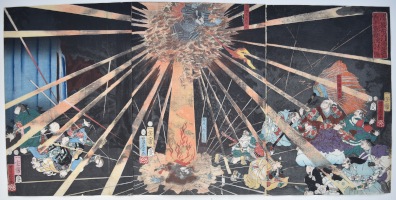
Click here to view image full size. A triptych showing the vengeful spirit of Akugenta Yoshihira in a giant ball of fire sending a lightning bolt down on Nanba Jiro. Retaliation for having been defeated and beheaded during the Heiji rebellion. (There are other explanations for Yoshihira’s revenge, but this is the most common.) The revenge takes place at the Nunobiki Waterfall near Kobe. The scene watched by Taira no Kiyomori. Published by Omiya Kyujiro (Kinkyu) 1856.   Fine impression. Very good colour although extensive oxidation. Edge crease on centre panel, otherwise very good condition. Signed Ipposai Yoshifusa Ga.   Status: Available Price:  £3,800  
Utagawa KUNIYOSHI (1797-1861)

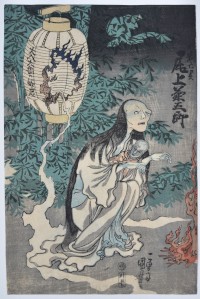
Click here to view image full size. The actor Onoye Kikugoro III as the ghost of Oiwa from a production of Yotsuya kaidan at the Morita Theatre, 1836. Probably the most famous Japanese ghost story. It was adapted by the playwright Tsuruya Nanboku IV for his friend Kikugoro in 1825. The left panel of a diptych (the right panel being boring and usually ignored). A scene on Snake Mountain showing Oiwa, disfigured by poison, emerging from a burning lantern to haunt her husband, Tamiya Lemon, who had murdered her father. Published by Kawaguchi-ya Chozo, 1836.   Very good impression, colour and condition. Signed Ichiyusai Kuniyoshi ga.   Status: Available Price:  £1,350  

Tsukioka YOSHITOSHI (1839-1892)

Click here to view image full size. Looking Itchy: the appearance of a kept woman of the Kaei era [1848-1854]. Shows a beauty emerging from a mosquito net that has apparently not been entirely successful. From a set Thirty-two Aspects of Women published by Tsunashima Kamekichi, 1888. The set depicts women of different backgrounds and occupations from the Kansei era through to the Meiji era with punning allusions to their situation or mood.   Very fine impression with strong blind-printing on the fall. Fine colour and condition. Full size. Signed Hiroshige ga.   Status: Available Price:  £2,800  

Utagawa KUNIYOSHI (1797-1861)

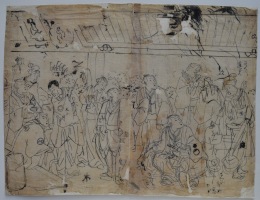
Click here to view image full size. A large original drawing, sumi on thin paper, 15 x 20 in; 38 x 51 cms. Shows a large group of actors in front of a theatre. Most likely two sheets for an intended triptych. There appears to be the publisher’s seal Kiya Sojuro brushed-in at the bottom who was active c 1851-1904. Provenance: Ex collection Dr. Julius Kurth (1870-1949), an eminent scholar who wrote extensively on Japanese and Chinese art. Sold “as is” with all imperfections.   Status: Available Price:  £1,400  

Nagasawa ROSETSU (1754-1799)

Click here to view image full size. An original fan painting, sumi on treated paper, 17 x 6.25 in; 43 x 16 cms. Shows two needlefish (family Belonidae).Rosetsu is considered one of the most important artists of the late Edo period but little is known of his short life – he died at forty-five, apart from the fact that he studied and was one of the top disciples of Maruyama Okyo. He is labelled an “eccentric” painter as he defies easy classification. His brushwork is a tour de force and he is known for his expressive depictions of animals. Signed Rosetsu with his Gyo (fish) seal. Framed and glazed with the fan mounted onto Japanese paper. Good condition, apart from the obvious fan folds.     Status: Available    

ANONYMOUS (Late 18th century)

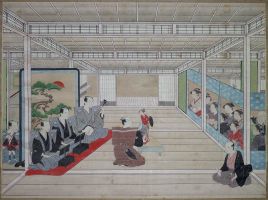
Click here to view image full size. An Uki-e, “floating picture” painting showing an interior with a puppet performance taking place. A puppeteer manipulates a female puppet in the centre, behind him two gidayu narrators and a shamisen player. A male puppet is being held behind a screen. Ladies behind a screen at right enjoy the drama. In fact, a male individual at the back seems overcome by emotion with a hanky to his face. The architecture is represented using one-point perspective, a style which made its way to Japan in the 1740’s from the West via China. (Interestingly the artist has got the perspective wrong on the screen at right.) This genre of painting – invariably unsigned – always shows interior or semi-interior views with banquets or, as here, puppet performances. Full colour on paper, 17 x 23 in; 43.2 x 58.5 cms. Minor marks, although good condition for this kind of painting.   Status:  Available Price:  £1,900 Click here to view image full size.

Ichiryusai HIROSHIGE (1797-1858)

 Click here to view image full size. An uncut fan print with title Shinkiro no zu which has a double meaning of being the Yoshiwara in the deep sea and also a chimera or mirage. The scene enclosed in a (dreaming ?) bivalve shows visitors in a watery Yoshiwara, all with fish heads. Of the utmost rarity: This appears to be the only impression known. There are also what appear to be keying marks on three sides that have not been removed. Published by Shinagawaya Kyusuke with censor seal for 1845.   Very fine impression. Fine colour and condition. Signed Hiroshige giga hitsu.   Status: Sold  

Katsushika HOKUSAI (1760-1849)

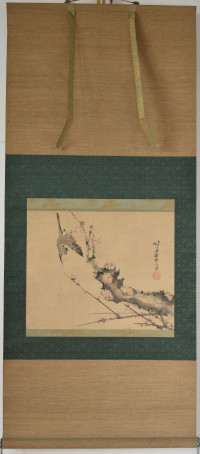
Click here to view image full size. An original painting, light colour on paper, 13 x 16.5 in; 33 x 42 cms. Shows a sparrow flying over a flowering plum tree. Light soil and creasing, but in generally good condition. Signed Hokusai suichu hitsu, “Hokusai painted while drunk.” Sealed Katsushika. (One of his better-known seals. He used different versions of it throughout his career.) Status: Sold Click here to view image full size.

Ichiyusai HIROSHIGE II (1826-1869)

Click here to view image full size. Suo Iwakuni Kintaibashi, “The Bridge of the Brocade Sash at Iwakuni in Suo Province.” From an uncompleted set: Shokoku meisho hyakkei, “One Hundred Views of the Provinces.” Published by Uoei between 1859 – 1861 (this being 1859). Shows the beautiful five-arch bridge spanning the Nishiki-gawa under heavy snow. The village of Nishikimi in the foreground. The bridge was built in 1673 using massive stone pilings because earlier bridges had been swept away. It was destroyed in 1950 due to a typhoon but rebuilt in 1953. The best print from the set and probably Hiroshige IIs finest design.     Fine impression of the first edition with mica applied. Fine colour. Minor edge discolouration, otherwise very good condition. Later editions lack the variegated cartouche and the colour-banded publisher’s seal in left margin. Signed Hiroshige ga. Status: Sold

Ichiryusai HIROSHIGE (1797-1858)

 Click here to view image full size. An extremely rare chu-tanzaku, Fuyu Sumidagawa no yuki, “Winter Snow on the Sumida River.” From a set Shiki Edo meisho, “Famous Places in Edo in the Four Seasons.” A lone figure in straw cape and large hat poles a log raft down the Sumida river in heavy snow. Published by Kawasho c. 1834. There are a number of states of this design known: As here (probably the earliest) with publisher’s seal and kiwame seal; with kiwame only; and without either. There are also extremely deceiving copies of this print. Provenance: Ex Le Veel collection, sold by Ader Picard Tajan, Paris, 2nd sale, 24/10/1980, lot 114, p. 50.   Very good impression, colour and condition. Signed Hiroshige ga.   Status: Sold  

Tsukioka YOSHITOSHI (1839-1892)

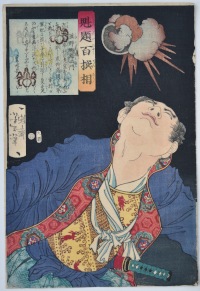
Click here to view image full size. The samurai Shigeno Yozaemon looking up at an exploding houroku-hiya “hand grenade.” (As with so much in Japan, the grenade originated in China from early times.) From a set Kaidai hyaku, “Yoshitoshi’s Selection of One Hundred Warriors.” Sixty-five prints published by Ohashiya Yashichi between 1868 and 1869, this being 1869. The text in the square cartouches in this set refer to prominent warriors in the internecine wars of the 16th century but in fact the subjects are Shogitai soldiers. (Those that held out against the imperial forces and were massacred at Ueno, 4) An excellent set.   Fine impression, colour and condition. Signed Ikkaisai Yoshitoshi htsu.   Status: Sold  

Utagawa KUNIYOSHI (1797-1861)

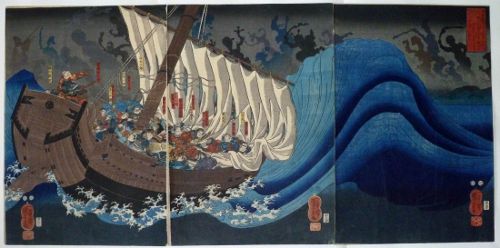
 Click here to view image full size. A triptych showing the ghosts of the Taira (Heike) warriors attempting to sink Yoshitsune’s ship off the coast of Settsu on his way to Shikoku. This is one of Kuniyoshi’s great designs – amongst the three or four best triptychs and is illustrated in numerous publications. The scene is the outcome of a great battle at Dan-no-ura where the Minamoto (Genji) clans clashed and defeated the Taira clans a few years earlier. The spirits of the drowned warriors rose up to seek revenge only to be pacified by Benkei reciting exorcisms with his rosary. Published 1849-52 by Enshuya Hikobei. Robinson T242. Rare. Very good impression and colour although slightly mismatched blue on the first and second sheets. Very good condition. Full size. There appear to be three states of this design: The main difference being in the shape of the ghosts and lines in the waves only on the first state. In this (the second state) the ghosts lack some of the features that are on the first and a large spirit appears above the wave over the ship on the centre panel. The third state has further differences in the ghosts and lacks this figure. Also, the colour of the boat gets greyer. Signed Ichiyusai Kuniyoshi ga. Status: Sold

Yurakusai NAGAHIDE (c 1799-1848)

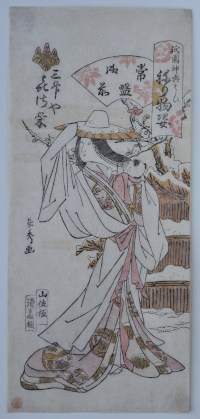
Click here to view image full size. An hosoban kappazuri (coloured by stencils) print from a set: Gion mikoshi arai nerimono sugata, “Gion Festival Costume Parade.” The set was jointly designed by: Goshichi, Seikoku (Charakusai) and Toyokuni, as well as Nagahide, although he appears to have been responsible for many in the set. A large group is in the MFA, Boston, with another impression of this design being acc. no 11.26554. Published by Yamashiroya Sahei (Yamasa) c 1818. Shows a courtesan, Kisae of Mimasuya, parading in the Gion Matsuri Festival, held in the geisha quarter of Kyoto in July, dressed as Tokiwa Gozen, the mother of Minamoto no Yoshitsune. She is usually depicted fleeing through the snow during the Heiji rebellion cradling her son to her chest. Seal bottom left Kato [Shozo] who was an art dealer/collector in Oxford Street, London and sold prints to the BM in the 1920s. Very good impression with extensive undamaged mica. Very good colour. Signs of mounting au verso, otherwise very good condition. Signed Nagahide ga. Status: Sold

Ichiryusai HIROSHIGE (1797-1858)

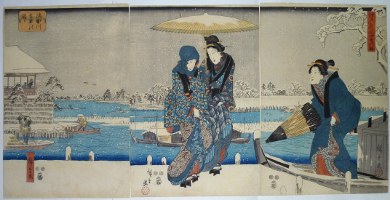
 Click here to view image full size. One of Hiroshige’s most beautiful triptychs: Sumidagawa setchu no zu,“The Sumida River in Snow” from a series Edo meisho shiki no nagame, “Views of the Famous Places of Edo in the Four Seasons.” Shows a ferry landing on the Sumida with a beauty disembarking from a boat and another pair ready to board. Published by Maruya Jinpachi, c 1847-8. Rare.   Very good impression and colour. Horizontal centre fold, otherwise good condition. Signed Hiroshige ga.   Status: Sold  

Utagawa KUNIYOSHI (1797-1861)

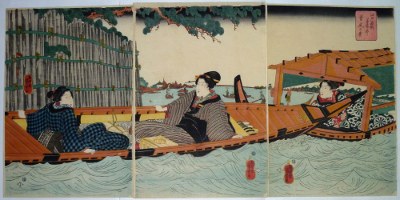
 Click here to view image full size. A complete triptych showing beauties in boats on the Sumida River. Shubi no matsu, “Successful-deal Pine Tree” from a set Edo meisho somoku-zukushi, “Notable Sights Famous for Grass and Trees in Edo.” This famous pine was blown down during the An’ei era (1772-1780); its successor died during the Ansei era (1854-1859); the third died at the end of the Meiji era (c 1910). There is also the Hiroshige view of this subject from the 100 Views of Edo. Published by Ebiya Rinnosuke (Kaijudo), 1845.   Very good impression. Fine colour and condition. Full size. Another state has darker water and variegated cartouche. Signed Cho-o-ro Kuniyoshi ga.   Status: Sold  

Utagawa KUNISADA (1786-1864)

 Click here to view image full size. A lively design showing Ichikawa Danjuro VII in the role of the loyal warrior Arajishi Otokonosuke Terumitsu fighting a giant rat in the cellar beneath the women’s quarters of the Ashikaga Palace. This scene, Yukashita no Ba, is from the play Date kurabe okuni Kabuki performed at the Kawarasaki-za Theatre, 3 Shortly afterwards, the rat escapes down a hole in the hanamichi pathway, only to re-emerge in a cloud of smoke as the arch-villain and master of the black arts, Nikki Danjo. Published by Eikyudo (Yamamoto Kyubei) 1829.   Fine impression, colour and condition on an extra large sheet of hosho. Signed Gototei Kunisada ga.   Status: Sold  

Jokei RYUKOSAI (Fl. c 1772-1816)

 Click here to view image full size. The most important and influential Osaka artist of the late eighteenth century. An innovator whose style may well have influenced such artists as Shunei and Sharaku. His prints – mostly hosoban – are all of the utmost rarity. Indeed, it is thought they originally formed triptychs but, so far, no complete design has been located. The oban design offered here is even rarer, there being only two other impressions known: Illustrated in colour, pl. 13, in Kamigata Ukiyo-e Nihyaku-nen Ten, “200 Years of Kamigata Ukiyo-e,” Susumu Matsudaira, 1975; and pl. 43, p. 56, catalogue of exhibition Ukiyo-e of the Kamigata Area at the Osaka Museum of History and Yamaguchi Prefectural Hagi Uragami Museum, Kitagawa Hiroko, 2014. Shows five actors. From right to left (rear): Nakamura Kyojuro, Arashi Sangoro III, Kataoka Nizaemon VII and (front): Asao Tamejiro I, Ichikawa Danzo IV. Published c 1790 by Ki.   Fine impression. Very good colour. Small areas of contemporary hand colouring to face and costume of Tamejiro. Slight folds and small sumi mark bottom left, otherwise very good condition. Probably full size. Signed Ryukosai ga.   Status: Sold  

SESSHUNSAI (Dates unknown but active c 1800)

 Click here to view image full size. An extremely rare early Osaka hosoban showing the actor Asao Tamejuro II (1779-1806) standing before a broken barricade in the role of Yamashiro Kantsubo in the play Meiboku sendai hagi. This artist and print appear to be unrecorded. Published by Houki (Honya Kichisai), c early 1800. A wonderful design. Many thanks to Hendrick Luhl for his help on this print.   Very good impression and colour. The fujitive background aobana, dayflower pigment, intact except for one small area affected by moisture visible au verso. Very good condition. Signed Sesshunsai ga with seal unread.   Status: Sold  

TOGAKUSAI (Active c 1782)

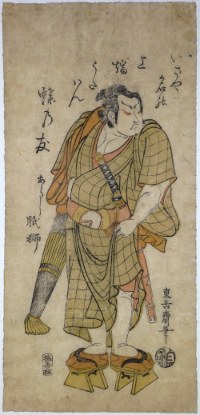
 Click here to view image full size. An extremely rare and early Osaka hosoban (probably unrecorded) showing the actor Kano Hinasuke I (who later became Arashi Koroku III) standing on large geta and holding an umbrella. Published by Shioki-han (Shioya Kisuke), c 1782. The poem above is signed using the actor’s hango Arashi Minshi. Only a few designs are known by this artist. Many thanks to Hendrick Luhl for his help on this print.   Very good impression and colour. Some wear and tear which has been skilfully restored. On very thin paper. Signed Togakusai hitsu with seal Sadakuni.   Status: Sold  

Utagawa KUNISADA (1786-1864)

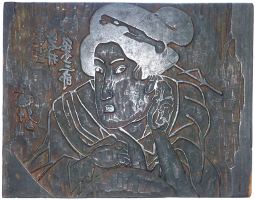
 Click here to view image full size. An exceptionally rare original double-sided woodblock. On one side is the key-block showing Ichikawa Danjuro VII as the strongman, “chikaramochi,” Ura no Kingo. On the other is the key-block showing Iwai Kumesaburo II as the female acrobat, “karuwazashi,” Tamamoto Kosan. The play is Fujikawabune noriai banashi performed at the Nakamura-za Theatre, 5 The block measures 8.5 x 10.75 x .75 in; 21.6 x 27.3 x 2 cms. The two images signed Gototei Kunisada ga. In very good condition but with obvious minor damage. Sold “as is.”   Status: Sold    Click here to view image full size.

Kubo SHUNMAN (1757-1820)

 Click here to view image full size. A rare surimono showing new year festivities before a large screen depicting Mount Fuji at sunset. A versatile and highly talented artist working in various mediums, Shunman produced (and cut and printed) some of the finest surimono. Published c 1810s. I cannot, at the moment, locate another impression. Fine impression and colour with extensive gold and silver. Fine condition. Sealed Shunman bottom right. Fine impression and colour with silver and gold. Light backing, otherwise very good condition. Signed Shokyuko Shuntei ga.   Status: Sold  

Totoya HOKKEI (1780-1850)

 Click here to view image full size. An exceptionally rare surimono showing salt gatherers on a beach, their huts behind them and Mount Fuji towering over the horizon. Published c 1820s. I cannot, at the moment, locate another impression. Fine impression with gold clouds and Fuji heavily blind-printed. Fine colour. Minimal soil, otherwise very good condition. Si8ned Hokkei.   Status: Sold  

Kitagawa UTAMARO (1753-1806)

 Click here to view image full size. No. 7 from a set of 12 prints: Joshoku kaiko tewazagusa, showing women engaged in the sericulture (silkworm) industry. This was traditionally the domain of women. The colour scheme is red-avoiding (murasaki-e) using predominantly purple. This stage of the process shows the metamorphosis – the winged moth stage – when silkworms are used to lay eggs. This set is taken verbatim from the Shunsho/Shigemasa set of chuban prints, Kaiko yashinai-gusa. (See elsewhere on this site for a Shunsho example.) Published 1798-1800 by Tsuru-ya Kiemon. Fine impression. Fine colour, perfectly retained. Very good condition; full size. Signed Utamaro hitsu.   Status: Sold  

Utagawa KUNIYOSHI (1797-1861)

 Click here to view image full size. A beauty in sumptuous clothing from a fine set of seventy numbered prints with title: Sankai medetai zu, “Excellences of Mountain and Sea.” The set compares busts of beautiful women with various products and occupations from the provinces of Japan. This is number 3, Tamba, and shows men fishing at night with the aid of flares. The set published 1852 by Sano-ya Kihei. Very fine impression and colour with strong burnishing on collar. Fine condition. Signed Ichiyusai Kuniyoshi ga.   Status: Sold  

Utagawa KUNIYOSHI (1797-1861)

 Click here to view image full size. A beauty reading a program while a cat dozes beside her. From a fine set of seventy numbered prints with title: Sankai medetai zu, “Excellences of Mountain and Sea.” The set compares busts of beautiful women with various products and occupations from the provinces of Japan. This is number 19. Catching octopuses, Takasago in Banshu [Harima] Province. The set published 1852 by Sano-ya Kihei. Very good impression and colour. The cat’s fur blind-printed. Light album backing, otherwise good condition. Signed Ichiyusai Kuniyoshi ga.   Status: Sold  

Utagawa KUNIYOSHI (1797-1861)

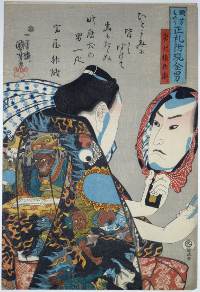
 Click here to view image full size. Token Gonbei using a mirror to pluck his forehead (hitai). The style became known as Token hitai. From a set: Kuniyoshi moyo shofuda tsuki genkin otoko, “Men of Ready Money with True Labels Attached, Kuniyoshi Style.” These otokodates (a word that is difficult to translate but was a chivalrous commoner, a fashionable man-about-town, street-wise and ready to assist the oppressed). Gonbei is said to have beaten a barking token (Dutch hunting dog) to death with his bare hands – thus he got his name. Published c 1845 by Iba-ya Kyubei. Very fine impression. Fine colour. Light album backing, otherwise fine condition. Signed Ichiyusai Kuniyoshi ga.   Status: Sold  

Utagawa KUNIYOSHI (1797-1861)

 Click here to view image full size. Sasai Kyuzo Masayasu (Sakai Kyuzo Narashige) enveloped in smoke and disintegrating before a volley of musketry at the battle of the Anegawa (1570). From the set Taiheiki yeiyuden, “Heroic Stories of the Taiheiki. A history of the wars of the loyalist Nitta and Kusunoki families against the Ashikaga war-lords during the second quarter of the fourteenth century. But in fact the subject of this set of fifty prints (this being 12, but not numbered) is the civil war of the late 16th century. Censorship restrictions imposed in the 1840s prevented publishers from illustrating historical subjects from the Tensho era 1573-92 onwards, so the publishers circumvented this by slightly altering the names of the historical figures. Published 1848-9 by Yamamoto-ya Heikichi. Robinson S62.36. The best design from the set. Fine early impression. Fine colour. Slight nibbling to left edge, otherwise very good condition. Fine impression. Fine colour. Slight trimming, otherwise very good condition. Signed Ichiyusai Kuniyoshi ga.   Status: Sold  

Katsushika HOKUSAI (1760-1849)

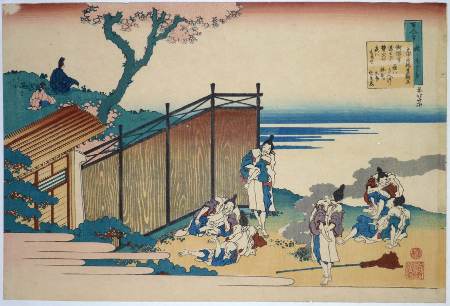
 Click here to view image full size. A poem by Onakatomi no Yoshinobu Ason from Hyakunin isshu uba ga etoki, the “Hundred Poems explained by the Wet Nurse.” Published by Nishimuraya Eijudo and Iseya Eijudo c 1835 Although obviously intended to be a set of 100 prints, only 27 are known plus drawings for the others. The poet speaks of his love being like a fire kept by guards at the Imperial Palace: It only burns hot at night. Shows a group of sleepy imperial guards with the fire burning low. The poet and servant are seen on the distant hill. Very fine early impression. Fine colour and condition. (The small white area without colour top left should appear on every untrimmed genuine impression.) Signed Zen Hokusai manji (the manji seal black).   Status: Sold  

Katsushika HOKUSAI (1760-1849)

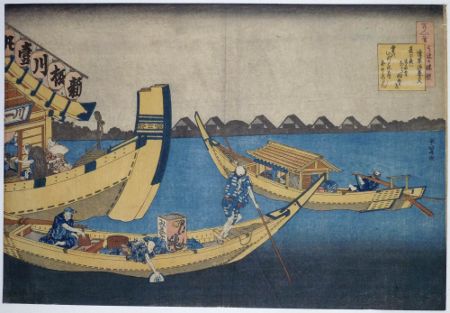
 Click here to view image full size. A poem by Kiyowara no Fukayabu from Hyakunin isshu uba ga etoki, the “Hundred Poems explained by the Wet Nurse.” Published by Nishimuraya Eijudo and Iseya Eijudo c 1835 Although obviously intended to be a set of 100 prints, only 27 are known plus drawings for the others. The poet speaks of the shortness of the summer night and asks if the moon is still overhead or hidden by clouds. Shows an evening on the Sumida River with a large pleasure boat accompanied by a smaller craft and a vessel providing food. Fine early impression. Fine colour. Slight centre fold, otherwise good condition. Signed Zen Hokusai manji (the manji seal black).   Status: Sold