Ichiryusai HIROSHIGE (1797-1858)

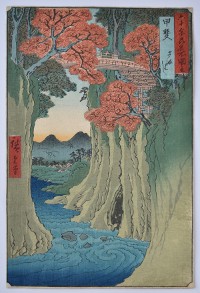
 Click here to view image full size. The cantilevered Monkey Bridge from Rokujuyoshu meisho zue, “Famous Views in the Sixty-odd Provinces.” Published by Koshimuraya Heisuke 1853-6 (this being 1853). This bridge – one of the three most famous bridges in Japan – is situated in Otsuki and purports to be 1300 years old (albeit rebuilt many times).   Fine impression of the first edition. Fine colour. Trimmed close, otherwise very good condition. Signed Hiroshige ga.   Status: Sold  
Ichiryusai HIROSHIGE (1797-1858)

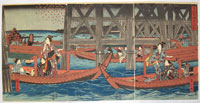
 Click here to view image full size. A rare triptych showing fireworks over Ryogoku bridge with numerous pleasure boats negotiating the huge trestles of the bridge. A fine design published 1847 – 50 by Sanoki. Very fine impression. Pristine colour and condition. Totally untrimmed and with deluxe double-printed red. Signed Hiroshige ga. Status: Sold

Ichiryusai HIROSHIGE (1797-1858)

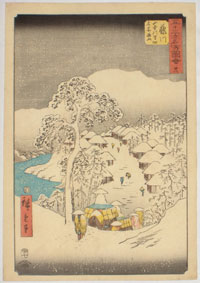
 Click here to view image full size. Fujikawa from the so-called “Upright Tokaido.” One of the two snow scenes from the set. Shows travelers coming and going at the edge of the village. Published by Tsutaya, Hare 7, 1855. Very good impression with woodgrain evident in the sky. Very good condition with full margins. Signed Hiroshige ga. Status: Sold

Ichiryusai HIROSHIGE (1797-1858)

 Click here to view image full size. Numazu from the Upright Tokaido, Gojusan tsugi meisho zue. Published by Tsutaya, 1855. The old adage that familiarity breeds contempt certainly applies to this set, which was reprinted many times. Early printings, as here, enable us to appreciate this underrated set. One of the two snow scenes from the set showing figures crossing one of two trestle bridges. Very good to fine impression. The red cartouches double printed ( only seen on early impressions ). Fine colour. Light album backing and trimmed close at bottom right but leaving black border, otherwise very good condition. Signed Ichiryusai Hiroshige ga. Status: Sold

Ichiryusai HIROSHIGE (1797-1858)

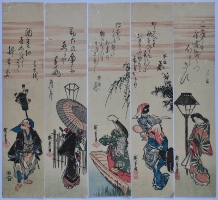
 Click here to view image full size. Five ko-tanzaku ( an oban cut into three ) prints of various subjects ( Bon odori, Sukeroku, Hatchitataki, etc ) from an excessively rare set of 15 such prints from 5 sheets. I have located only one other group ( of six designs duplicating three offered here ). Published by Matsumura Yahei c late 1830’s. Fine impressions and colour. Some wormage, otherwise very good condition. Signed Hiroshige ga on each. Status: Sold

Ichiryusai HIROSHIGE (1797-1858)

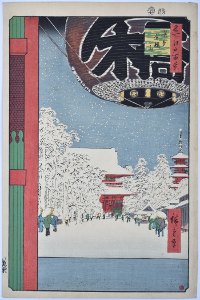
 Click here to view image full size. Asakusa Kinryuzan, “Kinryuzan Temple at Asakusa” Meisho Edo hyakkei, “The Hundred Views of Famous Places in Edo.” The view shown by Hiroshige is through the Kaminarimon gateway with the large hanging lantern after a heavy snowfall. The great temple, which still stands, was in the northern part of Edo, not far from the Yoshiwara. Published by Uoya Eikichi who published the set between 1856 – 1858 (this being 1856). There are 118 prints in the set plus a replacement design by Hiroshige II. This is one of Hiroshige’s best known designs.   Very good impression, colour and condition. Grain showing on the red wooden post at left and the lines still crisp. On later editions the red and green pigment gets cruder and the sky darker. And even later a slipping plug becomes evident in the blue area at bottom, below the black line at left. Signed Hiroshige ga.   Status: Sold  

Ichiryusai HIROSHIGE (1797-1858)

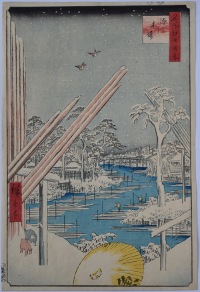
 Click here to view image full size. The Lumberyard, Fukagawa, from Meisho Edo hyakkei, “The Hundred Views of Famous Places in Edo.” Shows snow falling on the timber yards lining a river. An umbrella in the foreground is inscribed Uo, “Fish” – a reference to the publisher Uoya Eikichi who published the set between 1856 – 1858 (this being 1856). There are 118 prints in the set plus a replacement design by Hiroshige II. A large supply of timber was needed for the world’s largest wooden city. However, in 1641 a fire destroyed not only houses but the lumber which was then stored in a central area causing the government to move the yards to Fukagawa.   Very good impression, still with the lighter sky: Late editions have a black sky. Very good colour and condition. Signed Hiroshige ga.   Status: Sold  
Ichiryusai HIROSHIGE (1797-1858)

 Click here to view image full size. An extremely rare chu-tanzaku, Fuyu Sumidagawa no yuki, “Winter Snow on the Sumida River.” From a set Shiki Edo meisho, “Famous Places in Edo in the Four Seasons.” A lone figure in straw cape and large hat poles a log raft down the Sumida river in heavy snow. Published by Kawasho c. 1834. There are a number of states of this design known: As here (probably the earliest) with publisher’s seal and kiwame seal; with kiwame only; and without either. There are also extremely deceiving copies of this print. Provenance: Ex Le Veel collection, sold by Ader Picard Tajan, Paris, 2nd sale, 24/10/1980, lot 114, p. 50.   Very good impression, colour and condition. Signed Hiroshige ga.   Status: Sold  

Ichiryusai HIROSHIGE ( 1797-1858 )

 Click here to view image full size. “Evening Snow at Uchikawa”, Uchikawa bosetsu from the early set Kanazawa hakkei, “Eight Views in Kanazawa” published by Koshimuraya Heisuke, c 1835-6. This is an extremely rare and fine set and examples in good condition are very difficult to find. Each print contains a classical 31-syllable waka poem above. Kanazawa sits on the Sea of Japan bordered by the Japan Alps. One of Hiroshige’s finest compositions. Fine impression and colour. Small restored wormhole bottom edge left, otherwise very good condition.Large margins. Signed Hiroshige ga. Status: Sold

Ichiryusai HIROSHIGE (1797-1858)

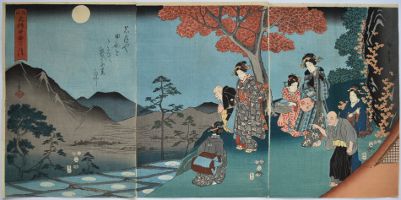
 Click here to view image full size. A triptych, Shinshu Sarashina tagoro no tsuki, “The Moon Reflected in the Rice Fields at Sarashina, Shinano Province.” Shows a group of women and two Buddhist monks admiring the phenomenon. The Japanese seem to have had a fascination with the full moon and especially Hiroshige who incorporated it into many prints. This fascination would have been multiplied viewing the many reflected moons in the paddy fields. In fact, Hiroshige designed two other prints on this subject, see his Honcho meisho set, c 1840 and the Rokujuyoshu meisho zue set, 1853-6. Published by Tsutaya Kichizo, 1853. Extremely rare.   Very fine impression with strong woodgrain evident. Fine colour and condition. Full size. Signed Hiroshige ga.   Status: Sold  

Ichiryusai HIROSHIGE ( 1797-1858 )

 Click here to view image full size. Fujikawa, Aichi Prefecture, from the so-called “Upright Tokaido”, Gojusan tsugi meisho zue. The 37th of the 53 Stations. At its peak in Edo times the town had 302 buildings. It is now part of Okazaki City. The old adage that familiarity breeds contempt certainly applies to this set, which was reprinted many times. Early printings, as here, enable us to appreciate this underrated series. One of the two snow scenes from the set showing figures entering the village. Published by Tsutaya, 1855. Very good impression, colour and condition. Signed Ichiryusai Hiroshige ga. Status: Sold

Ichiryusai HIROSHIGE (1797-1858)

 Click here to view image full size. Sagamigawa, “The Sagami River” Sagami Province. Rafts being poled down the river with tall water reeds and herons from Fuji sanjurokkei, “Thirty-six Views of Fuji” published by Tsutaya Kichizo, 1858. This set was started 5 months before Hiroshige’s death. Early impressions, as here, were printed very carefully as a tribute to Hiroshige. One of the six best designs from the set.   Fine, early impression. Perfect colour. Imperceptible centre fold, otherwise fine condition. Signed Hiroshige ga.   Status: Sold  
Ichiryusai HIROSHIGE (1797-1858)

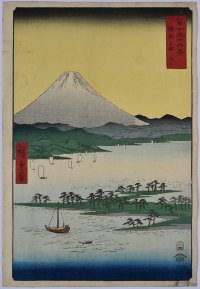
 Click here to view image full size. Suruga Miho no Matsubara. Shows the famous Pine Beech, Suruga Province. from Fuji sanjurokkei, “Thirty-six Views of Fuji” published by Tsutaya Kichizo, 1858. This was considered to offer one of the best views of Fuji.The set was started 5 months before Hiroshige’s death. Early impressions, as here, were printed very carefully as a tribute to Hiroshige. One of the six best designs from the set.   Fine, early impression. Perfect colour. Imperceptible centre fold and small soil in bottom right margin, otherwise fine condition. Signed Hiroshige ga.   Status: Sold  
Ichiryusai HIROSHIGE (1797-1858)

 Click here to view image full size. Kai Otsukinohara, the Otsuki Plain in Kai Province. A meandering stream with flowers and pampas grass from Fuji sanjurokkei, “Thirty-six Views of Fuji” published by Tsutaya Kichizo, 1858. This set was started 5 months before Hiroshige’s death. Early impressions, as here, were printed very carefully as a tribute to Hiroshige. One of the six best designs from the set.   Fine, early impression. Perfect colour. Imperceptible centre fold, otherwise fine condition. Signed Hiroshige ga.   Status: Sold  

Ichiryusai HIROSHIGE (1797-1858)

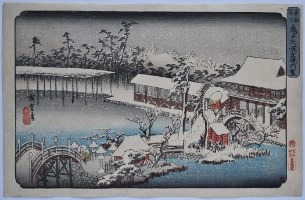
 Click here to view image full size. The compound of the Tenman Shrine at Kameido, Kameido Tenmangu keidai no yuki. The best design from a Toto meisho set of 21 prints published by Kikakudo (Sanoki) c 1832-5 and then extended to 55 in c. 1839-42. Also one of the best known places in Edo with the Drum Bridge, koi ponds and wisteria which flowered in the Fifth Month. The main shrine is dedicated to the memory of Sugawara no Michizane (Tenjin), the father of Japanese learning and built in 1662. Hiroshige shows the shrine in winter under falling snow.   Fine early impression with the red publisher’s seal in right margin (later editions having the black seal of Sanoki). These later editions have a black sky and a block defect appears at the edge of the pond centre left. Fine colour. Small restoration bottom left corner, otherwise very good condition. Signed Hiroshige ga.   Status: Sold  

Ichiryusai HIROSHIGE (1797-1858)

 Click here to view image full size. Musashi Tamagawa, “Tama River, Musashi” Musashi Province. A view from Koganei with flowering cherry trees from Fuji sanjurokkei, “Thirty-six Views of Fuji” published by Tsutaya Kichizo, 1858. This set was started 5 months before Hiroshige’s death. Early impressions, as here, were printed very carefully as a tribute to Hiroshige. One of the six best designs from the set.   Fine, early impression. Perfect colour. Imperceptible centre fold, otherwise fine condition. Signed Hiroshige ga.   Status: Sold  
Ichiryusai HIROSHIGE (1797-1858)

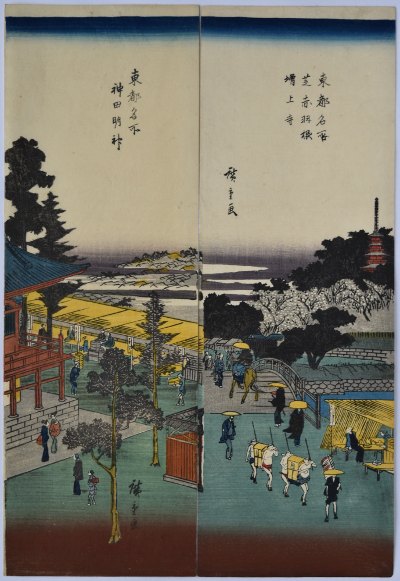
 Click here to view image full size. Two tanzaku prints from a Toto meisho “Famous Places of the Eastern Capital” set that were printed two-to-a-sheet. They were cut down the middle but in this case the two prints were kept together which is extremely rare. On the left: Kanda Myoujin, “Kanda Shrine.” On the right: Shiba Akabane Zojoji, “Shiba Akabane Zojoji Temple.” Published c 1840.   Very good impression, colour and condition. Signed Hiroshige ga.   Status: Sold  

Ichiryusai HIROSHIGE (1797-1858)

 Click here to view image full size. Izu no sanchu, “In the Mountains, Izu” the Joren Falls flow down between hills from Fuji sanjurokkei, “Thirty-six Views of Fuji” published by Tsutaya Kichizo, 1858. This set was started 5 months before Hiroshige’s death. Early impressions, as here, were printed very carefully as a tribute to Hiroshige. One of the six best designs from the set.   Fine, early impression. Perfect colour. Imperceptible centre fold, otherwise fine condition. Signed Hiroshige ga.   Status: Sold  

Ichiryusai HIROSHIGE (1797-1858)

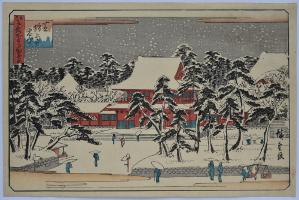
 Click here to view image full size. Shiba Zojoji setchu, “Snow at Zojoji Temple” from a set Edo meisho mitu no nagame, “Three Special Views of Edo” published by Uoya Eikichi, c 1840-42. The temple, together with Kan’ei-ji, was the Tokugawa’s family temple. Rare.   Fine impression, colour and condition. Signed Hiroshige ga.   Status: Sold  
Ichiryusai HIROSHIGE (1797-1858)

 Click here to view image full size. The compound of the Tenman Shrine at Kameido, Kameido Tenmangu keidai no yuki. The best design from a Toto meisho set of 21 prints published by Kikakudo (Sanoki) c 1832-5 and then extended to 55 in c. 1839-42. Also one of the best known places in Edo with the Drum Bridge, koi ponds and wisteria which flowered in the Fifth Month. The main shrine is dedicated to the memory of Sugawara no Michizane (Tenjin), the father of Japanese learning and built in 1662. Hiroshige shows the shrine in winter under falling snow.   Fine early impression with the red publisher’s seal in right margin (later editions having the black seal of Sanoki). These later editions have a black sky and a block defect appears at the edge of the pond centre left. Fine colour. Signed Hiroshige ga.   Status: Sold  

Ichiryusai HIROSHIGE (1797-1858)

 Click here to view image full size. Soshu Enoshima Benzaiten kaicho mode Hongu Iwaya no zu, “Pilgrimage to the Cave Shrine of Benzaiten on Enoshima.” A triptych showing the back view of the island (the causeway being on the other side) with the Iwaya cave on the right. Groups of women from Edo schools of narrative chanting are seen with umbrellas (Benzaiten was a deity associated with music). The statue was displayed once every six years. Published by Sumiyoshi Masagoro, 1851.   Fine impression. Very good colour. Fine condition. Signed Hiroshige ga.   Status: Sold  

Ichiryusai HIROSHIGE (1797-1858)

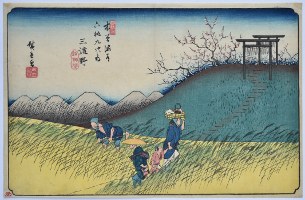
 Click here to view image full size. Midono from Kisokaido rokujukyutsugi no uchi , “Sixty-Nine Stations of the Kisokaido.” The set of seventy prints was published by Hoeido in 1835, but in 1837 Hiroshige took over and completed the series with the publisher Iseya Rihei (Kinjudo). The conjecture is that Hiroshige was the better known and more commercial artist, reinforced by the fact that Eisen’s name was removed from the designs already published. Hence only the first editions have his signature on those prints. Shows travellers in a field of pampas grass and a farm worker with a hoe to the left. On the hill above are torii gates leading to a Shinto shrine. The area here opens out after the narrow Kiso valley and is popular with walkers today. Provenance: Ex Grabhorn collection.   Fine impression of the earliest state with bokashi on the brow of the hill. Fine colour. Slight centre fold, otherwise very good condition. Signed Hiroshige ga.   Status: Sold  

Ichiryusai HIROSHIGE (1797-1858)

 Click here to view image full size. A snow scene: Atago shita yabukoji, “Bamboo Lane Below Atago Hill” from Edo meisho hyakkei, “The Hundred Famous Views of Edo”. Published by Uoya Eikichi between Ansei 3 and 5 (1856-58). This design dated Dragon 12 (1856). The large building on the left housed the daimyo’s servants and retainers.   Very good impression and colour. Small backed wormhole in top margin, otherwise very good condition. Signed Hiroshige ga.   Status: Sold  
Ichiryusai HIROSHIGE ( 1797-1858 )

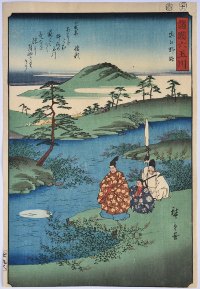
 Click here to view image full size. Noji Tama River in Omi Province with a poem by Minamoto no Toshiyori from the series of six prints Shokoku Mutamagawa , “Six Jewel Rivers in the Provinces.” Shows a nobleman and attendants admiring the moon’s reflection. The set published by Maruya Kyushiro 11 Very fine impression. Fine colour. Trimmed on black border at bottom, otherwise fine condition. Signed Hiroshige ga. Status: Sold

Ichiryusai HIROSHIGE (1797-1858)

 Click here to view image full size. The Lumberyard, Fukagawa, from Meisho Edo hyakkei, “The Hundred Views of Famous Places in Edo.” Shows snow falling on the timber yards lining a river. An umbrella in the foreground is inscribed Uo, “Fish” – a reference to the publisher Uoya Eikichi who published the set between 1856 – 1858 (this being 1856). There are 118 prints in the set plus a replacement design by Hiroshige II (see elsewhere on this update). A large supply of timber was needed for the world’s largest wooden city. However, in 1641 a fire destroyed not only houses but the lumber which was then stored in a central area causing the government to move the yards to Fukagawa.   Very good early impression (later editions have a dark sky). Very good colour and condition. Signed Hiroshige ga.   Status: Sold  
Ichiryusai HIROSHIGE (1797-1858)

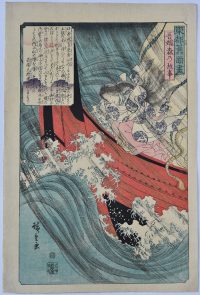
 Click here to view image full size. Azuma no Mori no koji “ The Old Story of Azuma” from a set Toto kyuseki tsukushi, “Old Edo Stories, Illustrated.” Exceptionally rare: Four other designs from the set came up at the Orange and Thornicraft sale, Sothebys, 25/3/1912, lot 440. And another impression of this design is illustrated in Hiroshige, The Albuquerque Museum, 1983, no. 722, pl. 74. Shows the concubine Tachibana Hime about to throw herself from the prow of the boat to appease the sea-gods and protect her lord Yamato Take. This she did despite him vowing to marry Miyazu Hime on his return. Published by Wakasa-ya, c. 1845. A wonderful design.   Fine impression, colour and condition. Signed Hiroshige ga.   Status: Sold  
Ichiryusai HIROSHIGE (1797-1858)

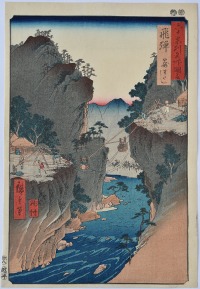
 Click here to view image full size. Hida. Kago-watashi, “The Basket Ferry, Hida Province” from Rokuju yoshu meisho zue, “Famous Places in the Sixty-Odd Provinces.” The set published by Koshimuraya Heisuke between 7/1853 and 3/1856 ( this being 1853 ).   Extremely fine impression of the first edition. Fine colour and condition. Signed Hiroshige ga.   Status: Sold  

Ichiryusai HIROSHIGE (1797-1858)

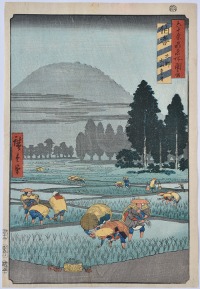
 Click here to view image full size. A distant view of Mount Daisen [ Oyama ] in Hoki Province. One of the best designs from Rokuju yoshu meisho zue, “Famous Places in the Sixty-Odd Provinces.” The set published by Koshimuraya Heisuke between 7/1853 and 3/1856 ( this being 12/1853 ). White rain ( printed with gofun ) falls on groups of peasants planting rice. A lovely design, the edges of the paddy fields zig-zagging into the distance. This is the rare first edition with blue and yellow diagonal bands on the sub-cartouche.   Fine impression with strong woodgrain showing. The second state of the first edition has the rain printed black (not using gofun as here).Very good colour and condition. Signed Hiroshige ga.   Status: Sold  
Ichiryusai HIROSHIGE (1797-1858)

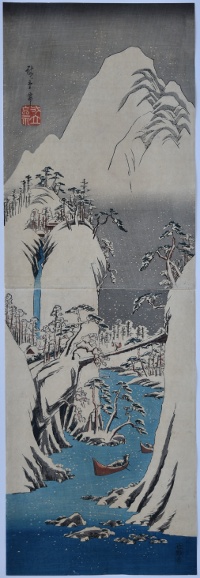
     Click here to view image full size. A vertical oban diptych, Fujigawa no setchu, “The Fuji River in Winter.” Hiroshige records in his diaries that he commenced on a journey westwards from Edo on the fourth month Tempo 12 (1842). He walked the Koshukaido to Kofu in Kai Province and then on to Shimo-suwa. On the route to Kofu, he mentions visiting the Saruhashi, Monkey Bridge, and consequently must have crossed the upper reaches of the Fuji River to reach Kofu. On his return Hiroshige designed two kakemono-e, one of the Monkey Bridge for the publisher Tsutaya, and the design here of Fujigawa for the publisher Kikakudo (Sanoya Kihei). Both are considered masterpieces. The magisterial format perfectly conveys the wild landscape with a diminutive figure crossing the bridge above the gorge with boatmen on the river. Published c. 1842-44. There are many copies of these two kakemono-e. Genuine impressions of this design should have a small vertical block defect bottom right where the mountain meets the river, just to the left of the publisher’s seal. Extremely rare.   Fine impression. The slopes of the mountain top left are printed without outline and appear different on different impressions, also because the block for the sky was changed. Fine colour (although the colour scheme is almost monochromatic relieved by only the blue of the river and touches of brown and green). Very good condition: Full size with ample room for joining of the two sheets. These designs often come heavily browned as they were hung as substitute paintings. Signed Hiroshige hitsu.   Status: Sold  
Ichiryusai HIROSHIGE (1797-1858)

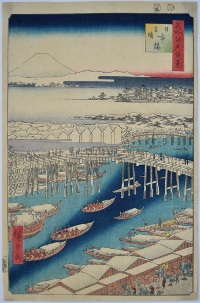
 Click here to view image full size. Nihonbashi yukibare, “The Nihon Bridge, Clear Weather after Snow.” From Meisho Edo hyakkei, the “One Hundred Views of Edo.” The set published between 1856 and 1858 (this being 1856) by Uoya Eikichi. The bridge was completed in 1603 and was originally called Edo Bridge. All points are measured from this bridge (similar to our Charing Cross).   Fine impression of the first edition. There are slight variants of the first with some having red bokashi on the lower clouds but lacking the subtle gradation on Fuji and lower roofs. And also some have mica on the lower roofs. Fine colour and condition. Signed Hiroshige ga.   Status: Sold