Kikugawa EIZAN (1787-1867)

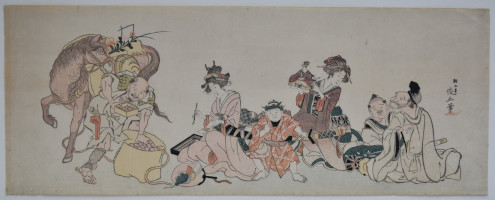
 Click here to view image full size. A surimono showing a game of rock-paper-scissors, although this might be a variant called Kitsune-ken, with fox-hunter-village chief. The game originates (as so much in Japan) from China and eventually made its way to the west. This was (and is) a dangerous game to play with ladies who entertained as they seldom lost. Published c 1820s. Eizan designed few surimono and this is rare.   Fine impression. Very good colour and condition. Signed Kikugawa Eizan hitsu.   Status: Sold  

Totoya HOKKEI (1780-1850)

 Click here to view image full size. A surimono showing two beauties by the pond at Tsunowazu Kumano Shrine in Yotsuya. The title is: Yotsuya Juniso, referring to the twelve shrines at Tsunowazu in Yotsuya. The poem on the large stone is by Shibanoya and refers to the peacefulness of the place with the willows and water. The other writing directs visitors to the cool of the nearby waterfall and the Unju forrest.   Fine impression with silver and gold. Fine colour and condition. Signed on request, Motome ni ojite Hokkei fude.   Status: Sold  

Utagawa KUNISADA (1785-1865)

 Click here to view image full size. A surimono showing the actors Ichikawa Monnosuke III (right) and Ichikawa Danjuro VII walking in the emado of Asakusa Temple in Edo. This was a pavilion at the Shinto shrine used for displaying votive tablets. This seems to be part of a three or five sheet set showing a continuous procession of Ichikawa actors at the shrine. Provenance: From my Catalogue 15, 1975, no. 67.   Fine impression with extensive gold and silver. Fine colour and condition. Signed Gototei Kunisada ga.   Status: Sold  

Kubo SHUMMAN (1757-1820)

 Click here to view image full size. A surimono showing court figures dancing from a series: Shofudai Hisakataya Bunbunsha Tosa Nikki, “The Tosa Diary for the Shofudai, Hisakataya and Bunbunsha Poetry Groups.” Issued late 1810s. For another from this series see: Jewels Of Japanese Printmaking: Surimono Of The Bunka-Bunsei Era 1804-1830, Joan B. Mirviss, Ota Memorial Museum of Art, 2000, no. 85, p. 131. Rare: Possibly the only known impression.   Fine impression. Very good colour. Lightly backed, otherwise very good condition. Artist’s seal Sho Shumman.   Status: Sold  

Utagawa KUNISADA (1785-1865)

 Click here to view image full size. A surimono showing Ichikawa Danjuro VII and Bando Mitsugoro III as Soga no Goro and Asahina no Saburo in the armour-pulling (kusazuri-biki) scene from the play Tsukisenzu haru gohiki Soga. Issued 1827. The story relates how Soga no Goro was feasting at a banquet when he learns of a plot to assassinate his brother, Juro. He rushes off to don his armour. Asahina, the liege of his enemy, tries to prevent him by pulling at his armour. Poems by Yukinoya Takane and Hoshitei Masunari. Rare.   Fine impression with extensive silver and gold. A gold ground. Fine colour. Some loss of the gold ground as is the case with other known impressions of this surimono. This appears to be the best preserved copy. Very good condition. Signed Oju Gototei Kunisada ga.   Status: Sold  

Katsushika HOKUSAI (1760-1849)

 Click here to view image full size. A surimono, Umazakushi, showing a saddle and cotton-gin from Watakuri uma, “A Series of Horses.” Issued for the Yomogawa club, 1822. Shows a horse’s saddle, a cotton-gin, basket of cotton floss and a branch of plum. A smoking set in the foreground. This set followed on from the success of the Shell surimono series issued in 1821. Twenty eight designs are known. The title (in a red gourd) top right is hand-stamped. Rare.   Fine impression with silver, gold and blind-printing. Fine colour. Minor soil, otherwise very good condition. Signed Fusenkyo Iitsu hitsu.   Status: Sold  

Takahashi CHIHARU (1777-1859)

Sold Click here to view image full size. A surimono in Yamato-e style showing Otohime and Tawara Toda on the long bridge at Seta. There are different versions of this popular legend. One has it that Otohime, the Dragon Princess, had an enemy in the form of a giant centipede that lived and poisoned Lake Biwa. It had also killed two of her sons. She begs Tawara Toda Hidesato, a famed archer, to kill it. This he does and she rewards him in the Dragon Palace with silk, a sword and armour, a temple bell, and a bag of rice. The silk and rice are to last forever, however much is used. Hence his name Tawara Toda, “Rice-bag Toda.” Probably issued for Dragon year 1832.     Fine impression, very good colour and condition. Signed Chiharu.     Status: Sold

Ryuryukyo SHINSAI (Active c 1799-1823)

Click here to view image full size. A surimono showing a scroll with a painting of a Takarabune ship and an enameled Persian clock (with Arabic numerals). Norizome, “Maiden Voyage [of the New Year].” The Takarabune, “Treasure Ship” is associated with the new year and carries the Seven Lucky Gods (Shichifukujin) with their treasures. Shinsai was a pupil of Hokusai and is best known for his surimono prints. Issued in 1822 by the Taiko-gawa, “Drum Poetry Group” with their emblem top right. Three poems by Shikishishima Michikusa; Ume no Sugatame; Fugentai. Another (trimmed) impression is in the MET, JP2116. Fine impression. Very good colour. Minor soil, otherwise very good condition. Signed Shinsai. Status: Sold

Yashima GAKUTEI (active 1815-1852)

 Click here to view image full size. A surimono showing a Chinese lady threading a needle on a balcony. First issued in Osaka for the Drum Group, c 1824. This is the excessively rare first edition with the blue sky and clouds; verses by two Osaka poets, and the coloured thread is connected to the spool on the floor. Another genuine impression is in the Metropolitan Museum of Art, accession number JP2090. In the second state the verses are replaced by Edo poets. In the third state the blue sky is replaced with a gold ground and there is a hand-stamped title. There are clever copies of this surimono produced in the 1890s. This is possibly the only other genuine impression of the first edition extant.   Fine impression and colour with areas of gold. Fine condition. Signed Gakutei Sadaoka hitsu. Ex Hayashi collection, seal bottom right.   Status: Sold  

Hotei GOSEI (Active c. 1804-1835)

 Click here to view image full size. A surimono showing a still life of fish and utensils from a fine and rare set Toto meisho awase, “Famous Attractions of the Eastern Capital.” The series title in a cartouche in the shape of the character “go” representing the Go-gawa Club. Each surimono shows something related to the location in Edo, in this case the sub-title is Nihonbashi. What the connection is is not obvious to me; perhaps the fish were a delicacy in restaurants which crowded round the bridge. Gosei was a pupil of Hokusai who gave him the name Hokuga which he changed to Gosei around 1810. Published c. 1820. Possibly the only known impression.   Very good impression and colour. Some slight soil, otherwise good condition. Signed Gosei hitsu.   Status: Sold  

Utagawa SADAKAGE (active c. 1818-1844)

 Click here to view image full size. A surimono, Kinsei, “Metal” from Gobantsuzuki, “A Set of Five” surimono based on the five elements: Wood, Fire, Earth, Metal and Water. Shows a woman polishing a metal mirror. Published c. mid-1820s. The set was designed for a group led by the poet Shakuyakutei whose plum-blossom emblem is seen at the top of the title cartouche.   Superb impression, colour and condition. Extensive silver and gold. Mint condition. Signed Gokotei Sadakage ga.   Status: Sold  

Utagawa KUNISADA (1786-1864)

 Click here to view image full size. A surimono showing the strong woman of Omi, Okane, stopping a runaway horse from a temple by holding its tether down with her geta. Published for the year of the Horse, 1834.   Fine impression and colour. Areas of gold and silver. Some slight crinkling, otherwise very good condition. Signed Kochoro Kunisada ga.   Status: Sold  

Utagawa KUNISADA (1786-1865)

 Click here to view image full size. An extremely rare and unusual surimono: I have only seen two impressions – both of which have passed through my hands, and one of which was gifted to the Rijksmuseum, Amsterdam. Shows the most famous playwright of his age – Tsuruya Nanboku IV (1755-1829). His crest is clearly visible on his shoulder. He died on the 27th of the 11th month, 1829 and this surimono must date from shortly after that: A sort of shini-e – very unusual in surimono form. He wrote the most famous Kabuki ghost story: Yotsuya kaidan, “Yotsuya Ghost Story” (1825) as well as the quick-change play Osome no nanayuki (1813).   Fine impression and colour. The poems above printed in gold. Slight soil. Very small restored binding holes at left edge, and slight trimming at bottom. Signed Gototei Kunisada ga.   Status: Sold  

Yashima GAKUTEI (1786?-1868)

Click here to view image full size. A surimono, Komatsu Shigemori, from the Heike Monogatari. One of a set with series title: Honchoren honcho nijushiko, “Twenty-four Japanese Paragons of Filial Piety for the Honcho Circle.” Issued by the Honchoren poetry club, c. 1821. Shows Taira no Kiyomori (1118-81) seated in an alcove being admonished by his son Shigemori (1138-79) for not being as loyal to the emperor as he had been. Kiyomori was a famous military leader and head of the Taira Clan. Poem by Kanenoya Arikado.   Fine impression, colour and condition with silver and gold. Signed Gakutei with Sadaoka seal.   Status: Sold  

Utagawa TOYOKUNI II (1777-1835)

Click here to view image full size. A surimono showing a bust portrait of the actor Ichikawa Danjuro VII as Kanawa no Goro, a retainer of Kamatari no Fujiwara, disguised as the fisherman Fukashichi from the Mikasayama Goten scene at the palace on Mount Mikasa in Act 4 of Imoseyama onna teikino. Three poems by Shoshokyo Otokado, Sakuragawa Jihinari and Sakuragawa Omokage. Issued c. mid 1820s. Rare.     Fine impression. Very good colour and condition. Signed Toyokuni ga.     Status: Sold

Yashima GAKUTEI (1786-1868)

Click here to view image full size. A surimono, Ni, Yukiwake no Wakanaya uchi Koromode, “Number Two: The Snow Clothes of Koromode of the Wakanaya” from the pentaptych entitled Hisakataya Nakanocho, “The Nakanocho for the Hisakataya Poetry Club.” Issued c. 1827. Shows the oiran Koromode of the Wakanaya parading with her Shinzo and another courtesan down the Nakanocho, the main street of the Yoshiwara. Two poems by Suihotei Komatsu and Hisakataya.   Fine impression, colour and condition with extensive gold and silver. Signed Gakutei Sadaoka.   Status: Sold  

Katsushika TAITO II (Fl. c 1810-1850)

Click here to view image full size. One of the great surimono designs and extremely rare: There appear to be four other genuine examples recorded, apart from this impression, which is from the Vever collection. (See Vever sale, Sothebys, 1977, lot 302. In fact, Vever had two copies. The other sold Vever sale, Sothebys, 1978, lot 231.) The Baur impression. See The Baur Collection, Matthi Forrer, Geneva, 1994, Volume 1, G224, and is also illustrated in the Chiba Museum catalogue, Ukiyo-e bino kiwami, 2001, no. 126. The Chester Beatty impression. See The Art of Surimono, Roger Keyes, Sothebys, 1985, vol. 2, no. 335, p. 384 (ex Gonse). And the MFA, Boston, impression, accession no. 11.20424, ex William Sturgis Bigelow. Three poems by Bunshuro Tomoyoshi, Bunkaro Kiyomaru, and Bumbunsha. Shows a carp swimming down amongst water-weeds and cherry blossom. The carp was a symbol of achievement against adversity in Japan and had a connotation with the new year. In fact, Taito designed another print of a carp amongst water-weeds which is part of a harimaze sheet and is most often encountered with the left calligraphy removed. Issued c 1832 for the Taikogawa Poetry Club. Vever seal bottom right.     Very fine impression with burnishing on the eye and the cherry blossom blind-printed. Fine colour. Minor foxing, otherwise very good condition. Signed Katsushika Taito.     Status: Sold

Totoya HOKKEI (1780-1850)

Click here to view image full size. A surimono showing the poetess Kiyogaki standing on Mukaigaoka Hill overlooking a frozen Shinobazu Pond with the shrine of Benten. (And since the snake was the messenger of Benten, this print was probably issued for Snake Year 1833.) Two poems by Tojuen Kiyogaki and Yayoian.   Fine impression and colour with extensive silver – especially on the frozen lake. Slight soil, otherwise very good condition. Signed Hokkei.   Status: Sold  

Totoya HOKKEI (1780-1850)

Click here to view image full size. A surimono from a set Onkyoku zukushi, “An Array of Songs.” In the cartouche, top right, on the right, is Tokiwazu (a school of vocal music featuring the 3-stringed shamisen), and on the left the title of the musical piece illustrated here, which is Oimatsu, “Old Pine Tree,” a brief and auspicious piece composed in 1747 and used for celebratory occasions. A warrior is shown reclining against an old pine in heavy rain. Issued c 1818. Another from the set is illustrated in Reading Surimono, John Carpenter, Hotei publishing, 2008, no. 76, p. 203. Rare.     Fine impression with gold, blind-printing and the rain printed in silver. Very good colour. The red may be down slightly but, as yet, I have not found another impression to compare. Very good condition. Signed Hokkei.     Status: Sold

Yashima GAKUTEI (1786-1868)

Click here to view image full size. A surimono showing Li Kui (Jap: Ri Ki), one of the brigands from the One Hundred and Eight Heroes of the Popular Water Margin (the Suikoden). He was nicknamed the “Black Whirlwind” and is usually shown wielding two giant axes (as here). From a set Suiko Juban, “Ten Characters from the Water Margin.” Probably for the Kadonumaren Poetry Club c. late 1820s. Another two designs from the set are in the Harvard Art Museums, 1933.4.2003 and the Asian Art Museum, S.F., 2010.193. Rare: I cannot locate another impression at the moment.   Fine impression and colour. Slight soil and possibly slightly trimmed, otherwise very good condition. Extensive silver. Signed Gakutei Harunobu.   Status: Sold  

Utagawa KUNINAO (1793-1854)

Click here to view image full size. A surimono with series title Bijin awase, “Beautiful Women.” Shows a scantily clad diver emerging from waves holding an abalone shell and clinging to a rock. There are obvious erotic overtones to this wonderful surimono: Awabi divers were objects of great voyeuristic curiosity to the general public and feature in many aspects of Japanese art. Poems by Chinchoya Chincho and Jingoro Takumi. Provenance: Ex collection Louis Gonse, 1846-1921, who was a great collector of Japanese art and published L’Art Japonaise in 1883. Seal au verso. Very Rare: Other impressions are in the Chester Beatty Library, Dublin. See The Art of Surimono, Roger Keyes, 1985, no. 236, p. 267; MFA, Boston, RES.46.27; and illustrated in McKee, Colored in the Year’s New Light: Japanese Surimono From The Becker Collection, Cornell University, 2008, no. 112.     Fine impression and colour with silver printing to the waves. Evidence of mounting around edge au verso, otherwise fine condition. Artist’s seal Kuninao.     Status: Sold

Utagawa KUNIYOSHI (1797-1861)

Click here to view image full size. A surimono from a series: Fuzoku onna Suikoden hyakuhachiban no uchi, “Modern Women as the One Hundred and Eight Heroes of the Suikoden.” Shows a beauty leaning on a fulling block beside a stream. She gazes at a flowering cherry tree with a village in the distance beneath a full moon. Each design is based on one of the characters from the Suikoden; in this case Shinkigunshi Shubu (Zhu Wu), the “Resourceful Strategist.” The series was inspired by a new translation of the 12th century Chinese novel Shui huchuan, “All Men are Brothers” which relates the deeds of a group of outlaws. Commissioned by the Hisakatayaren Club for the New Dragon Year 1832. Surimono were usually issued by these poetry clubs or for specific occasions, although individuals also commissioned them. They could employ every artifice available to the printers and engravers: metal powders, mica, blind-printing and burnishing, and were printed on the best, thick hosho. They were not issued in large numbers as conventional Ukiyo-e and are usually of a smaller format. Presumably ambitiously planned as 108 prints but never completed. Rare.    Very fine impression and colour with silver and gold. Slightly trimmed top and bottom, otherwise very god condition. Signed Ichiyusai Kuniyoshi ga with the red seal of the printer Suriko Shinzo (which is removed on some impressions).    Status: Sold

Ryuryukyo SHINSAI (1764[?]-1823)

Click here to view image full size. An early pupil of Hokusai who is best known for his fine surimono, but also produced a series of semi-western style landscapes and some paintings. A still life showing a group of pouches, one revealing a lacquered surface with a stylised dragon. Dragon year was 1808 and 1820. Extremely rare. Ex Beres collection, seal au verso.     Fine impression with extensive silver and burnishing. Fine colour. Very good condition. Signed Shinsai.     Status: Sold
Totoya HOKKEI (1780-1850)

Click here to view image full size. A surimono showing an unidentified fish – possibly a flying fish and carnations. An apparently unrecorded surimono. A pupil of Hokusai, Hokkei’s oeuvre was almost entirely in this genre, apart from illustrating ehon.     Very good impression and colour. Slight crease, otherwise very good condition. Signed Hokkei.     Status: Sold
Totoya HOKKEI (1780-1850)

 Click here to view image full size. An uncut large surimono with the poems attached showing a rustic bridge in a country setting. Geese flying above. Published c 1810s. Provenance: Ex Samuel Tuke collection, seal centre left. Tuke was a member of the Japan Society of London and many of his prints went to the British Museum, while others were sold at Sothebys in 1911. Rare.   Very good impression, colour and condition. Signed Totoya Hokkei ga.   Status: Sold  

Chokotei TOSHIMASA (Active c 1810s)

Click here to view image full size. A long surimono for a Horse year (probably 1810). Shows the Five Festivals, Gosekku no uchi, which are: Matsu-no-uchi, New Year; Hinamatsuri, Girls’ Day, or Doll Festival; Tango-no-sekku, Boys’ Day; Tanabata, Star Festival; Choyo-no-sekku, Chrysanthemum Festival.     Very good impression, colour and condition. Signed Chokotei Toshimasa hitsu. Status: Sold    
Utagawa TOYOKUNI II (1777-1835)

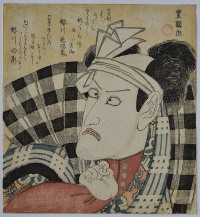
 Click here to view image full size. A surimono showing a bust portrait of the actor Ichikawa Danjuro VII as Kanawa no Goro, a retainer of Kamatari no Fujiwara, disguised as the fisherman Fukashichi from the Mikasayama Goten scene in Act 4 of Imoseyama onna teikino. Three poems by Shoshokyo Otokado, Sakuragawa Jihinari, and Sakuragawa Omokage. Issued c mid-1820s. Provenance: originally purchased from me in 1977 (see my catalogue 20, 1977, no. 38). Unidentified collector’s seal au verso. Rare.   Very good impression, colour and condition. Signed Toyokuni ga.   Status: Sold  
Utagawa TOYOKUNI I (1769-1825)

 Click here to view image full size. A surimono in the form of an ema (literally “picture-horse”) which were votive tablets left at Shinto shrines. The upper right plaque shows an actor in Shibaraku role with characters reading ganshu (temple petitioner) Bunri. Below, ten poems by poets from Edo, Kyoto and Osaka. The poem below the actor is signed Shikan which was the stage name and literary name of Nakamura Shikan I (Utaemon III, 1778-1838) who is most likely the actor portrayed. The text on the top left panel begins with San kudari indicating the 3rd came back, suggesting a return by Utaemon to Edo from acting in Kyoto or Osaka. Issued c 1810s. Very rare.   Very good impression, colour and condition. Signed Toyokuni ga.   Status: Sold  

Utagawa TOYOKUNI I (1769-1825)

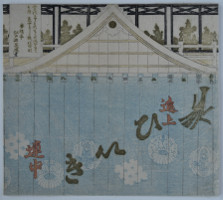
Click here to view image full size. Click here to view image full size. An extremely rare and unusual e-goyomi surimono for the year of the Horse, 1822, the long and short months running along the top of the theatre curtain. The surimono shows the Ichimura Theatre in Edo. The theatre curtain over the stage is a flap that hinges up to reveal the actors within. The characters on the curtain in pink and gold read: Shinjo hiiki renchu, “An offering from the [associated] patronage clubs.” (In fact, three fan clubs plus a daimyo, Mori Narimoto, whose poem top left is signed with his art name Ryuotei Edo No Hananari.) The three actors revealed are, from left to right, Seki Sanjuro II, Onoe Kikugoro V, and Ichikawa Danjuro VII in the play Three Famed Warriors Crossing Paths. However, they are not shown in character but dressed casually. Their emblems appear on the curtain: the waterfall-ascending carp for Danjuro; the chrysanthemum for Kikugoro; and the crosshatch for Sanjuro. Another impression is illustrated in The Private World Of Surimono, Sadako Ohki and Adam Haliburton, Yale University Press, 2020, no 59, p. 213. An impression missing the flap is illustrated in Surimono: Prints By Elbow, Edythe Polster and Alfred H. Marks, Lovejoy Press, 1980, F-D 1933-4-898, p. 441 and 437. Provenance: Ex H. Beres collection, sold Sothebys, Paris, 27/11/2002, lot 85. Seal on reverse.     Very good impression and colour with gold and silver. Very good condition. Signed Toyokuni ga.     Status: Sold    

Totoya HOKKEI (1780-1850)

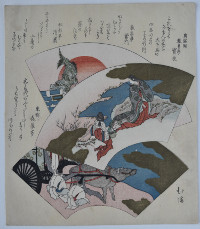
Click here to view image full size. A surimono showing three overlapping fans. The top fan shows the first sunrise of the new year behind a shachi on a castle roof. Usually called dolphins, they in fact had the head of a tiger and body of a carp. The second shows a court lady and attendant collecting young pines on the first day of the year. The third shows an imperial ox cart. Possibly for the Ox year 1829. Another impression was in the Adolphe Stoclet sale, Sothebys 8th June 2004, lot 463, p. 242. Poems by Shinshukei, Shigekado and Shinratei Manzo (leader of the Manjiren club).     Very fine impression and colour with gold and silver. Fine condition. Signed Hokkei.     Status: Sold