Ichiyusai KUNIYOSHI (1797 – 1861)

 Click here to view image full size. Takeda Sama-no-suke Nobushige from the set Koetsu yusho den “ Stories of Courageous Warriors from the Koetsu Region”. Shows Nobushige enveloped in a cloud of battle smoke. One of the two best designs from the set. Published by Sumiyoshi-ya Masagoro c1848-9. Very good impression, colour and condition. Signed Ichiyusai Kuniyoshi ga. Status: Sold

Tsukioka YOSHITOSHI (1839 – 1892)

 Click here to view image full size. A diptych showing Urashima Taro returning home from the palace of the Dragon King from the set Yoshitoshi manga, “Sketches by Yoshitoshi”. Published by Kobayashi, Meiji 19 ( 1/1886 ). First edition. ( It was republished by Hasegawa 1887.) Very good impression and colour with margin for joining. Minor backed wormhole otherwise very good condition. Signed Yoshitoshi ga. Status: Sold

Kawanabe KYOSAI (1831 – 1889)

 Click here to view image full size. Shoki the demon quellor. A wonderful image of this famous subject printed almost entirely in red, Extremely rare. Fine impression: the surface of the paper lightly blind-printed. Fine colour. The bottom edge with light soil and slightly deckled, otherwise fine. Full size. Signed Shoshuosai Toilku ga with seal. Status: Sold

Utagawa YOSHIFUJI (1828 – 1887)

 Click here to view image full size. The head of the cat-witch of Okabe from the Fifty-Three Stations. The head is composed of convoluted cats’ bodies; the eyes being two bells and the mouth a thick ribbon as worn by cats. The print was published circa 1847 by (appropriately) Kita. Excessively rare and a great 19th century design. Very good impression and colour. Some small expertly repaired wormholes, otherwise very good condition. Full size. Signed Ipposai Yoshifuji ga. Status: Sold

Ichiyusai KUNIYOSHI (1797 – 1861)

 Click here to view image full size. Umegaya, Kajiwara Genda Kagesuye fighting at Ikuta-no-mori from the set Buyu nazoraye Genji, “Heroic Comparisons for the Chapters of Genji”, published by Iba-ya Sensaburo, c.1843. Robinson S28.32. O-tanzako format. Very good impression and colour. Slightly trimmed top and bottom. Signed Cho-o-ro Kuniyoshi ga. Status: Sold

Ichiyusai KUNIYOSHI (1797 – 1861)

 Click here to view image full size. Nakamura Kansuke Masatatsu warding off a brazier of hot ashes from the set Seicho gishi shozo, “Portraits of the Faithful Samurai of True Loyalty”. Robinson S78.6. Published 1853 by Sumiyoshi-ya Masagoro. The set characterised by strong westernised effects. Very good impression and colour. Extensive sprayed pigment to simulate falling ash. Very small binding holes and slight trimming, otherwise very good condition. Signed Kuniyoshi ga. Status: Sold

Kawanabe KYOSAI (1831 – 1889)

 Click here to view image full size. Shoki riding a tiger and attacking a group of demons. “May” from a series of Twelve Months. Published by Fukuda Kumajuro Meiji 20 (1887). Fine impression and colour. Minor sumi spots, otherwise very good condition. (This design is often trimmed for albums and does not match.) Signed Shojo Kyosai ga. Status: Sold

Ichiyusai KUNIYOSHI (1797 – 1861)

 Click here to view image full size. Hatsuhana doing penance under the Tonozawa Waterfall fulfilling a vow made on behalf of our sick husband. The best design from Stories of Wise and Virtuous Women. Published c.1842 by Ibaya Sensaburo. Fine impression and colour. Slight trimming at bottom and small repaired wormholes at edge, otherwise very good condition. Signed Ichiyusai Kuniyoshi ga. Status: Sold

Ichiyusai KUNIYOSHI (1797 – 1861)

 Click here to view image full size. Fuse-hime saving the child Masashi from a thunderbolt from “Eight Hundred Heroes of our Country’s Suikoden, One by One”. Published by Kaga-ya Kichiyemon c.1836. Robinson S4c.3. Fine impression, colour and condition. Full size. Signed Ichiyusai Kuniyoshi ga. Status: Sold

Taiso YOSHITOSHI (1839 – 1892)

 Click here to view image full size. Mashiba Dairyo Hisayoshi Ko in lightning. The finest design (together with Kon Sosho and the storm dragon) from Yoshitoshi’s first set of ghost prints: Wakan hyaku monogatari. Published by Daikin, 1865 Fine impression, colour and, apart from minor crinkling, condition. Extensive burnishing and other special effects. Signed Ikkaisai Yoshitoshi ga. Status: Sold

Yanagawa SHIGENOBU II (Active 1824 – 1860)

 Click here to view image full size. San konoshitakage, “Number Three: In the Shade of a Tree” from a set: Meiba zoroe, “Famous Horses.” Shows a beauty sheltering from rain. Published for the Horse Year 1834. Fine impression. Very good colour and condition. Signed Nisei Yanagawa Shigenobu Status: Sold

Katsushika HOKUSAI (1760 – 1849)

 Click here to view image full size. Kinutagai, “The Fulling Block Shell” from the series: Genroku Kasen kaiawase, “A Matching Game with the Genroku Poem Shells.” ( An anthology published in 1689. ) A collection of verses with pictures designed by Hokusai printed on 36 sheets. Commissioned by the Yomogawa poetry group for the New Year 1821, Year of the Snake. Shows two women at a fulling block beating down scrap paper to pulp to remake into sheets. In the background a boy is stirring the pulp in a basket in a stream. One of the two best known Hokusai surimono sets. Rare. Fine impression, very good colour with gold and silver. Minor marks and signs of mounting au verso, otherwise very good condition. Signed Getchirojin I itsu hitsu, “Moonstruck Old Man, Iitsu.” Status: Sold

Katsushika HOKUSAI (1760 – 1849)

 Click here to view image full size. Sakuragai, “The Cherry Blossom Shell” from the series: Genroku Kasen kaiawase, “A Matching Game with the Genroku Poem Shells.” ( An anthology published in 1689. ) A collection of verses with pictures designed by Hokusai printed on 36 sheets. Commissioned by the Yomogawa poetry group for the New Year 1821, Year of the Snake. Shows travellers on the way to Narita Fudo, the Shinshoji at Naritasan. One of the two best known Hokusai surimono sets. Rare. Fine impression and colour with gold and silver. Minor marks, otherwise fine condition. Signed Getchirojin I itsu hitsu, “Moonstruck Old Man, Iitsu.” Status: Sold

Katsushika HOKUTAI (Act. c. 1800 – 1830)

 Click here to view image full size. A long surimono by an early pupil of Hokusai. Most likely an invitation to a New Year musical event at Shinagawa ( ? ). Shows three musicians playing samisen, koto and kokyu ( ? ). Probably a unique impression. An Eisai Hokutai was the artist for a book: Tokaeri-bana in 1809. This appears to be the same artist. Fine impression with gauffrage. Fine colour. Signs, as usual, of the foldmarks on the invitation: These invites were folded three times – once horizontally and twice vertically to form a neat packet. Otherwise very good condition. Signed Shinshinshi Hokutai. Status: Sold

Utagawa KUNISADA (1786 – 1865)

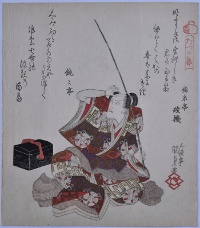
 Click here to view image full size. Ichikawa Danjuro VII as Urashima Taro, seated with his fishing rod and the black box behind him that contains his old age. Urashima Taro saved a giant tortoise and was rewarded by a visit to the Dragon King’s palace beneath the sea by the Dragon’s daughter Otohime. Published for the Taiko-gawa poetry group ( red drum seal top right ) in 1820. Very fine impression and colour with gold and silver. Fine condition. Signed Gototei Kunisada ga. Status: Sold

Utagawa KUNISADA (1786 – 1865)

 Click here to view image full size. Ichikawa Danjuro VII ( crouching below ) as Konoshita Tokichi and Segawa Kikunojo V as Princess Otohime. This does not illustrate a particular play, but was obviously intended for the year 1820 as Otohime was the daughter of the Dragon King ( 1820 being a dragon year ). Fine impression. Very good colour. Extensive gold and silver. Fine condition. Signed Gototei Kunisada ga. Status: Sold

Utagawa KUNISADA (1786 – 1865)

 Click here to view image full size. Two sheets ( of three ) showing the actor Ichikawa Danjuro VII ( left ) in the role of Minamoto Yorimasa holding a firebrand to better see the giant Nue and Bando Mitsugoro III as Tametomo with his giant bow. The complete set is in the Fitzwilliam Museum, Cambridge. It appears to be a mitate as these three actors did not act together. The dragon-patterned border indicates the dragon year 1820. The bright blue grounds make for striking compositions. Very fine impressions. Some slight loss of metallic powders, otherwise very good condition. Signed Kunisada ga on each. Status: Sold  Click here to view image full size.

Shibata ZESHIN (1807 – 1891), Ikeda TAISHIN and SUISHIN

 Click here to view image full size. A complete set of the four seasons in shijo style: Spring showing cherry blossom viewing signed Taishin; Summer is a still life of theatre props signed Zeshin; Autumn shows people moon viewing signed Suishin, and Winter shows a woman tentatively lifting a bamboo screen on a snow-bound boat signed Zeshin. Extremely rare: This is the only set I have recorded and came from me in the 1980s. The prints were originally folded and would have been sold in paper slip cases ( hence the slight vertical folds ). Although not strictly surimono, they probably served a similar purpose. Each 6.5 x 5.75 inches, 16.5 x 14.5 cms. Taishin and Suishin were pupils of Zeshin and the former was a life long friend of his until his death. Very good impressions, colour and condition. Signed Zeshin, Taishin and Suishin. Status: Sold  Click here to view image full size.  Click here to view image full size.  Click here to view image full size.

Utagawa TOYOKUNI I (1769 – 1825)

 Click here to view image full size. A wonderful design showing the actor Ichikawa Ebizo VI ( Danjuro VIII ) holding a large umbrella with his face reflected in a mirror held by an acolyte. Two poems above by Sakuragawa Jihinari and Jihinari’s son Oya no Omokage. In fact these two writers also composed poems for two other Toyokuni surimono of Danjuro around the same date, c. early 1820s. ( See The Art of Surimono, Roger Keyes, 1985, no. 348, p. 400 and One Hundred Surimono in the collection of Sidney C. Ward, 1976, no. 50, p. 62. ) Extremely rare. Fine impression. Minor creasing and turning of purple, otherwise very good colour and condition. Signed Toyokuni ga. Status: Sold

Harunobu GAKUTEI (c.1786 – 1868)

 Click here to view image full size. A sumptuously clothed beauty designed for the Shippo Club. The surimono is unusual in having a caramel-coloured background. Fine impression, colour and condition. Signed Gakutei with seal Shima. Status: Sold

Kubo SHUNMAN (1757 – 1820)

 Click here to view image full size. A superb surimono showing a group of five cranes on a split of sand. The tancho ( “red crest” ) Japanese Crane, Grus japonensis, is the second rarest crane in the world, migrating to East Asia in the fall to spend the winter. There is also a resident flock in Hokkaido. Much loved by the Japanese, the crane was a symbol of luck, longevity and fidelity.One of a set of six surimono with title: San hira no uchi, “Three Petals” written on a poem slip hanging from a plum branch, top left. Probably Shunman’s masterpiece in this format and one of the handful of great surimono. Exceptionally rare: I have not seen another for sale since I started dealing over 40 years ago and this may well be the only available impression extant. An example is in the Chester Beatty Library, Dublin. See The Art of Surimono, Roger Keyes, Sothebys, 1985, no. 318, p. 363 and colour, p. 344. Another is in the Tokyo National Museum, catalogue II, no. 1654. There are two states with the last character of poem changed. ( For an example of this other state see Surimono, Charlotte van Rappard-Boon, no. 16, p. 33. ) Issued 1816. Shunman, a man of great sophistication, designed only a few prints before concentrating on surimono and printing and issuing some of the finest in this format. ( See The Japanese Print A New Approach, J. Hillier, pp. 102 – 104: “Probably no artist except Choki has achieved so high a reputation on such a small number of prints.” ) He also excelled at painting, book illustration and light verse. Very fine impression with the feathers of the cranes deeply gauffraged. Fine colour with gold and silver. Minor marks and creases. Seal Shunman…

Katsushika HOKUSAI (1760 – 1849)

 Click here to view image full size. A rare surimono from a series Soramitsuyaren wakan buyu awase samban no uchi, “Japanese and Chinese Heroes for the Soramitsuya Circle.” ( A club named after its leader Soramitsuya Maeda. ) Shows Benkei in a tug-of-war with a Chinese beauty ( possibly Kosanjo according to Keyes ). Poems by Maeda, Magara and Komichi. Published 1820. Two other impressions illustrated in the Spencer Museum of Art, Surimono, Roger Keyes, Kodansha, 1984, no. 26, p. 74 ( catalogue no 110 ) and the Peter Morse collection catalogue, Ota Memorial Museum of Art, 1988, no. 184. Fine impression, colour and condition. Extensive gold and silver. Signed Hokusai Taito aratame Katsushika Iitsu hitsu. Status: Sold

Totoya HOKKEI (1780 – 1850)

 Click here to view image full size. The Dragon King, Ryu-jin, presenting the tide-ruling jewels Nanjiu and Kanjiu. In Japanese folklore he ruled the sea and inhabited a spectacular castle in the depths of the ocean. Fine impression and colour with extensive gold and silver. Minimal edge soil. Signed Hokkei. Status: Sold

Katsushika HOKUSAI (1760 – 1849)

 Click here to view image full size. A rare surimono from the series Umazukushi, “A Series of Horses” published 1822 ( Year of the Horse ). Shows the banks of the Sumida river, Komatomeishi, with the stone used for tethering horses bottom centre. This surimono is one of three that form a triptych. The complete set is in the Rijksmuseum, Amsterdam ( 1958: 293-294-295 ) and is illustrated in Matthi Forrer, Hokusai, Rizzoli, 1988, no. 265, p. 238 and elsewhere. The other two surimono were also in the Gerhard Schack collection, illustrated in Surimono, 1970, 77-78. Ex collection H. de Winiwater ( seal top right ). Fine impression with gold and silver. Some soil and loss of the gold. Signed Fusenkyo Iitsu no fude. Status: Sold

Wakai RYOUNTEI (Dates unknown)

 Click here to view image full size. Shows a dancing shojo: A mythical creature with long red hair who lived near the sea and had an unquenchable thirst for sake. Published c.late 1820s. Rare: Another impression illustrated in One Hundred Surimono in the Collection of Sidney C. Ward, no.95, p.115. Very fine impression with solid gold ground, other areas printed in gold and silver. Slight loss of gold ground, otherwise very good condition. Signed Morimaru aratame ( “changing his name to” ) Ryountei Wakai. A poet of the Tsubogawa ( the Asakusagawa ) Ren in Asakusa, Edo. Status: Sold

Katsushika HOKUSAI (1760 – 1849)

 Click here to view image full size. A rare long surimono complete with the attached invitation ( yokonagaban ). Mitate junidan soshi, “A Parody from Twelve Fairy Tales.” Shows Ushiwaka and prince Joruri. The invitation is to a dramatic recital with music ( joruri ) organised by Tokiwazu moji kiyo and has the names of the performers: Tokiwazu Komoji dayu; Kishizawa Koshikibu and others from the Kishizawa school. Another example ( lacking invitation ) is illustrated in Masterpieces Of Ukiyoe From The British Museum. Exhibition catalogue of collection of 300 prints from BM exhibited in Japan at Ueno Museum, Tokyo and Nara Prefectural Museum of Art, 1985, no. 194. But otherwise extremely rare as few of these prints can have been produced for this dramatic event. Sometimes the actual designs, without attachments, were reissued at a later date. An early design for Hokusai, c. 1800. Fine impression with gauffrage. Slight fading and signs, as usual, of the foldmarks on the invitation: These invites were folded three times – once horizontally and twice vertically to form a neat packet. Otherwise very good condition. Signed Gakyojin Hokusai ga. Status: Sold